
The Supply Chain Reckoning: How a US Trade Probe is Forcing India to Confront Its China Dependency
The United States has launched a sweeping Section 301 investigation into forced labour across 60 nations, including India, targeting not just goods produced with such practices but also products made using Chinese intermediate inputs—particularly from Xinjiang—that are suspected of being tainted. For India, this poses a direct threat to its rapidly growing exports of solar panels, electronics, and textiles, which rely heavily on imported Chinese components like polysilicon, solar cells, electronic sub-assemblies, and yarns. If US authorities determine that Indian-manufactured goods contain inputs from suspect Chinese supply chains, shipments could face detention, higher compliance costs, and stricter traceability requirements, forcing Indian exporters to either absorb expensive audits or risk losing market access. The probe serves as a stark wake-up call for India to deepen its domestic manufacturing ecosystem and reduce its structural dependency on China to safeguard its trade ambitions.
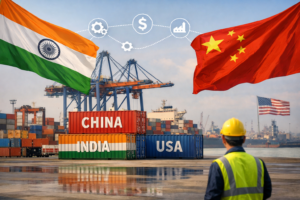
The Supply Chain Reckoning: How a US Trade Probe is Forcing India to Confront Its China Dependency
On March 12, 2026, the Office of the United States Trade Representative (USTR) fired a warning shot across the bows of global commerce. By launching a sweeping Section 301 investigation into the forced labor practices of 60 nations—ranging from strategic competitors like China to close allies like Japan and the EU—Washington signaled a new, aggressive phase in its trade policy . For India, named in the probe alongside economic powerhouses, the notification was not just another diplomatic memo. It was a stark reminder that in the new world of “supply chain accountability,” where your goods come from is just as important as what they are.
While the investigation directly targets nations with state-imposed labor programs, its most profound impact on India may be indirect. The probe is designed to scrutinize not just goods made with forced labour, but also goods made with components sourced from suspect supply chains . For an Indian economy rapidly scaling its manufacturing—particularly in solar electronics and textiles—on a foundation of Chinese intermediate goods, this represents an existential business challenge.
This isn’t a distant policy debate. It is a coming reality check for thousands of Indian exporters who may soon find their shipments detained at US ports, their compliance costs skyrocketing, and their hard-won market access threatened by factors seemingly beyond their control.
The Ghost in the Machine: Why Xinjiang is at the Heart of the Probe
To understand the risk for India, one must first understand the focus of the US investigation. The probe zeroes in on the Xinjiang Uyghur Autonomous Region, where accusations of large-scale forced labor programs have persisted for years—allegations that China firmly denies, framing them as vocational training and employment initiatives . The US response has been the Uyghur Forced Labor Prevention Act (UFLPA), which operates on a “guilty until proven innocent” presumption: any goods linked to Xinjiang are banned unless the importer can provide clear and convincing evidence otherwise.
Xinjiang is not a peripheral economic zone. It is the heart of global supply chains for two critical commodities. It produces about 20% of the world’s cotton and a staggering amount of polysilicon, the ultra-pure material used to make solar panels . Consequently, industries like textiles (cotton yarn, fabric, garments) and solar energy (polysilicon, wafers, cells) are considered “high-risk” sectors.
Herein lies India’s dilemma. To fuel its own export boom, India has become a massive importer of these very inputs.
India’s Three Exposed Fronts: Solar, Electronics, and Textiles
The Global Trade Research Initiative (GTRI), founded by former Indian Trade Service officer Ajay Srivastava, has outlined the specific sectors where Indian exports are most vulnerable . The analysis reveals a pattern of deep, structural dependency that US customs officials are now poised to exploit.
- The Solar Sector: A Shining Example of Hidden Risk
India’s renewable energy story is one of ambition. The government’s Production Linked Incentive (PLI) scheme has supercharged domestic solar module manufacturing. However, this is largely an assembly industry. While India makes the panels, the core technology—the solar cells and the polysilicon that makes them—is overwhelmingly imported from China .
This creates a dangerous funnel. An Indian manufacturer exports a finished solar panel to the US. It is labeled “Made in India.” But if the solar cells inside that panel were made in China—or worse, if the polysilicon for those cells was sourced from Xinjiang—the entire shipment is at risk of detention.
This isn’t hypothetical. Throughout 2024, US Customs and Border Protection (CBP) detained nearly $43 million worth of electronics shipments from India, with industry sources pointing to solar panels containing Chinese components as the primary culprit . Back then, it was a trickle. The new Section 301 probe threatens to open the floodgates. As Tim Brightbill, a US trade attorney, noted last year, the CBP likely didn’t initially realize how many “Indian” panels contained Chinese cells. Now, they are actively looking .
- Electronics: The Assembly Line Paradox
India’s mobile phone and electronics export boom is one of its greatest economic success stories. But behind the “Make in India” sticker lies a complex reality. As highlighted by events in mid-2025, when Foxconn reportedly asked hundreds of Chinese engineers to leave India, the manufacturing ecosystem is deeply reliant on Chinese expertise and components .
From display assemblies to precision brackets and complex sub-assemblies, the Indian electronics supply chain is inextricably linked to China. The new US probe means that every cable, every capacitor, and every connector with a Chinese origin story becomes a potential liability. If a component can be traced back to a region or supplier linked to labour-transfer programs, the final Indian-assembled product—be it a smartphone or a network switch—could be barred entry .
- Textiles: Tangled in Cotton Threads
The textile sector faces perhaps the most direct threat. Indian garment exporters, competing in a brutally price-sensitive market, often rely on Chinese yarns and fabrics to meet order deadlines and cost targets. Given Xinjiang’s dominance in global cotton, a significant portion of that yarn carries inherent risk.
The US probe will likely demand “traceability”—proof that the cotton in a garment was grown and processed outside of Xinjiang. For an Indian manufacturer who bought yarn from a trader in Mumbai, proving its origin back to a specific farm may be an impossible task. This could lead to a de-risking strategy where US buyers simply avoid Indian garments that cannot guarantee a “China-free” supply chain .
Beyond Tariffs: The New Cost of Doing Business
The most immediate impact of the probe on Indian businesses won’t be a tariff; it will be a burden of proof. The Section 301 process allows for hearings and evidence gathering, but the eventual outcome is likely to be stricter enforcement and mandatory due diligence .
For Indian exporters, this translates into three tangible challenges:
- Exploding Compliance Costs: Companies will need to audit their supply chains with forensic detail. This means tracing every raw material back to its source, securing affidavits from suppliers, and potentially using blockchain or other tracking technologies. For small and medium-sized enterprises (SMEs) that form the backbone of India’s export sector, these costs could be prohibitive.
- Inventory Delays and Waste: Even if a shipment is eventually cleared, detention at the US port can last weeks or months. For perishable goods or time-sensitive electronics, this delay can mean the difference between a profitable order and a total loss.
- The “China Discount” Disappears: The primary reason Indian manufacturers import Chinese inputs is cost. However, if using a cheaper Chinese component creates a 20% risk of shipment rejection, that “discount” vanishes. Exporters may be forced to switch to more expensive, but “cleaner,” alternatives from Vietnam, South Korea, or domestic sources, eroding their margins.
A Wake-Up Call for Strategic Autonomy
This US probe, combined with a separate Section 301 investigation into excess industrial capacity (where India is also named), signals a fundamental shift in Washington’s approach . The February 20, 2026 US Supreme Court ruling complicated the use of blanket tariffs, so the administration is now using investigations as a tool to rebuild leverage . They are weaponizing the supply chain itself.
For India, this is a pivotal moment. The country wants to be a global manufacturing hub. But a hub cannot be built on a foundation of contested imports. The probe exposes the fragility of an export strategy that relies on importing semi-finished goods from a geopolitical rival.
The path forward is difficult but clear. India must accelerate its goal of deepening the manufacturing ecosystem. This means:
- Investing in Polysilicon and Cell Manufacturing: Moving beyond module assembly to create a truly indigenous solar manufacturing value chain.
- Boosting Domestic Component Ecosystem: Doubling down on electronics component manufacturing to reduce dependence on Chinese sub-assemblies.
- Textile Traceability: Building a robust, certified supply chain for Indian cotton that can guarantee its provenance, turning it into a premium, “conflict-free” product.
The US investigation is not an indictment of Indian labour practices—India has its own laws prohibiting bonded labour . Rather, it is an indictment of India’s supply chain dependency. The next few years will determine whether Indian industry views this as just another trade barrier to navigate, or as the catalyst needed to finally build a truly self-reliant and resilient manufacturing base. The clock is ticking, and the scrutiny has only just begun.
You must be logged in to post a comment.