
The Strike on Qom: Inside the Attack on Iran’s Assembly of Experts and the Battle for a Theocracy’s Soul
The recent US-Israeli airstrike on the Assembly of Experts building in Qom, Iran, targeted the very institution constitutionally tasked with selecting a new Supreme Leader following Ayatollah Khamenei’s death, striking while members were reportedly deliberating on his successor and fundamentally shattering the established mechanism for theocratic succession. This unprecedented attack has not only thrown Iran’s opaque leadership transition into chaos by scattering and potentially killing key clerics, but it has also deepened a national trauma, empowered hardliners and the security apparatus like the IRGC to accelerate the decision-making process, and escalated the “War on Iran” into a conflict that now directly targets the religious and institutional pillars of the Islamic Republic, pushing the region toward greater instability and retaliation.
The Strike on Qom: Inside the Attack on Iran’s Assembly of Experts and the Battle for a Theocracy’s Soul
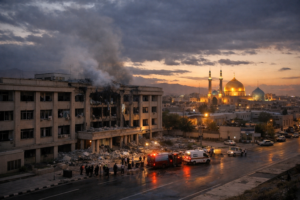
The air in Qom, the holiest city for Shi’a Muslims and the cerebral heart of the Islamic Republic, has never felt heavier. For centuries, the air here has been thick with the whispered prayers of seminarians, the rustle of religious texts, and the weight of theological debate. On Tuesday, it was filled with the acrid smell of smoke and the thunderous echo of airstrikes that targeted not a military barracks or a nuclear facility, but a building that represents the very mechanism of divine succession in the modern era: the headquarters of the Assembly of Experts.
The news, first carried by Iran’s semi-official Tasnim news agency, sent shockwaves through a region already teetering on the edge of the abyss. “The American-Zionist criminals attacked the Assembly of Experts building in Qom,” the report read, a phrase that, while politically charged, pointed to an undeniable and staggering escalation. This was not just another strike in the ongoing “War on Iran,” as the banner on Middle East Eye’s front page declares. This was a surgical strike aimed at the heart of the Iranian state’s legitimacy, its constitutional mechanism for continuity, and its clerical establishment.
To understand the magnitude of this moment, one must look beyond the rubble and the smoke plumes captured by AFP photographers. One must understand what the Assembly of Experts is, what its gathering in Qom represented, and how this attack has irrevocably altered the landscape of a succession crisis ignited just days earlier with the death of Ayatollah Ali Khamenei.
The Target: More Than Bricks and Mortar
For the uninitiated, the Assembly of Experts (Majles-e Khobregan) is one of the most unique and misunderstood institutions in the Islamic Republic. It is an elected body of 88 “learned jurists” (mujtahids) whose primary constitutional duty is to appoint, supervise, and, in theory, dismiss the Supreme Leader (Rahbar). While its elections are vetted by the Guardian Council, ensuring a hardline composition, the Assembly provides a crucial veneer of popular and clerical legitimacy to the office of the Velayat-e Faqih (Guardianship of the Islamic Jurist).
The building struck in Qom was not just an administrative office. It was a symbolic sanctuary. Qom is the seat of the Hawza, the grand seminary, and home to the shrine of Fatima Masumeh. For the Assembly to meet there is to root the political succession in the spiritual soil of Shi’a Islam. According to reports, the building was hit while the Assembly was engaged in its most sacred and secretive task: counting votes and deliberating on the appointment of a new Supreme Leader following the death of Ayatollah Khamenei on Saturday.
Imagine the scene before the strike. Behind the unassuming walls of that building, 88 of the most powerful clerics in Iran—men who are a mix of aging revolutionary icons, pragmatic powerbrokers, and hardline ideologues—were gathered. They were not just tallying votes; they were weighing the future of a nation of nearly 90 million people, the direction of the “Axis of Resistance” spanning from Lebanon to Yemen, and the very interpretation of the 1979 revolution. The air inside would have been thick with tension, a high-stakes negotiation between tradition and necessity, between loyalty to Khamenei’s legacy and the pragmatic demands of leading a country under unprecedented military and economic siege.
A senior Israeli official’s chilling confirmation to Fox News—”Israel struck while they were counting the votes for the appointment of the supreme leader”—transforms this from a news report into a historical fulcrum. It suggests an unprecedented level of real-time intelligence, a deep penetration of Iran’s most guarded political processes, and a strategic decision to decapitate the regime not just physically, but institutionally.
The Human Element: Chaos, Fear, and Defiance
On the ground in Qom, the reality is one of chaos and fear. The Mehr news agency’s report that the building was “no longer being used for meetings” is a grim understatement. Footage shows a structure with its innards exposed, shattered glass littering the streets, and rescue workers scrambling through debris. The lack of immediate information on casualties is often the worst kind of news, a silence filled with the anguished waiting of families in a city where nearly everyone is connected to the seminary or the state.
The human story here is twofold. First, there are the immediate victims: the guards, the clerical staff, the administrators, and potentially the assembly members themselves, whose fate remains unknown. Their loss is a personal tragedy that will ripple through the close-knit clerical families of Qom and Mashhad.
Second, there is the psychological impact on the leadership. The strike on the Qom building came just a day after the main headquarters of the Assembly in Tehran was reportedly targeted. This is psychological warfare of the highest order. It is designed to shatter the sense of security, to force the remaining leadership into an even deeper state of paranoia and seclusion. It communicates a terrifying message: There is no sanctuary. We see you. We can reach you wherever you deliberate.
In times of national trauma, such attacks can either break a people or forge an unbreakable resolve. In Iran, a nation that has endured an eight-year war with Iraq and decades of sanctions, the instinct is often to circle the wagons. The strikes on the Assembly are likely to be framed by the state not as a sign of weakness, but as the ultimate proof of the enemy’s enmity toward Islam and Iran’s independence. The narrative writes itself: “They are not just attacking our military; they are attacking our faith, our clergy, and our right to choose our own leader.”
The Power Vacuum: Who Steps Up When the Room is on Fire?
The attack throws an already opaque and fraught succession process into a state of hyperdrive and deep uncertainty. The constitutional mechanism, as outlined in the report, was already activated. An interim leadership council—comprising the President, the head of the Judiciary, and a jurist from the Guardian Council—was formed to manage the country. But this council was always meant to be a placeholder, a temporary steward while the Assembly deliberated on a permanent successor for the long term.
Now, the very body tasked with that deliberation has been bombed. Its members are scattered, possibly dead or injured, and its primary meeting place is a crime scene.
This is where figures like Ali Larijani, mentioned in the report as a “key powerbroker,” become paramount. Larijani, a former speaker of parliament and top security official, is a quintessential regime insider. He represents the pragmatic conservative wing, a man who can navigate the treacherous waters between the hardline security apparatus, the clerical establishment, and the political class. In a moment of crisis, power doesn’t just flow from institutions; it flows to individuals who can act decisively.
The strike in Qom may effectively bypass the slow, deliberative process of the Assembly. It could force the hand of the interim council and the security chiefs, led by the Islamic Revolutionary Guard Corps (IRGC), to fast-track a decision. The parameters of the next Supreme Leader are now being defined not in a hall in Qom, but in secure, undisclosed locations, likely under the heavy influence of the IRGC, which has seen its power and prestige grow immensely in recent decades.
Who could it be? The speculation will be rife. Is it a consensus candidate like Larijani himself, a political heavyweight rather than a top-tier marja (source of emulation)? Or will the hardliners, enraged by the attacks, push for a more combative cleric from within Khamenei’s own inner circle, perhaps his son Mojtaba, whose potential succession had long been rumored but faced significant clerical opposition within the Assembly? The bombing may have just silenced that opposition.
The Regional and Global Tinderbox
The strike on Qom cannot be viewed in isolation. It is part of a dramatic escalation in the “War on Iran” that began with the killing of Ayatollah Khamenei on Saturday. The report mentions an IVF clinic in Tehran being devastated, and hospitals and homes hit. This paints a picture of a campaign that is far from the “surgical” precision its perpetrators claim. It is a war that is rapidly becoming total, blurring the lines between combatant and civilian, between military target and national symbol.
The declared involvement of both the US and Israel, as per the Iranian reports, raises the stakes to a terrifying level. For Tehran, this is a joint US-Israeli assault on its sovereignty and its revolution. The “Trump administration” is referenced in the report’s “Recommended” section, highlighting the complex and volatile political environment in the US, where justifications for war range from geopolitical strategy to apocalyptic religious narratives, as noted by a referenced watchdog.
The international community’s response has been muted, a familiar and tragic pattern. Calls for restraint are drowned out by the roar of jets. The focus now shifts to the “Axis of Resistance.” How will Hezbollah in Lebanon, the Shia militias in Iraq, the Houthis in Yemen, and the Syrian government respond? Their patron, the strategic brain of the axis, has been killed. The body that was supposed to ensure ideological and strategic continuity has been bombed. This could lead to a period of confusion and paralysis, or it could trigger a coordinated, large-scale retaliation designed to prove that the axis is more than just one man or one institution.
For the Gulf states, the “security dependence” on the US, mentioned in another recommended article, is now being tested under the most extreme circumstances. They are caught between their security alliances with Washington and their geographic and cultural proximity to a nuclear-armed, and now possibly nuclear-aspiring, Iran that has just been mortally wounded.
Conclusion: A New Dark Age
As the sun sets over Qom, casting long shadows from the golden dome of the shrine of Fatima Masumeh, the city is forever changed. The strike on the Assembly of Experts building was more than a military operation; it was an attack on the Islamic Republic’s intricate system of theocratic governance.
It has transformed a succession crisis into a national trauma. It has shattered the institutional process and empowered the security apparatus. It has silenced the clerics’ chamber and amplified the roar of the battlefield.
The coming days and weeks will determine whether this attack accelerates the regime’s collapse, as its opponents hope, or forges a leaner, meaner, and more vengeful state, purged of moderate voices and united in its hatred for its enemies. The counting of votes has been interrupted by the counting of casualties. The future of Iran, and with it the stability of the entire Middle East, is no longer being decided in a quiet hall in a holy city, but in the smoke-filled rooms of shadowy power, under the constant threat of the next strike. The assembly has been bombed, but the battle for the soul of Iran has just entered its most violent and unpredictable chapter yet.
You must be logged in to post a comment.