
The Strategic Contrast: How Britannia Outmaneuvered Rivals in a Turbulent Year
In the challenging FY25 marked by severe input cost inflation, Britannia Industries demonstrated superior resilience compared to rivals Parle Biscuits and Mondelez India by achieving a 2% rise in net profit to ₹2,178 crore, even as Parle’s profit fell 29% and Mondelez’s collapsed by over 99%. This divergence stemmed from Britannia’s strategic advantages: a more premium and diversified biscuit portfolio granting greater pricing power, coupled with stronger operational agility to manage supply chain costs.
In contrast, Parle, heavily reliant on the price-sensitive mass market, saw its sales growth erased by soaring expenses, while Mondelez was uniquely hammered by historic cocoa inflation critical to its chocolate-centric business. The results underscore that in volatile markets, robust margin defense through product mix and operational efficiency, not just brand strength, defines true market leadership and separates stable performers from vulnerable ones.
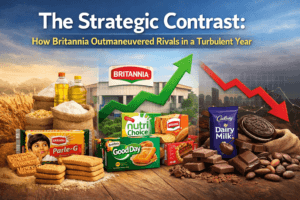
The Strategic Contrast: How Britannia Outmaneuvered Rivals in a Turbulent Year
In the fiercely competitive world of Indian fast-moving consumer goods (FMCG), the fiscal year 2024-25 served as a high-pressure test of corporate resilience. As consumer staples giants Parle Biscuits and Mondelez India grappled with steep profit declines, market leader Britannia Industries demonstrated a rare ability to navigate the storm. The contrasting results, revealed in recent financial disclosures, offer a masterclass in strategic preparedness and expose the vulnerabilities hidden within different business models.
This analysis delves beyond the headlines to uncover why, under identical macroeconomic pressures of soaring input costs, one company held its ground while others faltered. The lessons learned extend far beyond biscuits and chocolates, providing crucial insights into supply chain mastery, pricing power, and strategic agility in volatile times.
The Unforgiving Inflationary Backdrop of FY25
The year presented a perfect storm for India’s packaged food industry. Companies were squeezed from both sides: stubbornly high inflation in raw materials and a consumer base with a limited tolerance for price hikes. For Parle, the core of its portfolio relies on wheat, sugar, and edible oils—commodities that remained costly throughout the year. This was particularly punishing given Parle’s position in the highly price-sensitive mass market, where even a small price increase can significantly dent volume sales.
Mondelez India faced a different, but equally severe, cost catastrophe. The company’s chocolate-centric portfolio was ravaged by historic global cocoa inflation. The parent company, Mondelēz International, reported this as the primary driver behind a 21.3% constant-currency decline in adjusted gross profit globally in Q3 2025. The cost of dairy, another critical input, also surged, compounding the margin pressure. This global commodity shock created a challenge of unprecedented scale for its Indian subsidiary.
A Tale of Two Performances: The Financial Scorecard
The impact of these pressures is starkly visible in the financial results. The table below summarizes the divergent paths taken by the three industry giants:
| Financial Metric (FY25) | Britannia Industries | Parle Biscuits | Mondelez India |
| Revenue from Operations | ₹17,942.67 Cr (+7% YoY) | ₹15,568.5 Cr (+8.5% YoY) | ₹12,503 Cr (-1.9% YoY) |
| Net Profit | ₹2,177.86 Cr (+2% YoY) | ₹979.5 Cr (-29% YoY) | ₹10.5 Cr (-99%+ YoY) |
| Operating Margin | Not Explicitly Stated (Profit grew on 7% revenue rise) | Dropped to 5.3% (from 10.6%) | Dropped to 8% (from 19.4%) |
| Net Profit Margin | Approximately 12.1% (Calculated) | 6% (down from 10.7%) | ~0.1% (down from 15%) |
| Primary Pressure Point | Rising material costs & expenses | Surging costs of wheat, sugar, oil; price-sensitive segment | Historic cocoa & dairy inflation; high dependence on chocolates |
Britannia’s Resilient Stand: In this challenging environment, Britannia’s achievement of even a 2% profit growth is significant. The company managed to grow its top line by 7%, indicating it successfully navigated consumer demand. While its total expenses also rose by over 8%, the ability to largely offset this through operational efficiency and a balanced product portfolio was its key differentiator.
Parle’s Volume-Profit Paradox: Parle tells a story of growth without gains. While it posted a healthy 8.5% sales increase to nearly ₹15,569 crore, its profits collapsed by 29%. This decoupling reveals a critical weakness: its expenses ballooned by nearly 15%, utterly consuming the revenue gains. Operating in the fiercely competitive glucose and Marie biscuit categories, Parle likely had less room to pass on costs without losing market share, leading to a severe margin squeeze.
Mondelez’s Precipitous Fall: Mondelez’s results are the most dramatic. A marginal sales dip of 1.9% translated into a near-total evaporation of profit, plummeting over 99% to just ₹10.5 crore. The collapse was driven by a double whammy: a 13% jump in total expenses and a steep decline in “other income,” which fell to ₹98.7 crore from over ₹1,097 crore the previous year. This “other income,” often including returns on investments or treasury operations, had previously provided a substantial earnings cushion that disappeared in FY25.
The Strategic Drivers Behind the Divide
The raw numbers only tell half the story. The real insight lies in the strategic and operational choices that created these outcomes.
- Product Portfolio & Pricing Power: Britannia enjoys a more diversified and premium-tilted portfolio within the biscuit and snack space. Brands like Good Day, NutriChoice, and premium cookies offer better margins and more pricing flexibility than the iconic but ultra-competitive Parle-G. This allows Britannia to strategically manage price hikes and product mix to protect margins. Mondelez, while owning powerhouse brands like Cadbury and Oreo, faced an insurmountable external shock in cocoa prices that no degree of brand premium could fully offset in the short term.
- Supply Chain and Operational Agility: Surviving input cost volatility requires world-class supply chain management. Britannia’s long-term focus on operational efficiency, including strategic sourcing, operational leverage, and productivity programs, likely provided a critical buffer. In contrast, the sheer velocity of cost inflation for Parle’s staples and Mondelez’s cocoa may have overwhelmed their mitigation strategies. The broader Parle group’s experience with Parle Agro, which was severely impacted by a GST hike on its Appy Fizz brand, highlights how regulatory and cost shocks can destabilize operations.
- The Burden of Unlisted Status: Both Parle and Mondelez India are privately held subsidiaries. This can influence strategy, potentially allowing for a longer-term view without quarterly earnings pressure. However, it may also lessen the relentless public market discipline on cost control and margin defense that a listed entity like Britannia endures. The transparency and continuous scrutiny from analysts and investors can drive a different kind of operational rigor.
The Road Ahead: Strategy in a Volatile World
The FY25 results set the stage for a recalibrated competitive landscape.
- For Britannia, the challenge is to defend its hard-won ground. Its 38% market share in biscuits is now a formidable fortress, but maintaining it will require continued innovation, deeper rural penetration, and vigilance against private labels. The recent leadership transition also adds a layer of strategic uncertainty that the market will watch closely.
- For Parle, the path forward is about rebuilding profitability. It must find ways to either premiumize its portfolio or achieve breakthrough efficiencies in its core mass market. Leveraging its immense brand trust in Parle-G to drive mix toward higher-margin products like Hide & Seek or cookies will be essential.
- For Mondelez India, recovery hinges on the moderation of cocoa prices, which its global leadership has indicated may be on the horizon. Meanwhile, it must aggressively drive its non-chocolate segments like biscuits (Oreo) and beverages (Tang) to diversify its earnings base and reduce single-commodity dependence.
The story of FY25 is a powerful reminder that in the FMCG sector, brand strength alone is not enough. In an era of volatility, operational excellence, strategic diversification, and agile supply chain management are the true determinants of resilience. Britannia’s performance demonstrates that navigating a crisis is not just about survival, but about strengthening your position while competitors are weakened—a lesson that defines market leadership.
You must be logged in to post a comment.