
The Straits of Peril: Inside India’s Secretive Emergency Meeting to Avert an Energy Catastrophe
Facing a potential energy catastrophe after an escalation in Iran halted flows through the vital Strait of Hormuz—through which half of its crude oil and vast majority of its LPG passes—Indian officials and refiners held emergency talks in Bengaluru to weigh a series of fraught contingency plans. These include seeking US permission to tap into stranded Russian oil cargoes, asking Saudi Arabia to reroute supplies via a Red Sea pipeline, and potentially dipping into strategic reserves, while preparing for the worst-case scenario of prioritizing household cooking gas over industrial needs to prevent a humanitarian and economic crisis.
The Straits of Peril: Inside India’s Secretive Emergency Meeting to Avert an Energy Catastrophe
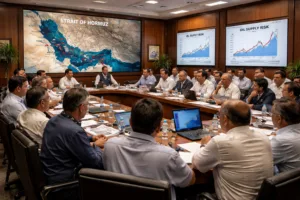
In a wood-panelled conference room in Bengaluru, far from the public eye and the usual cacophony of parliament, a crisis unfolded over whiteboards and spreadsheets this past weekend. It was a crisis not of India’s making, but one that threatens to paralyse its $4 trillion economy. As global powers braced for the fallout of a dramatic escalation in the Strait of Hormuz, a select group of Indian oil refiners and senior government officials gathered to answer a single, terrifying question: What happens if the world’s most important oil tap is turned off?
For India, the world’s third-largest oil importer, the Strait of Hormuz is not just a geopolitical buzzword; it is the aorta of its energy system. The narrow waterway, a sliver of sea bordered by Iran and Oman, is the conduit for roughly half of the nation’s daily crude intake—between 2.5 million and 2.7 million barrels. The weekend meeting, described by insiders as a blend of crisis management and strategic triage, underscores a stark reality: New Delhi is staring into the abyss of a supply shock that could send inflation soaring, widen the fiscal deficit, and destabilise a currency already under pressure.
The immediate trigger is the recent escalation involving Iran, which has effectively choked flows through the Strait. While the world watches the military and diplomatic dimensions, India is quietly fighting a war for its economic survival, sifting through a dwindling deck of contingency cards.
The Russian Barrel Paradox
The most tantalising, yet politically fraught, option on the table is the approximately 9.5 million barrels of Russian crude currently loitering like ghost ships in Asian waters. For India, this represents a cruel paradox. Just two years ago, following the invasion of Ukraine, India emerged as the white knight of Russian oil, snapping up discounted barrels with abandon and reshaping global energy flows. It was a masterclass in realpolitik, securing the nation’s energy needs while pocketing hefty discounts.
But the geopolitical weathervane has spun again. In the wake of a crucial trade deal struck with Washington last month—one that rolled back punitive tariffs—New Delhi has been walking a tightrope. American pressure, once a distant hum, has become a deafening roar. The result has been a dramatic self-sanctioning: Indian refiners have slashed Russian purchases to just over 1 million barrels a day in February, the lowest level since September 2022, pivoting instead to costlier Middle Eastern grades.
Now, with the Hormuz route paralysed, those very same Russian barrels—previously shunned to placate Washington—look like lifeboats. The dilemma for Prime Minister Narendra Modi’s government is excruciating. Turning back to Moscow in a big way could be seen in Washington as a betrayal, potentially jeopardising the hard-won trade agreement and inviting the ire of a protectionist US administration. The people familiar with the discussions revealed that the Petroleum Ministry is now leaning heavily on the Ministry of External Affairs to go back to the United States, pleading for “some room for manoeuvre.” India needs a temporary hall pass from Washington to tap into the floating Russian inventory without triggering diplomatic reprisals.
This is the high-stakes poker game of energy security. India is asking the US to choose: would you rather we tap this Russian oil as a short-term fix, or risk a supply vacuum that sends our economy—and potentially global prices—into a tailspin?
The Strategic Kleenex Box
Beyond the Russian option, the Bengaluru meeting dissected a series of other, less palatable contingencies. One is India’s strategic petroleum reserve (SPR). With roughly 30 million barrels stashed in underground caverns, the reserve is a critical buffer. Yet, as Oil Minister Hardeep Puri recently noted, this equates to a mere six days of consumption. It is a modest cushion, especially when compared to China’s sprawling strategic stockpiles. It is also a reserve of last resort, designed for a doomsday scenario. Dipping into it now would be like using a Kleenex—once it’s gone, it’s gone, and the psychological assurance it provides to the markets vanishes with it.
Officials are also considering accelerating the diversification of supply sources. There were whispers in the meeting about fast-tracking discussions with Venezuela, a sanctioned nation with vast heavy crude reserves that match the configuration of some Indian refineries. This, however, opens another diplomatic minefield with Washington, which has oscillated on Venezuelan sanctions.
Domestically, the government is leaning on state-owned explorers like ONGC and Oil India to squeeze every last barrel out of domestic fields. But India’s domestic production is a drop in the ocean of its demand, and ramping up output is a slow, geological process, not a flick of a switch.
Perhaps the most innovative, yet logistically complex, solution being explored is a plea to Saudi Aramco. Refiners are asking the Kingdom to reroute crude through a less vulnerable artery: the pipeline from its eastern fields to the Red Sea port of Yanbu. This bypasses Hormuz entirely, delivering oil to a port from which it can be shipped to India via the Red Sea and the Indian Ocean. It’s a viable workaround, but it relies on pipeline capacity and the willingness of the Saudis to prioritise this route for Indian clients, potentially at the expense of other markets.
The LPG Time Bomb
While crude oil dominates the headlines, the meeting in Bengaluru was reportedly gripped by an even more acute fear: the supply of Liquefied Petroleum Gas (LPG) and Liquefied Natural Gas (LNG). Nearly 95 per cent of India’s LPG—the cooking gas used by hundreds of millions of households, from the richest suburbs to the poorest villages—comes from the Middle East, overwhelmingly via Hormuz. LNG, vital for power generation and fertilizer plants, is similarly dependent on the waterway.
A prolonged closure doesn’t just mean expensive petrol; it means millions of women in rural India struggling to cook their evening meal. It means fertilizer plants shutting down, threatening the next harvest. This is the “household gas and piped supplies” priority mentioned in the discussions. The government is prepared to make the deeply unpopular move of directing industrial users to switch fuels or face curtailment, effectively rationing gas to keep the lights on in homes and stoves burning in kitchens.
This is where the crisis transforms from an economic problem into a political and humanitarian one. The government is acutely aware that energy security at the macro-level is meaningless if it fails at the micro-level. Contingency plans reportedly include asking refiners to tweak their output “cracks,” maximising the production of LPG at the expense of less critical products like naphtha, a feedstock for petrochemicals.
The Reliance Factor
No discussion of India’s energy resilience is complete without addressing the elephant in the room: Reliance Industries. As the operator of the world’s largest refining complex at Jamnagar, Reliance is a private behemoth that functions as a swing producer. Its export-oriented refineries are a major source of foreign revenue. However, in a national emergency, the government could invoke provisions to compel Reliance to divert a greater share of its refined fuels—diesel, petrol, and LPG—to the domestic market.
While such a move would stabilize internal supplies, it would come at a massive economic cost, slashing export revenues and disrupting long-term supply contracts with international partners. It is a nuclear option in the policy arsenal, one that officials are hoping they won’t have to deploy.
The Human Cost of the Chokepoint
As the officials in Bengaluru pored over shipping data and strategic options, the human cost of this crisis was already beginning to crystallize. India’s vulnerability is a function of its success. It has lifted hundreds of millions out of poverty, fuelling a middle class that demands mobility and a manufacturing sector hungry for power. This energy appetite has locked the nation into a dependency on a region perpetually on the brink.
The crisis in the Strait of Hormuz lands at the worst possible time. Global markets are already jittery, haunted by inflation and slowing growth. An oil shock could be the “SaaS-pocalypse” for the Indian economy—a sudden, brutal correction that erodes corporate profits, widens the trade deficit, and forces the Reserve Bank of India into a painful cycle of rate hikes.
The world watches the fighter jets and the warships in the Gulf, but the real battleground for India is the kitchen table and the factory floor. The outcome of the Bengaluru meeting will shape not just India’s energy policy for the coming months, but the very well-being of its 1.4 billion citizens. The contingency plans are drawn, the diplomatic cables are being drafted, and the tankers are idling. But as the officials disbanded, one sobering truth hung in the air: in a crisis of this magnitude, there are no good options, only a hierarchy of painful ones. India is now racing against time to choose the least damaging path forward before the lights begin to flicker.
You must be logged in to post a comment.