
The Stolen Hours: How Checkpoints Control Time and Lives in Jerusalem
The article details how a simple 2-kilometer commute for Palestinian teacher Laila al-Halasa becomes a daily three-hour ordeal due to the sudden, unexplained closure of a direct checkpoint near her East Jerusalem village, forcing lengthy detours through other checkpoints; this personal story exemplifies a systemic reality where movement restrictions and the strategic weaponization of time and delay are used as tools of control, crippling education, fracturing communities, and enforcing a hierarchy of mobility that fragments Palestinian territory and normalizes a lack of autonomy under occupation.
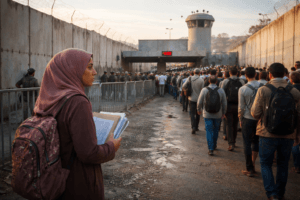
The Stolen Hours: How Checkpoints Control Time and Lives in Jerusalem
The 2-kilometer journey from Laila al-Halasa’s home in the East Jerusalem village of Al-Sawahreh al-Sharqiyeh to her school should take five minutes by car. Instead, it is a daily three-hour ordeal of detours, checkpoints, and unexplained delays. Her story is not an anomaly but a systematic reality for hundreds of Palestinians for whom a simple commute has become a profound daily struggle. This transformation of time from a personal resource into a controlled commodity reveals a deeper, often overlooked dimension of life under occupation: the weaponization of time and movement.
A Teacher’s Daily Marathon
Laila al-Halasa is a special-education teacher. Her pre-dawn routine is dictated not by lesson plans but by a labyrinth of closures. A checkpoint near her village that once provided direct access to Jerusalem is now off-limits to most residents without explanation from the authorities. This forces her and her neighbors on a long, indirect route through other checkpoints, turning a short trip into a half-day journey.
Her experience is a microcosm of a widespread systemic issue. The village of Al-Sawahreh al-Sharqiyeh, home to over 6,000 people, is predominantly classified as Area C under the Oslo Accords, placing it under full Israeli administrative and security control. This classification subjects residents to a complex matrix of movement restrictions. The village is also intersected by segments of the Israeli separation barrier, which cuts through agricultural land and isolates communities.
The Architecture of Delay: More Than Just Checkpoints
The obstacle Laila faces is part of a broader infrastructure of control. According to official travel advice, movement in the West Bank, including East Jerusalem, is governed by an unpredictable network of checkpoints and road closures. For Palestinians, these are not simple security stops but capricious chokepoints that can shut down life for hours.
Table: Types of Movement Restrictions Faced by Palestinians
| Restriction Type | How It Manifests | Primary Impact |
| Fixed Checkpoints | Permanent structures staffed by soldiers, like the “Container” checkpoint near Al-Sawahreh. | Creates predictable but long delays; access can be denied arbitrarily. |
| “Flying” Checkpoints | Temporary, surprise roadblocks set up without warning. | Creates extreme uncertainty and unpredictability for daily travel. |
| Road Closures & Permit Systems | Roads reserved for Israeli settlers; areas declared closed military zones. | Forces long, circuitous detours; makes direct travel physically impossible. |
| Age/Gender Restrictions | Policies, especially during times like Ramadan, barring certain groups from Jerusalem. | Splits families and prevents worship, work, or medical care based on identity. |
This system creates what anthropologist Julie Peteet calls **”calibrated chaos”**—a reality where the only discernible logic is the generation of perpetual uncertainty and delay. As one Palestinian lamented in Peteet’s research, “They are stealing our time”. Time itself becomes a resource extracted, a form of power exercised not just over land, but over the most fundamental aspect of daily life: the ability to plan, to be productive, and to live with dignity.
The Ripple Effect: Education Under Siege
The impact of this stolen time extends far beyond individual frustration. It cripples essential societal functions, most critically education. Laila’s story as a teacher is a poignant entry point into a national crisis.
The United Nations reports that movement restrictions, military operations, and violence have exacerbated a pre-existing education crisis to unprecedented levels, affecting at least 782,000 students across the West Bank. When teachers like Laila spend six hours commuting for a full day’s work, educational quality inevitably suffers. The psychological toll is immense, creating an atmosphere of stress and exhaustion that permeates the classroom.
Table: Impact of Conflict and Restrictions on Palestinian Education
| Statistic | Gaza Strip | West Bank (including East Jerusalem) |
| Students Deprived of Access | 625,000 | 782,000 affected by crisis |
| Teachers Unable to Work | 23,000 | Data not specified, but severely impacted by closures |
| Schools Damaged | 93% | Data not specified |
| Students & Teachers Killed | ~9,400 | ~78 |
These figures reveal a devastating assault on the right to learn in a safe environment. The daily commute ordeal for educators is a critical, though less visible, front in this battle, directly undermining the stability and consistency needed for effective learning.
A Tale of Two Systems: Contrasting Realities of Mobility
The injustice of this stolen time is thrown into sharp relief when contrasted with infrastructure development elsewhere in Israel and the West Bank. While Palestinian villages face closures, Israel has invested heavily in bypass roads and highways that connect Israeli settlements and cities, often built on occupied land.
A 2011 article in Haaretz highlighted how Transportation infrastructure is a key driver of economic development. The article notes that investment in highways has been shown to increase salaries by 10% to 14% and was crucial for developing high-tech centers like Yokneam, allowing workers to commute efficiently from the center of the country. The CEO of the company operating Highway 6 stated, “The development of employment centers or industrial parks along the highway is dramatic”.
This creates a stark, apartheid-like duality in mobility. As Peteet describes, “Israeli settlers speed to their destinations along well-groomed bypass roads. No checkpoints or permits for them! For Palestinians to go nearly anywhere requires moving through an obstacle course”. This separation ensures that economic and social integration remain impossible, enforcing a hierarchy written into the very landscape.
The “Why”: Time as a Tool of Control
The authorities provide no official explanation for closing the direct checkpoint near Al-Sawahreh al-Sharqiyeh. However, analysts and scholars see a clear strategic logic. This is not merely about security in a narrow sense but about asserting demographic and territorial control.
The confiscation of time serves several long-term objectives:
- Economic Pressure: Making normal economic life untenable, strangling Palestinian livelihoods.
- Territorial Fragmentation: Dividing Palestinian land into disconnected cantons, undermining geographic cohesion.
- Demographic Engineering: Encouraging a “slow-motion displacement” by making daily life so arduous that people consider leaving.
- Psychological Dominance: Enforcing a reality where Palestinian life is subject to the unpredictable whims of military authority, normalizing a lack of autonomy.
In this context, the checkpoint is more than a physical barrier; it is a temporal valve, regulating the flow of Palestinian life. It ensures that Palestinian space shrinks not only physically but temporally—time slows, opportunities are missed, and life is lived in a state of suspended waiting.
Conclusion: Beyond the Headline
Laila al-Halasa’s three-hour commute is a powerful headline, but its true significance lies in the silent theft it represents. It is a story about a teacher robbed of hours with her family, students robbed of a rested educator, and a community robbed of its right to a coherent life. It exposes a system where, as one Facebook commenter on the article noted, the situation has been characterized as an apartheid regime based on institutionalized domination.
This daily reality for hundreds of Palestinians is a deliberate strategy that uses time as a weapon. It is a form of control that is less visible than walls but more pervasive, woven into the fabric of every day. Understanding this—the systemic “stealing of time”—is crucial to moving beyond simplistic narratives of conflict and recognizing the profound, human costs of an occupation that seeks to control not just land, but the very minutes and hours of people’s lives. The road to justice, therefore, must be paved not only with the return of land but with the restoration of time—the right to move, to live, and to learn without the crushing weight of perpetual delay.
You must be logged in to post a comment.