
The Solar Shockwave: Why America’s 126% Tariff on India Is More Than Just a Trade War
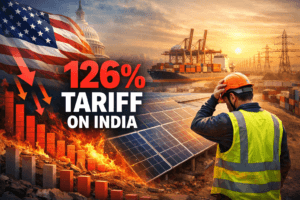
The Solar Shockwave: Why America’s 126% Tariff on India Is More Than Just a Trade War
By the FE Global Desk Updated: February 26, 2026
The message from Washington landed like a thunderclap in boardrooms and on factory floors across three continents. On February 25, 2026, the US Commerce Department lowered the boom on solar imports from India, Indonesia, and Laos, slapping them with sweeping anti-subsidy countervailing duties. For India, the headline figure was a staggering 125.87% .
It’s a number that seems pulled from the fevered pages of an economic thriller, not a government fact sheet. But for the thousands of people whose livelihoods are tied to the sun’s most powerful commercial application—solar energy—this wasn’t fiction. It was a new, daunting reality.
While the news cycle fixates on the tit-for-tat of global tariffs and the legal gymnastics of trade policy, the 126% duty on Indian solar imports is a story about far more than just numbers. It’s a story about a green energy revolution hitting a geopolitical wall, about American installers facing impossible choices, and about Indian manufacturers who saw a lifeline in the US market only to have it potentially severed.
To understand the shockwave, we have to look beyond the fact sheet and into the human and strategic forces at play.
The “America First” Solar Doctrine
The official rationale from the Commerce Department is clear: India, Indonesia, and Laos have been unfairly subsidizing their solar manufacturing sectors. The investigation, likely initiated after complaints from domestic US producers, concluded that these nations were flooding the American market with artificially cheap solar cells and modules. This, the argument goes, undercuts American jobs and investment in home-grown solar tech.
This decision is the muscle behind the “America First” economic policy now in its second term. The logic is straightforward, if controversial: protect US industries at all costs, even if it means short-term pain for American consumers and businesses that rely on imports. The data cited in the report is stark: the three nations accounted for a staggering $4.5 billion in solar imports in 2025, roughly two-thirds of the US total. India alone saw its solar exports to the US skyrocket from $84.7 million in 2022 to $792.6 million in 2024—a more than nine-fold increase in just two years.
For the US Department of Commerce and the domestic manufacturers cheering this decision, that explosive growth was a red flag. It was proof, in their eyes, of a market distorted by foreign government subsidies. The 126% duty is not just a tariff; it’s a corrective crowbar, designed to prise open that imbalance by making Indian panels so expensive that American buyers will have no choice but to look elsewhere—ideally, at home.
The View from Pune: A Manufacturer’s Dilemma
To grasp the human impact, travel 8,000 miles east of Washington to the bustling industrial belt surrounding Pune, India. Here, in a sprawling Special Economic Zone, is the headquarters of “Lotus Solar,” a mid-sized manufacturer that, until this week, was riding high. (The name has been changed to protect the company’s competitive position.)
“We saw the US as our promised land,” says Rajesh Sharma, Lotus Solar’s founder, his voice a mix of exhaustion and defiance over a crackling international line. “Europe was plateauing, the domestic Indian market is price-sensitive and dominated by giants. The US… the US had the demand and the premium pricing.”
For Sharma, the American dream began in 2023. He invested millions in upgrading his production lines to meet US quality standards, hired 200 new engineers and technicians, and built an entire export division. His company’s story was one of globalization at its finest: Indian ingenuity and cost-efficiency powering the American green transition.
Now, a 125.87% duty means a solar panel that cost him $100 to manufacture and ship, and which he sold to a US distributor for $150, would effectively cost that distributor over $330 after the tariff. It’s a death sentence for that business model.
“We can’t absorb that. No one can,” Sharma laments. “We are now looking at stopping production on two of our three export-dedicated lines. We’re trying to find alternative markets in Africa and the Middle East, but they don’t have the volume or the margins. I had to call a meeting with my workforce yesterday. The fear in their eyes… it’s the hardest part. They didn’t sign up for trade wars; they signed up to build a future.”
Sharma’s story is being repeated across the solar manufacturing hubs of Gujarat, Maharashtra, and Tamil Nadu. The tariff isn’t just a line item on a spreadsheet; it’s a halt sign for expansion plans, a potential pink slip for factory workers, and a shattered dream for entrepreneurs who bet big on a globalized green economy.
The American Installer’s Nightmare
But the pain isn’t confined to the subcontinent. Fly back to the US and land in Denver, Colorado, where Sarah Jenkins runs “Mile High Solar Solutions,” a small residential and commercial installation company. For Jenkins, the last few years have been a delicate balancing act of supply chains, customer expectations, and razor-thin margins.
“This news is a punch to the gut,” Jenkins says, sitting in her showroom surrounded by brochures of gleaming solar roofs. “People think we just buy panels and put them on roofs. It’s so much more complicated. We’ve spent the last year building relationships with suppliers for high-efficiency bifacial panels. A lot of that top-tier, cost-effective tech was coming from India. It wasn’t just cheap; it was good.”
Jenkins explains that the tariff creates a cascade of problems. First, the price of her installed systems will have to go up immediately—or she’ll have to eat the cost and go out of business. She estimates a typical residential installation could jump by $5,000 to $8,000.
“Every time prices spike, customers pause,” she explains. “They get ‘sticker shock.’ They delay the project, or they cancel it altogether. We’re not just selling a product; we’re selling a 25-year value proposition. When the upfront cost jumps by 20%, that proposition gets a lot harder to sell.”
She’s already fielding frantic calls from suppliers. Her main distributor for Indian panels told her they have containers stuck in customs, their fate uncertain. Now, she’s scrambling to find alternative supply from Southeast Asia or domestic US manufacturers. But the US manufacturers, who are the intended beneficiaries of this tariff, are already at capacity or charging a significant premium.
“I want to buy American. I really do,” Jenkins insists. “But my customers have budgets. If American panels are suddenly 40% more expensive than anything else, and the ‘anything else’ is now also hit with tariffs, the customer just… doesn’t go solar. And that’s the real tragedy. The planet loses, the American consumer loses, and my employees lose.”
The Geopolitical Tangle: Beyond the Solar Cell
The solar tariff is not happening in a vacuum. It’s a fresh wound in an already complicated and confused US-India trade relationship. The article mentions a US Supreme Court ruling that threw the Trump administration’s global tariff regime into legal chaos, deeming some of them “illegal.” This ruling created a bizarre yo-yo effect on tariffs, with rates on Indian goods bouncing from 50% down to 18%, then up to a proposed 15%, before settling back at 10%.
For businesses on both sides, this unpredictability is as damaging as the tariffs themselves. A planned trade deal between the US and India, which was supposed to smooth over these very issues, has been deferred as both sides “study the implications” of the court’s ruling.
“It creates a climate of extreme uncertainty, which is the enemy of investment,” explains Dr. Anjali Mathur, a trade economist at a New Delhi-based think tank. “You cannot build a supply chain on quicksand. The US is sending a message that market access can be revoked based on opaque countervailing duty investigations. India will now have to decide whether to challenge this at the WTO or retaliate with its own tariffs on US goods. This could spiral.”
The timing is particularly bitter. For years, the US and India have positioned themselves as strategic partners in countering China’s dominance, including in the solar supply chain. The idea was to create a “China plus one” strategy, where the West could rely on friendly nations like India for critical components. This 126% tariff feels, to many in New Delhi, like a slap in the face of that partnership.
“We were doing exactly what the US wanted—building a manufacturing base outside of China,” says Sharma from Lotus Solar. “And now we’re being punished for our success. The message is confusing: ‘Build your industry, but don’t sell to us.'”
The Human Cost of Green Protectionism
In the end, the story of the 126% tariff is a story about people. It’s about the factory worker in Pune who just took out a loan to build a house, now facing an uncertain future. It’s about the solar installer in Denver who has to explain to a family that their dream of energy independence just got more expensive. It’s about the policymaker in Washington trying to balance the demands of domestic industry with the broader goals of climate change and international diplomacy.
There are winners, of course. US-based solar manufacturers like First Solar are poised to benefit, as their products suddenly become far more competitive. Lobbyists who pushed for these protections are likely celebrating. But in the complex calculus of global trade, the immediate, tangible costs are often borne by the least powerful.
The “America First” approach offers a simple, compelling narrative. But the reality on the ground is far messier. As Sarah Jenkins in Denver gets ready for a day of difficult calls with confused customers, she sums it up best:
“I get protecting American jobs. I’m an American job. But my job depends on a healthy, growing solar market. These tariffs feel like they’re trying to save a small piece of the industry by putting a tourniquet on the whole body. Eventually, the body stops growing.”
The sun will rise tomorrow over Pune and over Denver. But for the solar industry caught in the geopolitical crossfire, the forecast is suddenly a lot cloudier. The 125.87% is more than a duty; it’s a down payment on a more fragmented, more expensive, and more uncertain global future for the energy we harvest from the sky.
You must be logged in to post a comment.