
The SIM Card Spy: How a Gujarat Arrest Exposes the Digital Underbelly of Naval Espionage
The SIM Card Spy: How a Gujarat Arrest Exposes the Digital Underbelly of Naval Espionage
In the quiet precincts of Gujarat’s Anand Taluk, a routine technical trace by Karnataka police culminated in an arrest that lays bare a modern truth: in today’s espionage, the most critical tool isn’t always a hidden camera or a stolen blueprint. Sometimes, it’s a simple SIM card. The detention of 34-year-old Hirendra Kumar, the third accused in a shocking Indian Navy data leak case, reveals a sprawling spy network built not on shadowy agents, but on the digital infrastructure of everyday life—activated phones, encrypted apps, and the universal lure of quick money.
This case, which first surfaced with a security breach at the Udupi Cochin Shipyard in Malpe in November 2025, has evolved from the arrest of two subcontractor employees to uncovering a pan-Indian logistical chain supporting foreign handlers. Kumar’s alleged role wasn’t to steal secrets directly, but to facilitate the communication channel itself, acting as a vital node in a network that traded the nation’s maritime security for financial gain.
Anatomy of a 21st-Century Spy Ring: From Shipyards to SIM Vendors
The espionage operation, as pieced together by investigation teams led by officer Harsh Priyamvada, follows a disturbingly efficient division of labor:
- The Insiders (The Source): Rohit (29) and Santri (37), employees of subcontractor Shushma Marine Pvt Ltd, were the initial arrestees. Hailing from Uttar Pradesh, their position granted them access to highly sensitive data: confidential lists of Indian Navy ship identification numbers, detailed vessel repair schedules, and sensitive infrastructure data. Police allege they captured and shared this information in exchange for illegal financial gains from Pakistani handlers.
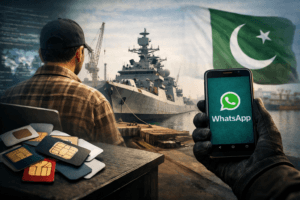
- The Enabler (The Conduit): Enter Hirendra Kumar, based over 1,500 kilometers away in Gujarat. His alleged contribution was logistical. According to police reports, he purchased SIM cards in his own name and supplied them, along with their accompanying One-Time Passwords (OTPs), to the main accused. These SIMs were not for casual calls; they were specifically used to activate WhatsApp accounts, creating encrypted communication lines directly to foreign handlers.
- The Handlers (The Beneficiaries): While not in custody, the shadowy beneficiaries based in Pakistan form the third pillar. They provided direction, presumably requested specific information, and funneled money through digital channels, exploiting both the insiders’ access and the enabler’s provision of secure communication.
This structure is emblematic of modern hybrid threats. It bypasses traditional vetting by recruiting individuals not in core defense positions but in the extended periphery of subcontractors. It then uses commercially available encrypted platforms, enabled by anonymously acquired SIM cards, to create a secure pipeline out of the country.
The Critical Vulnerability: Encrypted Apps and “Burner” SIMs
The police have highlighted that Kumar’s supplied SIM card was a “critical tool” used to communicate via encrypted platforms like WhatsApp, “bypassing standard security monitoring.” This statement underscores a central tension in national security.
- The Encryption Shield: Apps like WhatsApp offer end-to-end encryption, making the content of messages indecipherable to anyone without the specific device keys. For spies, this provides a robust layer of operational security.
- The SIM Card Achilles’ Heel: However, the activation of these accounts leaves a metadata footprint. By tracing the acquisition and activation patterns of the SIM card—purchased in his own name, a surprising lapse in tradecraft—police used technical surveillance to map the network. This shows that while message content may be secure, the identity and location of the communicator can still be uncovered through forensic financial and telecom analysis.
Kumar’s arrest from Gujarat confirms the network’s wide geographic spread, moving the investigation from a localized breach at a Karnataka shipyard to a multi-state support apparatus.
Human Motives: The Financial Lure in the Shadow of Patriotism
Beyond the technical setup lies a more mundane, yet powerful, driver: money. The police explicitly state that both the insiders (Rohit and Santri) and the enabler (Kumar) were motivated by “illegal financial gains” and acted “in exchange for money.”
This highlights a profound vulnerability. The defendants were not ideologically driven moles in the classical sense. They were individuals, one a subcontractor employee and another a SIM card provider, allegedly compromising national security for personal financial benefit. This presents a distinct challenge for counter-intelligence: how to guard against the exploitation of economic vulnerability within the vast ecosystem of personnel connected to defense projects.
Legal Repercussions and the Shadow of UAPA
The gravity of the alleged crimes is reflected in the legal charges. The accused have been booked under various sections of the new Bharatiya Nyaya Sanhita (BNS) and, significantly, the Unlawful Activities (Prevention) Act (UAPA).
The UAPA is a stringent anti-terror law that makes bail exceedingly difficult to obtain and allows for extended pre-charge detention. Its application in this case signals that the state is treating the alleged leak of naval ship identifiers and repair schedules as an act that threatens the sovereignty and security of India. All three arrested individuals remain in judicial custody, and the UAPA charges ensure this case will proceed through a specialized legal framework designed for severe threats to the state.
Broader Implications for India’s Maritime and Defense Security
The Udupi shipyard case is not an isolated incident but a symptom of systemic challenges:
- The Subcontractor Vulnerability: Modern defense projects rely on complex layers of contractors and subcontractors. While core Navy personnel undergo rigorous background checks, the security protocols for employees of ancillary service providers can be less stringent, creating a soft underbelly for espionage rings to exploit.
- The “Gray Zone” Espionage: This operation fits the pattern of “gray zone” tactics—actions below the threshold of war. By using financial incentives to recruit non-ideological assets in commercial or support roles, adversaries can gather invaluable intelligence without deploying a single official intelligence officer onto Indian soil.
- Need for Holistic Monitoring: The case argues for enhanced monitoring not just of classified networks, but of the digital and financial patterns of individuals in sensitive environments. This includes tracking unusual financial transactions and the procurement of multiple communication devices.
Conclusion: An Unfinished Investigation and a Stark Warning
The arrest of Hirendra Kumar is a significant breakthrough, but the police have indicated that the investigation is ongoing to “identify more links in this chain.” His role as an enabler suggests there could be other similar facilitators, or that the network extended beyond the one shipyard.
This case serves as a stark warning. It demonstrates that in the digital age, protecting national secrets requires guarding not just vaults and server rooms, but also the mundane digital pathways that lead out of them. It underscores that every individual with access to sensitive infrastructure, no matter how indirect, is a potential vector for compromise. As India advances toward its ‘Viksit Bharat’ vision with the seas playing a central role, as noted by the Navy Chief, securing the human and digital links in its maritime defense chain becomes as crucial as building the ships themselves. The breach at Udupi is a reminder that vigilance must extend to the farthest subcontractor and the most commonplace SIM card.
You must be logged in to post a comment.