
The Silent Siege: How Extreme Heat is Rewriting the Future of Indian Cities
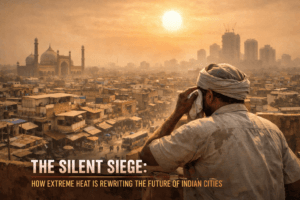
The Silent Siege: How Extreme Heat is Rewriting the Future of Indian Cities
While headlines across the globe flash record-breaking temperatures from Phoenix to Madrid, a more profound and insidious transformation is taking place in the heart of India’s urban landscapes. Extreme heat has shed its identity as a seasonal weather event; it has become the oppressive, inescapable backdrop of daily existence. This is not merely a climate story—it is a story of urban design, economic survival, and deepening inequality. As the world grapples with a new thermal reality, Indian cities stand at the forefront, revealing in stark relief what happens when a planetary crisis collides with local vulnerabilities.
The Indian Multiplier: When Global Warming Meets Local Realities
The science is unequivocal: heatwaves are longer, more frequent, and more intense. But the metric that truly terrifies scientists—wet-bulb temperature, which combines heat and humidity—finds its most potent breeding ground in Indian coastal and plains cities. When high humidity meets high temperature, the human body’s ability to cool itself through sweating fails. This isn’t just discomfort; it’s a physiological threshold for survival.
Globally, cities are responding with redesigned public spaces, mandated siestas, and widespread cooling centers. Yet, for Indian metropolises like Delhi, Chennai, or Ahmedabad, the equation is complicated by a powerful multiplier effect: density, informality, and pre-existing inequality. Here, the same 45°C that triggers public advisories in Europe unfolds in a context where air conditioning is a privilege, reliable water is a daily struggle, and home is often a tin-roofed dwelling in a congested settlement. The crisis, therefore, shifts from one of adaptation to one of cost. The question for millions is not “How do we stay cool?” but “What must we sacrifice to avoid overheating?”
The Self-Made Furnace: Urban Planning That Traps Heat
At the core of urban overheating is the Heat Island Effect—a phenomenon where cities, built of concrete, asphalt, and glass, absorb heat by day and release it slowly by night. Indian cities have unintentionally become masters of this effect. In the relentless pursuit of “development,” urban planning has often traded climate-sensitive design for speed and scale.
Tree-lined avenues make way for wider, exposed flyovers. Water bodies that once cooled neighborhoods are encroached upon or polluted. Low-density, ventilated housing is replaced by towering glass-and-concrete complexes that act like thermal batteries. The result is a city that is not only hotter but one that denies its citizens nightly respite. This rising nighttime minimum temperature is a silent killer, preventing the human body from recovering and turning homes into sweltering boxes. For the night-shift worker, the street vendor sleeping on their cart, or the family in a cramped room, there is no escape.
The Body on the Frontline: Heat as an Occupational Hazard
Perhaps the most glaring injustice of the heat crisis is its discriminatory impact on labor. The global discourse is beginning to frame heat as a productivity issue. In India, it is a matter of livelihood and life for the informal sector, which forms the backbone of the urban economy.
Consider the construction worker balancing on a scaffold under the midday sun, the delivery executive navigating traffic with a broken helmet, the sanitation worker clearing garbage without protective gear, or the street vendor tethered to their spot for 12 hours. For them, heat is not an advisory; it is an uncompensated, high-risk workplace condition. There are no legally enforced “heat breaks,” no mandatory shaded rest areas, and certainly no loss-of-pay protections for heat-induced sick days.
This creates a vicious cycle: the poorer you are, the more likely you are to work in extreme heat. The more you work in heat, the greater your health risks and medical costs. The greater these costs, the deeper you sink into poverty. Heat, thus, becomes a powerful engine of socio-economic entrapment.
Beyond Alerts: The Limits of Heat Action Plans and the Need for Structural Cooling
India deserves credit for its pioneering Heat Action Plans (HAPs). First rolled out in Ahmedabad, these blueprints for early warning systems and public awareness have saved lives and set a global precedent. However, over a decade into their implementation, their limitations are evident.
HAPs are fundamentally reactive. They are disaster management tools for a slow-onset, continuous disaster. They issue alerts but do little to alter the physical environment that creates the danger. They advise staying indoors but are silent on the quality of housing. They recommend hydration but don’t address erratic municipal water supply in informal settlements.
The next frontier must shift from managing heat to designing it out. Global cities are experimenting with reflective “cool roofs,” expanding urban forest corridors, and mandating permeable surfaces. India’s challenge is to adapt—not just adopt—these solutions. This means reviving traditional architecture that promoted cross-ventilation, legally protecting urban lakes and wetlands as public cooling infrastructure, and reimagining streetscapes with mandatory shaded footpaths and public drinking water points. Cooling must be reframed from a private luxury, powered by AC units, to a public good, powered by intelligent design.
Climate Justice in a Concrete Jungle: The Divide Between Who Overheats and Who Cools Off
Extreme heat holds up a mirror to society, reflecting and amplifying its deepest fissures. The geography of heat exposure in an Indian city is a map of its inequality. On one side are the gated enclaves with 24/7 power backup, air-conditioned cars, and landscaped gardens that create micro-climates. On the other are the informal settlements with corrugated metal roofs, narrow lanes that block breezes, and erratic electricity that makes even a fan a intermittent relief.
This is the everyday, slow violence of heat—a violence that doesn’t make headlines like a flood but erodes health, well-being, and economic potential just as surely. It shortens lifespans, reduces educational outcomes for children in hot classrooms, and pushes household budgets toward exorbitant cooling costs.
The Path Forward: Building Cities for Thermal Comfort
The global heat crisis demands a fundamental redefinition of what a “livable city” means. For India, this redefinition cannot be a distant promise in a master plan. It requires urgent, actionable priorities:
- Protect the Worker: Enact and enforce mandatory occupational heat stress standards, including rest-shade-hydration protocols, for all sectors, especially the informal economy.
- Mandate Cool Design: Urban development bylaws must incentivize green roofs, reflective materials, and native tree plantation. Building codes should prioritize ventilation and thermal insulation.
- Reclaim Blue-Green Infrastructure: Protect and restore urban water bodies and create interconnected green corridors. These are not aesthetic luxuries but essential public utilities for cooling.
- Democratize Cooling: Integrate accessible, round-the-clock cooling centers—libraries, community halls, metro stations—into the fabric of public life, particularly in low-income neighborhoods.
Heat may be a global phenomenon with no respect for borders, but its impacts are meticulously local, dictated by the choices of planners and policymakers. As the mercury continues to climb, Indian cities face a critical juncture. They can become laboratories of resilient, equitable adaptation, proving that a cooler city is a more just and productive one. Or, they can become cautionary tales of what happens when governance fails to keep pace with a warming world.
The ultimate question is no longer if Indian cities can survive extreme heat. They are already enduring it. The question is who will be allowed to thrive within them, and who will be left to pay the ultimate price for our collective inaction. The answer will determine the future of urban India itself.
You must be logged in to post a comment.