
The Silent Revolution: How Bifacial Modules, String Inverters, and Smart Trackers Are Redefining Utility-Scale Solar
A new data analysis from RatedPower reveals that utility-scale solar project design is undergoing a fundamental shift toward an integrated, intelligent system architecture, driven by the need for grid stability and improved economics. The report highlights the dominance of bifacial modules (featured in over 90% of simulations), the strategic ascendancy of modular string inverters over central units for their resilience and grid responsiveness, and the evolution of smart trackers that optimize energy capture for bifacial technology. This technological convergence is accelerating the hybridization of solar with battery storage—now present in 20% of simulations—as the industry moves beyond simple generation toward creating dispatchable power plants capable of navigating the structural challenges of grid saturation and curtailment.
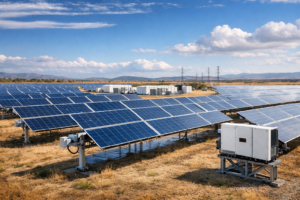
The Silent Revolution: How Bifacial Modules, String Inverters, and Smart Trackers Are Redefining Utility-Scale Solar
The image of a solar farm has become iconic: vast, shimmering fields of glass and metal, silently converting sunlight into the currency of the modern world. But beneath that serene surface, a profound technological transformation is underway. It’s a shift driven not by a single breakthrough, but by a confluence of smarter choices, economic pressures, and the relentless pursuit of efficiency.
According to new data from RatedPower, a leading cloud-based design platform now part of Enverus, the blueprint for the utility-scale solar project of the future is being rewritten. Their 2026 Global Renewable Energy Trends Report, drawing from over 64,000 simulated projects representing a staggering 5.1 TW of capacity, points to a clear victor in the technology race. It’s not about a single “best” component, but rather a new, dominant system architecture: one built on bifacial modules, decentralized string inverters, and intelligent, advanced trackers.
This isn’t just a technical footnote for engineers. This shift has massive implications for project bankability, grid stability, land use, and the pace of the global energy transition. Let’s pull back the curtain on this silent revolution and explore what it means for the future of energy.
The Rise of the Two-Sided Panel: Why Bifacial is Becoming Ubiquitous
Just a few years ago, bifacial modules—panels that capture sunlight on both their front and rear sides—were a niche, premium product. They were the intriguing but expensive option for projects where every last watt counted. Today, they are the industry standard. RatedPower’s data reveals that bifacial modules now feature in over 90% of utility-scale project designs on their platform, with expectations to hit a staggering 95% market share by 2032.
So, what happened? How did the two-sided panel go from curiosity to king?
The answer lies in a classic industrial story: the perfect alignment of performance gains and cost reduction. The initial premium for bifacial technology has eroded as manufacturing processes have matured and scaled. At the same time, our understanding of how to maximize their potential has grown exponentially.
The real human insight here is about a shift in mindset. Developers and engineers have stopped asking “can we afford bifacial?” and started asking “can we afford not to use it?”
The gains are simply too compelling to ignore. By capturing albedo—the light reflected from the ground beneath them—bifacial modules can generate 5% to 15% or more additional energy compared to their monofacial counterparts. This isn’t just about having a slightly more efficient panel; it’s about fundamentally improving the economics of an entire project.
Consider a project in a high-albedo environment like a desert or a snowy region. The back-side gain can be transformative, effectively lowering the Levelized Cost of Energy (LCOE) and improving the project’s internal rate of return (IRR). This allows developers to bid more competitively in power purchase agreements (PPAs) or simply achieve higher profitability.
But the insight goes deeper. The industry has learned that “bifacial” isn’t just a module specification; it’s a system design philosophy. To unlock that extra energy, you can’t just plop a bifacial module on a standard tracker. You need to consider the entire system. This is where the synergy with other technologies becomes critical.
The Great Inverter Shift: Why String Inverters Are Winning the Utility-Scale Battle
Perhaps the most surprising revelation from the RatedPower report is the ascendancy of the string inverter. For decades, the utility-scale world was the undisputed kingdom of the central inverter—a single, massive unit, often housed in its own dedicated building, acting as the heart of the solar farm. It was powerful, proven, and for a long time, the only game in town for projects over 50 MW.
Today, that kingdom is crumbling. According to the data, string inverters now command 54.2% of the utility-scale on-grid inverter market.
This isn’t just a minor fluctuation; it’s a fundamental power shift. To understand why, we need to look at the changing demands of the grid and the very nature of risk in a massive solar project.
A central inverter is a single point of failure. If it goes down, megawatts of generation capacity go offline instantly. It’s like a traditional mainframe computer—powerful, but vulnerable.
String inverters, by contrast, represent a distributed, modular architecture. Imagine a solar farm not as one giant computer, but as a network of thousands of smaller, smarter processors. Each string inverter manages a small group of panels. If one inverter fails, only that small “string” of panels is affected. The rest of the plant continues to hum along, minimizing downtime and lost revenue. This granularity offers a resilience that is incredibly attractive to asset managers and investors who prioritize long-term, predictable performance.
But resilience is only part of the story. The real game-changer is grid responsiveness. Modern electrical grids are becoming more complex and strained, with rising levels of renewable penetration leading to concerns about stability. Utilities don’t just want power plants that can turn on; they need them to be smart, responsive partners.
String inverters are inherently better at this. Their distributed nature allows for more nuanced control. They can provide finer grid support functions, such as volt-var control (managing voltage and reactive power) at a more localized level. This helps mitigate the very grid bottlenecks and instability that RatedPower identifies as the industry’s most persistent challenge. They are the difference between a plant that simply dumps power onto the grid and one that actively participates in keeping the grid healthy and balanced.
Furthermore, the modularity of string inverters simplifies installation and maintenance. Instead of wrestling a 50-ton central unit into place, crews can install lighter, smaller inverters with standard equipment. Troubleshooting becomes a process of swapping out a single, relatively small unit rather than diagnosing a complex, centralized behemoth. This ease of service is a direct response to one of the industry’s other major headaches: skills shortages.
The Tracker’s New Brain: From Sun-Followers to Power Plant Orchestrators
For years, a solar tracker was a relatively simple machine. Its job was singular: follow the sun across the sky to maximize direct irradiance capture. While this basic function remains vital, the role of the advanced tracker has evolved dramatically. It is no longer just a piece of steel and a motor; it has become a critical node in the project’s “brain.”
RatedPower’s data highlights a clear shift toward these advanced trackers, particularly in sun-rich regions like the US, Brazil, Australia, and Chile. The value proposition has expanded beyond simple energy gain.
The first layer of this evolution is software-enabled optimization. Trackers now use algorithms to make intelligent decisions. For example, during cloudy or diffuse-light conditions, the optimal position might not be directly facing the sun, but a more horizontal “diffuse sky” position to capture light from the entire sky vault. This requires a tracker that can think, not just move.
But the real genius of the modern tracker is its ability to act as the perfect partner to the bifacial module. This is where the synergy becomes undeniable.
A standard tracker casts a shadow. With a monofacial module, that shadow is simply a loss. But with a bifacial module, the game changes. Advanced trackers can be programmed to perform “back-tracking” maneuvers that are specifically designed to maximize rear-side irradiance.
Imagine the early morning and late afternoon sun. By subtly adjusting the angle of the entire row of panels, a smart tracker can allow more reflected light to reach the back of the modules in the next row. This isn’t just about following the sun; it’s about orchestrating the entire field of panels to act as a cohesive, light-capturing system. The tracker’s new brain is constantly calculating the optimal balance between front-side direct light and back-side reflected light, squeezing every possible electron from the available resource.
This intricate dance between tracker, module, and inverter is the defining characteristic of the modern utility-scale solar plant. It’s a move away from siloed components toward a holistic, system-level approach to energy generation.
The Dawn of the Hybrid: Solar + Storage as the Default Mode
Perhaps the most consequential trend identified in the RatedPower report transcends individual components. It’s the rapid hybridization of solar with battery energy storage systems (BESS). The data shows a dramatic surge, with hybrid solar-plus-storage projects rising from 12% of simulations in 2024 to 20% by the end of 2025.
This is the moment the industry grows up. Solar is no longer being designed as an intermittent energy source to be managed by the grid; it is being designed as a dispatchable power plant that can deliver energy when it’s actually needed.
The human insight here is about project economics and market reality. In many mature renewable markets, the “duck curve” is a formidable threat. It describes the phenomenon where solar floods the grid during midday, driving prices down (sometimes even negative), only to disappear as the sun sets, right when evening demand peaks.
A standalone solar farm is at the mercy of this curve. Its revenue is tied to a generation profile that is often inversely correlated with high prices.
A solar-plus-storage plant, however, can play a completely different game. It can charge its batteries during those low-value midday hours and discharge during the high-value evening peak. This is the “time-shifting” of energy, and it’s the key to protecting and enhancing project economics. The report confirms this, noting that industry professionals consistently identify energy storage and flexible dispatch as essential.
The data shows a clear preference for AC-coupling, used in 83% of hybrid simulations. In this configuration, the BESS is connected on the alternating current (AC) side of the solar inverters, often with its own dedicated inverters. This offers greater flexibility, allowing the battery to be charged from the grid as well as from the solar array, enabling participation in ancillary services markets like frequency regulation.
The rise of standalone BESS projects (now 3% of simulations) further underscores this shift. Batteries are no longer just an accessory to solar; they are becoming an asset class in their own right, capable of providing grid stability and arbitrage value independently. The future grid will be a complex interplay of solar generators and battery assets, all communicating and coordinating to keep the lights on.
Navigating the Rapids: The Persistent Challenges
Despite this wave of technological optimism, the RatedPower report doesn’t shy away from the immense challenges that persist. The momentum is real, with renewables on track to supply an estimated 45% of global electricity by 2030. But navigating the path to that future will be like steering a supertanker through rapids.
For four consecutive years, grid saturation and instability have topped the list of industry concerns. This is no longer a temporary headache; it’s a structural reality. In regions with high renewable penetration, the transmission infrastructure is simply overwhelmed. The result is curtailment—literally throwing away free, clean energy because the grid cannot accept it.
This challenge directly fuels the technology trends we’ve discussed. It’s why grid-responsive string inverters are winning. It’s why hybrid plants with storage are becoming essential. The industry is innovating furiously to create plants that can be good grid citizens because the old model of “build and connect” is no longer viable.
Alongside grid issues, permitting and regulation remain a major bottleneck. The world’s top growth markets, according to survey respondents, tell a story of political and economic will. China (37%) leads, followed by Australia (32%), India (31%), Saudi Arabia (30.1%), and the US (29.2%). These are regions with strong policy drivers, whether it’s decarbonization targets in China and Australia, massive energy demand in India, or diversification plans in Saudi Arabia.
But even in these high-potential regions, the pace of development is throttled by the time it takes to secure land, conduct environmental studies, and navigate complex permitting processes. This, coupled with persistent skills shortages, creates a perfect storm of constraints. We are trying to build a 21st-century energy system with a workforce, supply chains, and administrative frameworks that are still catching up.
Conclusion: The End of the Commodity Mindset
The story told by RatedPower’s data is ultimately one of maturation. The utility-scale solar industry is moving past the era where a solar panel was viewed as a simple commodity and a project was just a collection of parts.
The new paradigm is about intelligent, integrated systems. The dominance of bifacial modules, the rise of string inverters, and the evolution of smart trackers all point to a more sophisticated, data-driven approach to project design. These technologies don’t exist in a vacuum; they are chosen and configured to work in harmony, optimizing for a grid that is no longer a passive recipient of power but an active, and often constrained, participant.
The addition of battery storage is the final piece of the puzzle, transforming solar from a variable energy source into a flexible, reliable grid asset. This hybridization is not just a trend; it is the inevitable endpoint of an industry learning to thrive within the complexities of the modern energy landscape.
The challenges of grid bottlenecks and slow permitting are real and pressing. But the direction of travel is clear. The technology choices being made today in the design phase of thousands of projects are building the bones of a cleaner, smarter, and more resilient global power system. The silent revolution in the solar farm is laying the groundwork for a very loud and profound transformation of our world.
You must be logged in to post a comment.