
The Silent Return: How Odisha’s Rivers Are Reclaiming Their Ancient Guardians
The Silent Return: How Odisha’s Rivers Are Reclaiming Their Ancient Guardians
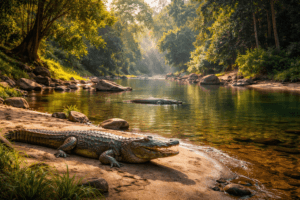
Beneath the dappled sunlight filtering through the dense canopy of Similipal, a ripple disturbs the still surface of the West Deo River. It is not a fish jumping, nor a falling branch. It is the subtle, purposeful wake of a creature older than memory itself—the mugger crocodile. In the waterways of Odisha’s premier tiger reserve, a quiet but profound revolution is unfolding. After decades of silent decline, these ancient reptiles are gliding back into their ancestral homes, one patient, scaly body at a time.
The recently concluded census for January 2026 offers a numeric testament to this revival: 84 mugger crocodiles recorded, a careful climb from 81 the previous year. To the untrained eye, a gain of three individuals may seem modest. But in the painstaking world of wildlife conservation, where every life is a hard-won victory, this figure is a powerful heartbeat—a sign that Similipal’s rivers are healing, and their most prehistoric residents are coming home.
A Count of Scaly Proportions: More Than Just Numbers
The annual crocodile census in Similipal is an exercise in meticulous patience. Over three intense days, more than a hundred forest personnel transform into silent observers, forming thirty teams that fan out across eight major rivers and countless water bodies. They scan muddy banks for the tell-tale bask of a camouflaged log that might blink, and peer into deep pools for the ghostly shape of an armored predator suspended in the current.
The data paints a revealing map of reptilian real estate. The West Deo River emerges as the undisputed capital, supporting approximately 60 crocodiles. Its banks and deep pools offer the perfect trifecta: ample fish, secluded sandy stretches for nesting, and undisturbed basking sites. Others are scattered through the park’s North and South divisions, while five remain at the strategic Ramatirtha breeding centre, the cradle of this recovery.
This census is far more than a headcount. It is a vital health check for the entire aquatic ecosystem. Mugger crocodiles (Crocodylus palustris), often called the “keepers of the river,” are apex predators and ecosystem engineers. Their presence indicates clean water, a thriving fish population, and intact riverbanks. Their nests create microhabitats, and their movements help cycle nutrients. Therefore, counting them is akin to taking the pulse of the river itself. The slight upward tick in population is a diagnostic reading: the patient is stabilizing.
The Long Road Back: From Brink to Breeding
The story behind the number ‘84’ is written in years of determined effort. The decline of mugger crocodiles in Similipal was a silent crisis, driven by the familiar culprits of habitat degradation, sand mining, water pollution, and incidental snaring. By the early 2000s, their future in the park hung in the balance.
The turning point came with the establishment of the Ramatirtha Mugger Crocodile Breeding Centre. This facility became the ark for the species within the park. Here, eggs collected from vulnerable wild nests or from breeding pairs are incubated in safety. Hatchlings are raised in protected ponds, shielded from predators and poachers, until they reach a sturdy size of about 1.2 meters—a stature that gives them a fighting chance in the wild. This practice of “head-starting” is central to the repopulation strategy. Every year, these young, satellite-tagged crocodiles are carefully released into the Deo, Khairi, and Budhabalanga rivers, seeding the waterways with a new generation.
But conservation is not just about releasing animals. It is about securing their world. Forest officials have intensified patrols to curb illegal fishing and mining. Communities on the park’s fringes are engaged in dialogue to mitigate conflict, fostering a sense of shared stewardship. The rivers themselves have been given a broader shield: in 2025, a significant portion of Similipal was officially notified as a National Park, Odisha’s largest and India’s 107th. This elevated legal status imposes stricter protections for the entire landscape, benefiting every creature within it, from the tiger to the crocodile to the fish upon which both depend.
The Deeper Significance: Why This Comeback Matters
The resurgence of Similipal’s muggers transcends species-specific success. It offers a blueprint for holistic conservation in India.
First, it underscores the power of long-term commitment. Conservation rarely produces overnight miracles. It is a grind of daily patrols, careful monitoring, and community education. The increase from 81 to 84 is the result of cumulative actions taken over a decade, not a single policy shift. It rewards patience and persistence.
Second, it highlights the interconnectedness of ecosystems. Efforts to protect the tiger—Similipal’s flagship species—by safeguarding forests and curbing human intrusion have indirectly created safer waterways for crocodiles. Conversely, healthy crocodile populations mean balanced aquatic ecosystems, which support the diverse prey base that sustains the park’s entire food web. Protecting one apex predator, it turns out, aids another.
Third, the mugger’s return is a cultural reconnection. In Indian mythology and folklore, crocodiles are often venerated as vahanas (vehicles) of river deities and guardians of watery realms. Their absence from these rivers was not just an ecological loss but a cultural amnesia. Their return helps restore that ancient, symbolic link between the land, its people, and the primal creatures that inhabit it.
Challenges on the Horizon: Navigating a Shared Future
The path ahead is not without its obstacles. As crocodile numbers slowly rise, the potential for human-crocodile interaction may increase, especially in peripheral areas. Proactive measures, like awareness programs and the creation of designated, safe water access points for local communities, will be crucial. Furthermore, the ever-present threats of climate change— altering rainfall patterns, drying rivers, and increasing temperatures—could impact nesting sites and prey availability.
The continued success of this program will depend on adaptive management. This means using census data not just for celebration, but for strategy—identifying new release sites, strengthening protection for key basking and nesting zones, and deepening community collaboration.
A Living Promise for the Future
As the sun sets over Similipal, casting long shadows across the West Deo, a four-meter-long mugger slides off the bank and disappears into the darkening water. Its silent passage is a message written in water. It tells of a time when these rivers were barren of such majesty, and of the unwavering human effort that helped mend that rupture.
The count of 84 is more than a statistic; it is a covenant. Each individual crocodile represents a second chance, a life enabled by care and released back into the wild. Their slow, steady return is a powerful reminder that even species on the edge can be pulled back with science, dedication, and respect. In the fluid depths of Odisha’s rivers, the mugger crocodile is no longer just a survivor from a distant past. It has become a resilient symbol of a possible future—where ancient life and modern conservation find a way to flow, together.
You must be logged in to post a comment.