
The Silent Minaret: Life Under Lock and Key at Al-Aqsa on the Eighth Day
The Silent Minaret: Life Under Lock and Key at Al-Aqsa on the Eighth Day
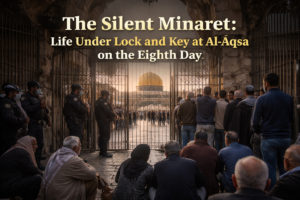
The dawn over the Old City of Jerusalem is usually a symphony of layered sounds: the first call to prayer (the Fajr adhan) resonating from the minarets, the clatter of metal shutters rising on shop fronts in the Muslim Quarter, and the low hum of anticipation for another day in the city’s pulsating heart. But for the eighth straight morning, the gates surrounding the Al-Aqsa Mosque compound have remained stubbornly, defiantly shut. The symphony has been replaced by an uneasy silence, broken only by the shuffling of Israeli police boots and the distant, frustrated murmurs of men and women gathered at checkpoints, peering through the bars at a sanctuary they cannot enter.
What began last Saturday as a “security closure” has stretched into one of the most prolonged and complete shutdowns of the holy site since Israel’s occupation of East Jerusalem in 1967. While official statements from Israeli authorities cite “security assessments” following a dramatic escalation with Iran, for the millions of Muslims who hold this land as their third holiest site, and for the people of Jerusalem who live in its shadow, the closure is a visceral, spiritual, and communal rupture that cuts to the core of their identity.
This is not merely a logistical inconvenience; it is an eight-day etching of a new, painful reality into the collective memory of a people.
The Rarity of a Friday Lockdown: A Strategy of Exception
To understand the gravity of the current situation, one must appreciate the historical rarity of a complete closure, particularly on a Friday. As the original WAFA report noted, since 1967, full closures on the holiest day of the Muslim week have been imposed only a handful of times. Friday at Al-Aqsa is not just another day of prayer; it is a weekly pilgrimage, a mass gathering of faith and community that can draw tens of thousands of worshippers from across the occupied West Bank, East Jerusalem, and the Arab communities inside Israel.
To close the gates on a Friday is to make a political and religious statement of immense weight. It transforms the compound from a place of worship into a symbol of occupation’s reach. For the third consecutive Friday, the sprawling courtyards, usually teeming with life, remain eerily empty. The olive trees, ancient and gnarled, have no one to offer shade to. The Dome of the Rock’s golden cupola, usually reflected in the eyes of countless worshippers, now stares down at vacant stone.
Abu Talal, a 68-year-old resident of the Old City whose family has lived in the shadow of the mosque for centuries, stands by the Lion’s Gate, one of the main entrances now sealed by metal turnstiles and a heavy police presence. “My father told me stories of the days before 1967, when you could come and go as you please. But even he would be shocked by this,” he says, his voice a mixture of anger and profound sadness. “They close the doors, but they cannot close the mosque from our hearts. We stand here because standing here is our prayer now. To be absent is to forget, and we will not forget.”
More Than a Building: The Soul of a People
For the global Muslim community, Al-Aqsa is the first qibla (the original direction of prayer) and the site from which the Prophet Muhammad is believed to have ascended to heaven on the Night Journey. But for the Palestinians of Jerusalem, it is also the last remaining symbol of sovereignty. It is a university of theology, a playground for children, a place of quiet contemplation, and a bustling community center all rolled into one.
To close it for eight days is to sever a vital organ from the body of the city. The Isha (night) and Taraweeh (special Ramadan prayers) mentioned in the original report are not just rituals; they are social fabrics woven in the cool night air. Families break their fast together, then walk to the mosque as a unit. Neighbors greet neighbors. The young help the elderly. This nightly procession, a tradition for centuries, has been violently interrupted.
“I feel like a part of my soul is missing,” says Umm Mohammed, a mother of four from the nearby neighborhood of Silwan. Her family, like many, has a generational key to the gates, a symbolic gesture of their connection to the site. “My children keep asking me, ‘Mama, when can we go pray?’ I have no answer. The shabab (youth) are frustrated. When you close the door to God, where are people supposed to go with their anger and their sadness?” Her question hangs in the air, a poignant acknowledgment of the volatile mix of religious fervor and political frustration that such closures inevitably fuel.
The Occupation at the Gate: A Daily Reality
The scene at the gates is a study in controlled tension. Young Israeli border police officers, many looking scarcely older than the Palestinian youths they are confronting, stand in rigid formation. Their presence is a daily reminder of the military order that now governs access to one of the world’s most sensitive religious sites. Worshippers, young and old, are turned away with a curt “It’s closed. Go home.” For some, the response is silent, seething submission. For others, it’s a brief argument that dissolves into the resigned acceptance of the powerless.
One young man, a university student named Amir, holds up his phone, displaying a photo of his grandfather at the mosque in the 1940s. “Look at this,” he implores, not to the police, but to any passerby who will listen. “This is our history. You cannot close history with a gate. You cannot lock away a people’s identity. This is collective punishment, plain and simple. It is a war on our right to exist here.”
The closure of Al-Aqsa is not happening in a vacuum. It is a critical piece of a larger puzzle of escalation. The WAFA report correctly links the closure to the “large-scale attack launched by Israel and the United States against Iran.” In the geopolitical chess game of the Middle East, the pawns are often the daily lives and religious freedoms of ordinary people. The justification of “security” becomes a catch-all term that, to the local population, feels like a pretext for a slow, steady erasure of their presence.
Dr. Rami Khouri, a retired professor of Islamic History at Al-Quds University, explains the deeper context. “For the Israeli authorities, control of Al-Aqsa is the ultimate control of the Palestinian narrative. By shutting it down, they are demonstrating, in the most public way possible, who holds the power in this city. It is a message not just to worshippers, but to the entire Islamic world: our security concerns trump your religious rights. The connection to the Iran strike is a convenient umbrella. It allows them to implement a hardline policy under the guise of a temporary, extraordinary security measure.”
The Eighth Day: A Dangerous Precedent
As the sun sets on the eighth day, painting the Jerusalem stone in hues of gold and amber, a new question emerges: What happens when the gates finally open? Will the spiritual scar heal, or will this event serve as a precedent for future closures? The international community, often vocal in moments of crisis, has been largely muted. The usual statements from UNESCO and various world powers expressing “concern” seem hollow against the tangible reality of locked doors.
Inside the Old City, shopkeepers whose livelihoods depend on the flow of worshippers and tourists look on with despair. The spice-scented alleyways of the suq are quieter. The pastry shops that usually bustle after Taraweeh prayers have few customers. The economic ripple effect of the closure is another layer of punishment, a slow strangulation of a community already living under immense economic pressure.
For the Muslim Worshippers standing vigil, like Abu Talal and Umm Mohammed, the waiting game continues. They speak not of politics, but of faith. “They can close the gates,” Umm Mohammed says, finally turning to walk home, her children trailing behind her. “But the call to prayer still comes from the minarets. We still fast. We still face the same direction in our homes. The mosque is not just the stones. The mosque is us. And as long as we are here, waiting, it is open.”
Her words linger as the Maghrib call to prayer begins, its haunting melody drifting over the locked gates and the empty courtyards, a reminder that while access may be denied, faith, resilience, and the deep, unbreakable connection to a holy place cannot be shut out. The eighth day ends, but the vigil for the ninth has already begun.
You must be logged in to post a comment.