
The Silent Emergency: How Extreme Heat is Redrawing the Map of Urban Survival in India
Extreme heat has transitioned from a periodic weather event to a permanent, structural crisis in Indian cities, where it merges dangerously with pre-existing social and urban vulnerabilities. Unlike wealthier global cities, India’s urban centers face a “multiplier effect” due to high humidity, dense informal settlements, and an overburdened infrastructure, turning high temperatures into a lethal threat for millions. The urban heat island effect, exacerbated by concrete-heavy planning, traps heat day and night, while the vast informal workforce—construction laborers, street vendors, and delivery personnel—bears the brunt with no legal protection from life-threatening exposure. Despite pioneering Heat Action Plans, responses remain reactive, failing to address the root causes of urban design and deepening a “thermal apartheid” where cooling is a luxury for the affluent and a struggle for the poor. Ultimately, the crisis demands a justice-oriented reimagining of cities through enforceable labor safeguards, mandated green spaces, water-body restoration, and community-led upgrades to housing, positioning urban resilience as a matter of basic rights and survival.
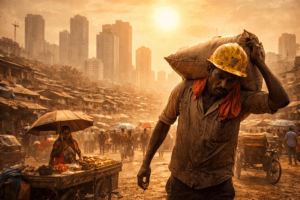
The Silent Emergency: How Extreme Heat is Redrawing the Map of Urban Survival in India
A new, searing normal is etching itself into the fabric of our cities. As thermometers shatter records from Madrid to Manila, the crisis of extreme heat has evolved from a seasonal peril into a permanent, structural feature of urban life. For India’s rapidly urbanizing landscape, this global phenomenon isn’t a distant warning—it’s a present-day, multiplying emergency. The story here is not merely about degrees on a gauge; it’s a stark narrative of how inequality, urban planning, and the very nature of work are being stress-tested under an unrelenting sun.
Beyond the Thermometer: Heat as a Slow Violence
Globally, the discourse has shifted from reacting to heatwaves to adapting to a persistently hotter reality. Cities like Phoenix are painting streets white to reflect sunlight, while Southern European nations are mandating altered work hours. However, in Indian metropolises, heat intersects with a potent mix of dense informal economies, acute spatial inequality, and infrastructural strain. This creates a “multiplier effect,” where a 45°C day in Delhi is a fundamentally different, more dangerous event than the same temperature in a wealthier, less dense global city.
The true metric of danger is shifting from dry heat to wet-bulb temperature—a measure combining heat and humidity that indicates when the human body can no longer cool itself through sweat. For coastal cities like Chennai, Mumbai, or Kolkata, high humidity levels mean the threshold for survival is reached at a lower temperature. When this scientific reality collides with overcrowded homes lacking cross-ventilation, intermittent water access, and power cuts that silence fans, heat becomes a form of slow, pervasive violence. Its casualties are not always counted in immediate fatalities but in diminished livelihoods, chronic health burdens, and stolen years.
The Concrete Trap: Why Indian Cities are Self-Combusting
The Urban Heat Island (UHI) effect is a global phenomenon, but in India, it is supercharged by a development model that trades green cover for grey concrete. The relentless replacement of trees with glass-fronted high-rises, permeable soil with asphalt, and water bodies with real estate projects means our cities are engineered to absorb heat by day and radiate it back by night.
This nocturnal heating is particularly insidious. It robs the urban poor of the critical recovery period cooler nights once provided. For the rickshaw puller sleeping on a rooftop, the factory worker in a tin-roofed tenement, or the family in an informal settlement, there is no respite. The city becomes a 24-hour furnace. This isn’t an accidental outcome; it’s the direct result of planning priorities that value vehicular mobility and land monetization over ecological sensitivity and human thermal comfort.
The Body on the Frontline: Heat and the Crisis of Labor
Perhaps the most glaring injustice of the heat crisis is its unequal occupational burden. While the professional class shifts to air-conditioned homes, cars, and offices, the engine of the city—its informal workforce—remains exposed. Construction laborers, street vendors, delivery personnel, and sanitation workers form the backbone of urban functionality, yet they lack the most basic protections against heat.
Unlike in some Western nations where “heat codes” can mandate work stoppages, India’s vast informal sector operates on daily wages. For a mason or a waste-picker, stopping work means starving. Thus, heat transforms from a weather condition into a coercive force, compelling physical labor in life-threatening conditions. The economic loss is staggering, not just in national productivity metrics, but in the micro-economies of households pushed deeper into precarity by heat-induced illness and lost wages. This makes heat not just an environmental or health issue, but a fundamental economic crisis for the majority.
The Limits of Lip Service: Moving Beyond Reactive Heat Action Plans
India deserves credit for pioneering city-level Heat Action Plans (HAPs), which have undoubtedly saved lives through early warning systems and public advisories. Ahmedabad’s model is studied worldwide. However, after a decade of implementation, their critical limitations are exposed.
Most HAPs remain fundamentally reactive—focused on responding once a heatwave is declared. They are heavy on advisories (“stay indoors, drink water”) but light on enforceable mandates and structural transformation. They rarely address the root causes: the lack of green spaces, the design of affordable housing, the regulation of outdoor work, or the redesign of public transit hubs into shaded, cool spaces.
The global frontier of heat adaptation is now about passive cooling: reviving traditional architecture, creating urban forests and water-sensitive design, mandating reflective materials, and weaving a network of publicly accessible, naturally cool spaces. India’s challenge is to indigenize these solutions—to move from issuing bulletins to fundamentally retrofitting its urban morphology.
Thermal Apartheid: The Deepening Chasm of Cooling Access
Extreme heat acts as a brutal revealer of social fissures. It creates what can be termed a “thermal apartheid.” On one side of the divide are the climate-controlled enclaves of the affluent, sustained by uninterrupted power, air conditioning, and private water tankers. On the other are neighborhoods where the very architecture is a heat trap, electricity is a luxury, and water is a daily struggle.
This divide mirrors global inequalities but with a sharper, more visceral edge. Access to cooling is no longer about comfort; it is becoming a prerequisite for basic health and economic stability. In this light, the humble ceiling fan or a reliable water connection becomes as critical a piece of infrastructure as a road or a bridge. Framing cooling as a universal civic right, not a private commodity, is the essential justice-oriented approach the crisis demands.
Blueprint for a Cooler Future: Resilience from the Ground Up
The path forward requires a paradigm shift in urban imagination. It must begin with urgent, tangible actions:
- Legislate Labor Protection: Enforceable “Right to Shade” laws mandating adjusted work hours, compulsory breaks, access to shaded areas and potable water for all outdoor workers, formal and informal.
- Mandate Green Urbanism: Implement strict bylaws for green cover retention, promote cool roofs and permeable pavements, and prioritize the protection and restoration of urban water bodies, which are natural coolants.
- Design for the Pedestrian, Not the Car: Reclaim street space for shaded, tree-lined footpaths and cycle tracks. Bus stops and market areas must be redesigned with cooling and shelter as core principles.
- Decentralize Water Management: Promote rainwater harvesting and revive local water systems to combat the dual crises of water scarcity and urban heating.
- Listen to Informal Settlements: Upgrade informal housing with heat-reflective materials, ventilation, and green walls. Community-led solutions often hold the most pragmatic, scalable answers.
The global heat crisis knows no borders, but the failures of policy and imagination are intensely local. India’s cities stand at a crossroads. They can continue on a path that allows heat to deepen existing wounds, or they can become global laboratories for equitable climate resilience. The question is not whether India can survive a hotter world—its people demonstrate grim resilience every summer. The question is whether we will choose to build cities where survival is dignified, shared, and sustainable for all. The answer will define not just India’s urban future, but offer a crucial lesson for an overheating world.
You must be logged in to post a comment.