
The Silent Demolitions: How Israel’s Post-Ceasefire Actions are Redefining Gaza’s Future
The Silent Demolitions: How Israel’s Post-Ceasefire Actions are Redefining Gaza’s Future
The Breach Behind the “Yellow Line”
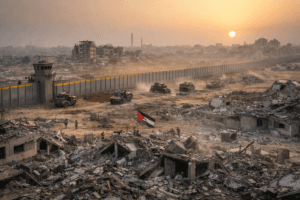
In the tense calm of a ceasefire that began on October 10, 2025, a different kind of operation has been unfolding in Gaza. Satellite imagery analyzed in December 2025 reveals a pattern of systematic building demolitions conducted by the Israeli military in areas it continues to occupy—actions that legal experts warn likely violate international law and the spirit of the truce itself. While the world’s attention may have shifted, the structural transformation of the Gaza Strip continues unabated, raising critical questions about the territory’s future and the very meaning of a ceasefire in modern warfare.
This ongoing destruction, concentrated in neighborhoods like Shujayea and Tuffah in Gaza City, represents more than mere military strategy. It occurs against the backdrop of what Israeli army chief Eyal Zamir has called the “new borderline”—the so-called “yellow line” that now divides Gaza. This line is not just a military boundary but potentially a political one, suggesting a permanent reconfiguration of the territory that could have lasting implications for Palestinian self-determination and regional stability.
The Legal Battlefield: Demolitions Under International Scrutiny
The Fourth Geneva Convention establishes clear protections for civilian property during occupation, permitting destruction only when “absolutely necessary by military operations“. According to Professor Adil Haque, an expert in law and armed conflict at Rutgers Law School, this exception is “extremely narrow,” requiring that the necessity arise specifically from combat or direct preparations for combat. With a general ceasefire in effect since October 2025 and only sporadic exchanges of fire reported, legal experts argue that the widespread destruction of civilian buildings cannot plausibly meet this stringent standard.
The United Nations has been unequivocal in its assessment. A UN Independent International Commission of Inquiry concluded in September 2025 that Israel has committed genocide against Palestinians in Gaza, citing the systematic destruction of healthcare, education, and civilian infrastructure as evidence of genocidal acts. This finding was reinforced by UN human rights experts in December 2024, who stated that Israel’s actions represent “an assault on the foundations of international law” that “must have consequences”.
Table: Key International Legal Findings on Israel’s Actions in Gaza
| Body/Report | Key Finding | Date | Relevant Violations Cited |
| UN Independent International Commission of Inquiry | Israel has committed genocide against Palestinians in Gaza | September 2025 | Killing, causing serious harm, inflicting conditions calculated to destroy the group, imposing measures to prevent births |
| UN Special Rapporteurs | Israel’s assault on international law must have consequences | December 2024 | Indiscriminate attacks, siege conditions, apparent intent to permanently displace population |
| Human Rights Watch | Israel engaged in collective punishment of Gaza’s population | October 2023 | Cutting off food, water, electricity, and fuel; willfully blocking humanitarian relief |
The legal framework governing occupation is well-established under international humanitarian law. As Human Rights Watch explains, an occupying power like Israel has specific obligations to ensure the humane treatment of the population and provide for their basic needs. The deliberate destruction of civilian infrastructure, particularly outside of active combat, contravenes these fundamental responsibilities.
A Landscape of Loss: The Humanitarian Catastrophe Deepens
The physical destruction documented in satellite imagery tells only part of the story. Behind each demolished building lies a deeper humanitarian catastrophe that has reshaped life in Gaza:
Shelter and Survival: According to UNRWA, 282,000 housing units have been destroyed throughout the war, leaving approximately 1.5 million Palestinians displaced. The recent demolitions compound a shelter crisis of staggering proportions, with displaced people now living in conditions that average just 0.5 square meters per person—far below the humanitarian standard of 3.5 square meters.
Health System Collapse: The destruction has extended to Gaza’s healthcare infrastructure, with 63% of hospitals remaining out of commission as of December 9, 2025. The World Health Organization reports that ongoing attacks and resource shortages have damaged or destroyed 94% of hospitals, overwhelming the few partially functional facilities that remain. Al-Shifa and Al-Ahli hospitals in Gaza City are operating at nearly 300% over capacity, struggling with a constant influx of trauma injuries amid shortages of medicines, fuel, and basic supplies.
Education Erased: The war has devastated Gaza’s educational future, with 93% of schools destroyed or damaged. More recent data indicates that 97% of school buildings have sustained some level of damage, with the majority requiring either full reconstruction or major rehabilitation. This has left 660,000 children in Gaza deprived of formal education for the third consecutive year.
Food Security Crisis: Perhaps most alarming is the nutritional emergency. Famine has been confirmed in Gaza governorate, with 100% of the population in Gaza, Deir Balah, and Khan Younis facing crisis or worse levels of food insecurity. UNRWA’s findings show that malnutrition has reached 28.5% in Gaza City, meaning nearly one in three young children is now malnourished. The Ministry of Health in Gaza has documented 404 malnutrition-related deaths, including 141 children, since October 2023.
The Strategic Pattern: From Demolition to Displacement
Analysts observing the destruction patterns identify concerning strategic objectives behind what might appear as random demolitions. The acceleration of building destruction in Rafah Governorate is particularly telling—increasing from approximately 15,800 demolished buildings in April 2025 to about 28,600 by July 2025. This rapid destruction coincided with Israel’s announced plan to relocate Gaza’s population to what Defense Minister Israel Katz called a “humanitarian city” in the south.
Philippe Lazzarini, head of UNRWA, warned that this plan would “de facto create massive concentration camps at the border with Egypt for the Palestinians”. The strategic preservation of certain educational and medical facilities in Rafah, while surrounding residential areas were leveled, suggests these spared buildings are intended for use in housing a displaced population.
This aligns with what British Israeli analyst Daniel Levy described as “a premeditated part of a plan of social-demographic engineering to move Palestinians—to relocate, displace and kettle them”. The strategic objective appears to extend beyond immediate military needs toward longer-term territorial and demographic reconfiguration.
International Complicity and the Failure of Accountability
A particularly damning dimension of this crisis is the international community’s role. UN Special Rapporteur Francesca Albanese, in her October 2025 report “Gaza Genocide: a collective crime,” argues that “without the direct participation, aid and assistance of other States, the prolonged unlawful Israeli occupation… could not have been sustained”. The report identifies four sectors of support that have enabled Israeli actions: diplomatic, military, economic, and what it terms “humanitarian”.
The legal obligations of third-party states are clear under international law. States have responsibilities to prevent genocide, ensure respect for international humanitarian law, and refrain from aiding or assisting in internationally wrongful acts. When these obligations are not met, states risk complicity. As Albanese’s report states, “The world now stands on a knife-edge between the collapse of the international rule of law and hope for renewal”.
The military support provided to Israel, particularly by Western states, has drawn specific criticism. The report notes that “large-scale military aid, cooperation and arms transfers, primarily to and from the United States and European States, have enabled Israeli domination over the Palestinian people”. This complicity extends beyond mere inaction to active facilitation of violations.
The Human Cost: Beyond the Statistics
Behind the satellite imagery and legal analyses are human stories of unimaginable loss. The Gaza Health Ministry reports that 391 Palestinians have been killed in Israeli attacks since the ceasefire went into effect. This brings the total Palestinian death toll to at least 70,663 since October 7, 2023. Each number represents a life extinguished, a family shattered, a community diminished.
The psychological trauma inflicted on Gaza’s population—particularly its children—will endure for generations. With most children having witnessed violence, lost family members, and experienced displacement, the mental health crisis unfolding alongside the physical destruction may prove to be one of the conflict’s most enduring legacies.
Conclusion: A Ceasefire in Name Only?
The ongoing demolitions in Gaza reveal a troubling reality about contemporary conflict: military operations can continue under the guise of a ceasefire, and territorial transformation can proceed through means other than direct combat. The “yellow line” that now divides Gaza may represent more than a temporary military boundary; it could signify a permanent fragmentation of Palestinian territory and the institutionalization of a new, precarious reality for Gaza’s population.
The international community faces a critical test of its commitment to international law and human rights. As UN experts have warned, “Israel’s continued impunity sends a dangerous message suggesting that parties to other conflicts around the world need not comply with their obligations under international humanitarian law”. The response—or lack thereof—to the silent demolitions in Gaza will establish precedents that extend far beyond this conflict, shaping global norms on occupation, sovereignty, and human dignity in the 21st century.
What remains clear is that buildings can be rebuilt, but the erosion of international legal norms and the normalization of population displacement as a tool of policy may prove far more difficult to restore. The silent demolitions behind the yellow line are not just changing Gaza’s landscape—they are testing the very foundations of the international order.
You must be logged in to post a comment.