
The Silent Deaths: How Israel’s Detention System Creates a Void of Information and Accountability
The delayed confirmation of 67-year-old Hamza Abdullah Adwan’s death in Israeli custody—four months after he died on September 9, 2025—exemplifies a systematic policy of information denial and enforced disappearance that has escalated since October 2023. Adwan, a Gazan with heart disease detained despite needing medical care, is one of over 100 Palestinian prisoners reported to have died in Israeli detention during this period, with rights organizations attributing the deaths to widespread torture, starvation, and medical neglect.
This surge in fatalities, centered in facilities like the Sde Teiman military prison, coincides with blocked access for international monitors like the Red Cross and policy shifts under political leaders advocating harsher detention conditions. The crisis reflects what rights groups describe as a systemic failure of accountability, transforming detention sites into spaces where abuses occur with impunity, leaving thousands of families in agonizing uncertainty about missing loved ones.
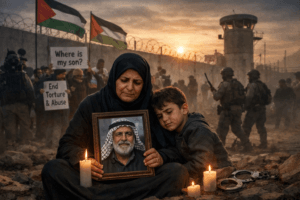
The Silent Deaths: How Israel’s Detention System Creates a Void of Information and Accountability
The delayed confirmation of 67-year-old Hamza Abdullah Adwan’s death in Israeli custody reveals more than just another statistic—it exposes a systematic policy of ambiguity that denies families closure and shields authorities from accountability. On January 11, 2026, Palestinian rights institutions announced that Adwan, a father of nine from Gaza with serious heart conditions, had died four months earlier on September 9, 2025. His family, who had received conflicting information about his fate for months, finally learned the tragic truth, joining thousands of Palestinian families trapped in what rights groups describe as an “information void” regarding loved ones detained by Israel.
A Personal Tragedy Within a Systemic Crisis
Hamza Adwan’s story is both unique and tragically familiar. Detained at a military checkpoint on November 12, 2024, the 67-year-old suffered from serious heart disease and required continuous medical care. According to his family, he was taken despite these known health conditions. He left behind nine children, two of whom had been killed before the war.
The four-month delay in notifying his family of his death exemplifies what Palestinian rights organizations term **”enforced disappearance”**—a systematic policy of withholding information that they describe as integral to Israel’s ongoing war. For families, this creates unbearable psychological limbo. As the wife of another missing man told Al Jazeera: “We do not know if he is detained or a martyr. We filled out many forms … but hope still exists”.
Another father described the cruel uncertainty after being told his son died in custody on December 13, only to later receive accounts from released prisoners who had seen his son alive after that date. This chaotic reality, where official information is scarce or contradictory, leaves families suspended between hope and grief.
Escalating Death Toll and Systemic Abuses
Adwan’s death adds to alarming statistics that multiple sources confirm represent a dramatic escalation:
| Data Source | Reported Deaths Since October 2023 | Time Period Covered | Key Findings |
| Palestinian Prisoner’s Society | 87 identified (100+ estimated) | Oct 2023 – Jan 2026 | 51 from Gaza; systematic torture, medical neglect |
| UN Human Rights Office | 75 confirmed (94 with unverified cases) | Oct 2023 – Aug 2025 | 22 had pre-existing medical conditions; evidence of beatings/torture in 12 cases |
| Physicians for Human Rights Israel | 94-98 documented | Oct 2023 – Aug 2025 | “Systematic killings and cover-ups”; 29 deaths at Sde Teiman facility alone |
These figures gain stark perspective when contrasted with the decade before October 2023, when fewer than 30 Palestinians died in Israeli custody. The current death toll thus represents a three to fourfold increase in mortality rates.
Rights organizations point to consistent patterns behind these deaths: widespread torture, starvation, medical neglect, sexual abuse, and detention under inhumane conditions. The UN has documented “repeated beatings, waterboarding, stress positions, the use of rape and other sexual and gender-based violence” alongside deliberate inhumane conditions like starvation and denial of hygiene necessities.
The Sde Teiman Facility: A Microcosm of the Crisis
The Sde Teiman military prison in southern Israel has emerged as a particular focus of concern. According to Physicians for Human Rights Israel, 29 detained Palestinians from Gaza died at this facility alone between October 2023 and August 2025. The site gained additional notoriety in July 2024 when five Israeli reservists were charged with aggravated abuse after a Palestinian prisoner was allegedly beaten and stabbed with a sharp object.
Footage emerged showing reserve soldiers surrounding a detainee with riot shields before the alleged attack. The case divided Israeli society, with some right-wing politicians criticizing the investigation and even “right to rape” protests occurring outside the jail.
International Monitoring Blocked
A critical factor enabling this crisis is the systematic blocking of international monitors. The International Committee of the Red Cross (ICRC) confirmed to Al Jazeera that it has been completely barred from visiting Palestinian detainees since October 2023. “We are constantly receiving inquiries from families concerned about the health and safety of their loved ones,” said ICRC spokesperson Amani Al Naouq.
This isolation extends beyond the ICRC. The UN Human Rights Office noted that Israeli authorities have “subverted internationally recognised protections against torture, especially access to lawyers, family, and the ICRC,” while imposing restrictions on lawyers’ access to detainees. Family visits have been banned entirely.
Policy Context and Political Leadership
The surge in deaths coincides with significant policy shifts under Israel’s far-right National Security Minister Itamar Ben-Gvir. Physicians for Human Rights Israel alleges that under Ben-Gvir’s control, incarceration facilities holding Palestinians have been “effectively been transformed into sites of torture and abuse”.
Ben-Gvir has publicly advocated for imposing minimum legal conditions on Palestinian prisoners, arguing that “the conditions in prison add deterrence”. He lashed out at the Israeli Supreme Court in September 2025 after it ruled that the state must improve nutrition for Palestinian prisoners, with authorities reportedly refusing to comply with the order.
Concurrently, there are legislative efforts to pass laws approving the execution of Palestinian prisoners—a move rights groups warn aims to “legalize” extrajudicial killings and transform them from actions outside the law into “legitimate and codified policy”.
Medical Community Targeted
The crisis has particularly impacted healthcare workers. Medical staff in Gaza recently held protests demanding the release of 30 doctors and paramedics detained from Kamal Adwan Hospital alone. Among those detained was Dr. Hussam Abu Safia, the hospital director seized while treating patients.
Tragically, some detained medical professionals have died in custody, including Dr. Iyad al-Rantisi, director of the maternity department at Kamal Adwan Hospital, who died under interrogation. Another prominent case is Dr. Adnan al-Bursh, 53, head of orthopedics at Al-Shifa Hospital in Gaza, who died after showing signs of physical abuse according to fellow detainees.
The Numbers Behind the Crisis
The scale of detention itself has expanded dramatically. Current estimates indicate approximately 9,300 Palestinian political prisoners in Israeli prisons, with the majority held without trial or charge. This includes:
- 3,385 administrative detainees held indefinitely on secret evidence
- 1,237 detainees classified as “unlawful combatants” from Gaza, denied prisoner-of-war status or legal rights
- Approximately 600 children and 200 women among those detained since October 2023
Palestinian organizations have documented about 7,000 arrests in 2025 alone, with total arrests since October 8, 2023 reaching approximately 21,000.
Historical Context and Shifting Norms
The current crisis represents what the Palestinian Prisoner’s Society calls “the most dangerous and bloodiest transformation in the history of the prisoner movement”. Since 1967, at least 324 Palestinian prisoners have died in Israeli custody according to documented cases, meaning the deaths since October 2023 represent nearly one-third of the total historical death toll.
The UN has characterized these practices as potentially amounting to war crimes and crimes against humanity. They note that “torture and other ill-treatment forms are a serious violation of international humanitarian law” and that Israel has obligations to protect detainees from such practices.
The Path Forward: Accountability and Transparency
Multiple human rights organizations emphasize that accountability remains elusive. The UN reports that despite calls for independent investigations, Israeli authorities have announced investigations into very few deaths “with no outcome known to date”. Physicians for Human Rights Israel similarly notes a “failure to prosecute Israeli prison staff and soldiers”.
The crisis continues amidst a broader geopolitical context including ceasefire agreements and discussions about Gaza’s governance. However, for families like Hamza Adwan’s, and thousands of others awaiting news of missing loved ones, the immediate need is for basic information, transparency, and adherence to international law.
As one rights advocate stated: “These findings—and the ongoing failure of Israeli law enforcement to prosecute those responsible—turn Israeli law itself into a fig leaf and a tool for concealment”. Until Israel permits independent monitoring, ensures proper medical care, and ends systematic abuses, the silent deaths in its detention facilities will continue, leaving families trapped between hope and despair in an agonizing information void.
You must be logged in to post a comment.