
The Silence of the ‘Vishwaguru’: Why India’s Stance on West Bank Annexation Exposes a Deeper Diplomatic Dilemma
In a sharp critique of Prime Minister Narendra Modi’s foreign policy, Congress leader Jairam Ramesh accused him of lacking the courage to oppose Israel’s accelerating West Bank annexation, arguing that the ongoing West Asia war is providing cover for Israel to advance its “Greater Israel” vision while extinguishing any hope for a Palestinian state. Ramesh highlighted that Israel approved land registration across half the occupied West Bank—a move amounting to mass dispossession—just before Modi’s recent visit, and that the Prime Minister’s silence since then has effectively abandoned India’s historic commitment to Palestine. The broader analysis suggests that Modi’s embrace of Israel, while rhetorically still paying lip service to Palestinian statehood, represents a fundamental realignment that compromises India’s moral standing in the Global South, undermines its “Vishwaguru” aspirations, and risks alienating both its large Muslim population and traditional Arab allies—all at a moment when Israeli territorial expansion is rapidly reshaping regional realities.
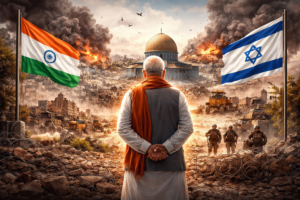
The Silence of the ‘Vishwaguru’: Why India’s Stance on West Bank Annexation Exposes a Deeper Diplomatic Dilemma
For decades, India’s foreign policy carried a distinct moral compass—one that pointed unwaveringly toward the Palestinian cause. From Mahatma Gandhi’s philosophical opposition to a Jewish state on religious grounds to Jawaharlal Nehru’s active support at the United Nations, New Delhi’s position was consistent, principled, and largely uncontested within its domestic political landscape. That consistency, however, has undergone a seismic shift in the past decade—and nowhere has this transformation become more glaring than in the current West Asia crisis.
On Saturday, Congress leader Jairam Ramesh launched a blistering attack on Prime Minister Narendra Modi, accusing him of lacking the courage to oppose Israel’s escalating actions in the West Bank. The accusation is not merely political rhetoric; it cuts to the heart of a fundamental realignment in Indian foreign policy that has profound implications for India’s standing in the Global South, its carefully cultivated image as a voice for the non-aligned world, and its relationship with the Islamic world.
The Accusation: Silence in the Face of Annexation
Ramesh’s statement, delivered with the precision of a seasoned political operative, zeroed in on a critical timing detail that has largely escaped mainstream attention. The U.S.-Israel bombardment of Iran began just two days after Prime Minister Modi left Israel—a visit that itself drew sharp criticism from opposition parties. But more significant, Ramesh noted, was what transpired in the days before Modi’s arrival: the Israeli Cabinet approved land registration in roughly half of the occupied West Bank for the first time since 1967.
To understand the gravity of this, one must recognize what land registration in occupied territory actually means. It is not a bureaucratic technicality. It represents the formalization of annexation—a systematic dispossession of Palestinian land that legal experts argue constitutes a war crime under international law. The move affects approximately half of the West Bank, potentially displacing lakhs of Palestinians from land they have inhabited for generations.
“This would lead to the dispossession of lakhs of Palestinians. But Mr. Modi does not have the courage to raise his voice and speak truth to his good friend Benjamin Netanyahu,” Ramesh said, framing the Prime Minister’s silence as a failure of both moral leadership and strategic statecraft.
The Greater Israel Vision: A Regional Reality
Ramesh’s reference to Israel’s “vision of Greater Israel” is deliberately provocative, but it reflects a growing consensus among West Asia analysts that the current conflict is being leveraged for long-term territorial ambitions. The concept of “Greater Israel” (Eretz Yisrael HaShlema) has historically been associated with the revisionist Zionist movement—an ideological current that envisions Israeli sovereignty extending from the Mediterranean Sea to the Jordan River, encompassing the West Bank, Gaza Strip, and parts of neighboring countries.
What Ramesh argues—and what regional developments increasingly suggest—is that the current war is providing operational cover for this expansionist vision. In the past four weeks alone, while global attention has been fixated on the Strait of Hormuz, energy infrastructure strikes, and the broader Iran-Israel confrontation, Israel has:
Continued its military operations in Gaza with no signs of abating, maintaining what humanitarian organizations describe as catastrophic conditions for civilians Initiated operations in southern Lebanon aimed at creating a large buffer zone—effectively annexing territory beyond its internationally recognized borders through military occupation Accelerated West Bank annexation through land registration and settlement expansion, converting what was previously considered “occupation” into de facto sovereignty
Each of these actions individually represents a significant escalation. Taken together, they suggest a coordinated strategy to reshape the territorial realities of the region before any diplomatic settlement can be negotiated.
India’s Diplomatic Contradiction
The Congress party’s criticism of Modi’s Israel policy is not new, but it has gained renewed urgency as the West Asia crisis deepens. The opposition has repeatedly accused the Modi government of making “cynical and hypocritical statements” about its commitment to the Palestinian cause while actively abandoning it in practice.
This accusation is difficult to dismiss. Under the Modi administration, India’s voting pattern at the United Nations has shifted dramatically. Where India once consistently supported resolutions critical of Israeli occupation and settlements, it now frequently abstains or votes in favor of Israel. The transformation has been stark enough that Palestinian officials have privately expressed disappointment, noting that they can no longer count on New Delhi’s automatic support.
Yet the Modi government continues to invoke its historical commitment to Palestine when politically convenient. This dual-track approach—maintaining rhetorical support for Palestinians while deepening military and strategic ties with Israel—creates what Ramesh called a “cynical” posture that risks undermining India’s credibility both domestically and internationally.
The Timing Question: Why Modi’s Silence Matters
Ramesh’s critique of Modi’s timing is particularly pointed. The Prime Minister’s visit to Israel occurred just before the current escalation—a visit that, in the opposition’s view, effectively gave political cover to the Israeli government at a critical juncture. When world leaders were considering how to respond to the West Bank land registration, India’s Prime Minister was meeting with Israeli leadership, participating in bilateral agreements, and projecting an image of unqualified partnership.
The question of courage—”Modi does not have the courage to raise his voice”—is perhaps the most charged element of Ramesh’s statement. It suggests that the Prime Minister’s silence is not merely a policy choice but a failure of leadership. In this framing, the leader who positions India as the “Vishwaguru”—a global teacher or guide—has abdicated the moral responsibility that comes with such aspirations.
This critique resonates beyond India’s borders. For countries in the Global South that have long looked to India as a voice for the non-aligned movement and a champion of decolonization, New Delhi’s stance on West Asia appears increasingly indistinguishable from that of Western powers. The “self-styled Vishwaguru,” as the Congress party has derisively called Modi, finds itself silent on one of the defining moral issues of our time.
The Domestic Political Calculus
To understand India’s stance, one must consider the domestic political dimensions. The Modi government’s relationship with Israel has been part of a broader realignment that includes deepening ties with the United States, the Abraham Accords countries, and a strategic hedging against China’s growing influence in the region.
There is also a domestic electoral calculation. The Hindu nationalist constituency that forms the BJP’s core support base has historically been sympathetic to Israel, viewing it through a lens of civilizational kinship, security concerns about Islamist extremism, and a shared narrative of victimhood followed by assertive self-determination. For this constituency, Modi’s embrace of Israel represents a break from what they perceive as Congress-era appeasement of Muslim voters.
However, this calculation ignores India’s significant Muslim population—approximately 200 million people—and its long-standing relationships with Arab and Islamic nations. India has historically maintained close ties with Iran, Saudi Arabia, and the United Arab Emirates, balancing these relationships with its Israel engagement. The current crisis threatens to disrupt this delicate equilibrium.
The Palestinian Statehood Question
At the heart of Ramesh’s critique is the future of Palestinian statehood. The “Greater Israel” vision, if realized, would effectively extinguish any possibility of a viable, contiguous Palestinian state. The West Bank land registration alone represents a fait accompli that would make a two-state solution geographically impossible.
For India, which has historically supported a sovereign, independent Palestinian state alongside Israel, this presents an uncomfortable contradiction. How does a country continue to profess support for Palestinian statehood while remaining silent as the territorial foundations of that state are systematically dismantled?
The answer, according to the Congress party, is that it does not. The government’s actions, Ramesh suggests, have already answered the question: India has effectively abandoned the Palestinian cause, whatever its official statements may claim.
Beyond the Headlines: What Comes Next
As the West Asia war continues to unfold—with Iran, Israel, and their respective allies engaged in what increasingly appears to be a protracted confrontation—India faces difficult choices. The Houthi missile launches against Israel, the tensions in the Strait of Hormuz, and the potential for wider regional conflict all have direct implications for Indian national interests, including energy security and the safety of approximately nine million Indian expatriates in the Gulf region.
But the moral dimension cannot be easily separated from the strategic one. India’s position on West Asia has long been a cornerstone of its identity as an independent, principled actor in international affairs. To abandon that position—or to maintain it only rhetorically while acting in opposition to it—risks undermining the very foundations of Indian diplomacy.
For the Congress party, the issue represents both a genuine policy disagreement and an electoral opportunity. By framing Modi’s Israel policy as cowardly and hypocritical, they seek to appeal to traditional Congress constituencies—particularly Muslim voters—while also positioning themselves as defenders of India’s historical foreign policy legacy.
But for India as a whole, the stakes are higher than partisan politics. The choices made in the coming months will shape India’s relationships with the Islamic world, its standing in the Global South, and its credibility as a voice for international law and justice for years to come.
Conclusion: The Price of Silence
Jairam Ramesh’s accusation that Modi lacks courage to oppose Israel’s West Bank actions is, on one level, political theater—a predictable exchange between government and opposition in a vibrant democracy. But beneath the partisan rhetoric lies a serious question: What does India stand for?
When thousands of Palestinians face dispossession, when the territorial integrity of a future Palestinian state is being systematically destroyed, and when a nation that positions itself as a global leader remains conspicuously silent, the world notices. The “Vishwaguru” cannot claim moral authority on one issue while abdicating it on another.
Whether one agrees with the Congress party’s assessment or not, the question it raises is inescapable. India has long prided itself on speaking truth to power, on standing with the oppressed, and on maintaining an independent foreign policy rooted in principle rather than expediency. The current West Asia crisis tests whether those commitments remain intact—or whether they have been quietly sacrificed in the pursuit of narrower strategic interests.
The answer, for now, lies in the silence. And in diplomacy, as in politics, silence is rarely neutral. It is, in itself, a choice—and one that India’s leaders may one day be called upon to explain, not just to the opposition in Parliament, but to history itself.
You must be logged in to post a comment.