
The Silence Before the Storm: Gaza’s Digital Blackout and the Terrifying Calculus of Urban Warfare
In response to escalating Israeli ground operations advancing into Gaza City’s central neighborhoods, a complete communications blackout has been imposed across Gaza, severing internet and phone lines in what residents fear is an ominous prelude to intensified military action. This isolation compounds a severe humanitarian crisis for hundreds of thousands of trapped civilians, with reports of tanks advancing, heavy bombardment, and rising casualties, even as the armed wing of Hamas warns the offensive endangers the remaining hostages and international bodies level accusations of genocide, creating a landscape of profound terror and desperation amid stalled diplomatic efforts.
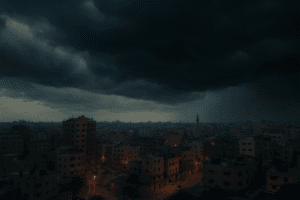
The Silence Before the Storm: Gaza’s Digital Blackout and the Terrifying Calculus of Urban Warfare
The most terrifying sound in modern warfare isn’t the whistle of an incoming shell or the rattle of gunfire. It is, increasingly, the deafening click of a severed connection. For the 1.5 million Palestinians still in Gaza, that sound descended not as a noise, but as an absence. On September 18, 2025, the internet and phone lines across the Gaza Strip went dead. This digital blackout, attributed by the Palestinian Telecommunications Company to the targeting of “main network routes,” is not a technical glitch. It is a tactic, a historically grim omen that signals an imminent and brutal escalation of Israel’s ground offensive into the heart of Gaza City.
This deliberate severing of the lifeline to the outside world plunges an already traumatized population into profound isolation. It is a move that human rights organizations and observers have long warned facilitates atrocities by shrouding them in darkness. As Israeli tanks are reported in the gateway neighborhoods of Sheikh Radwan and Tel Al-Hawa, the stage is set for what may be the most intense urban combat yet in a conflict that has already ravaged the Strip for nearly two years.
The Strategic Purpose of Silence: Why Cut the Lines?
To understand the gravity of the communications blackout, one must look beyond the immediate inconvenience. In military strategy, controlling the information environment is as critical as controlling the physical terrain. For the Israeli Defense Forces (IDF), severing Gaza’s digital tether serves multiple purposes:
- Operational Security: It denies real-time intelligence to Hamas militants. Without phones and internet, the ability to coordinate movements, report troop positions, or plan ambushes is severely degraded. It allows advancing Israeli infantry, tanks, and artillery to operate with a degree of surprise.
- Information Control: It stifles the narrative. In the age of the smartphone, horrific images and videos from the ground have the power to shape global public opinion and intensify international pressure. A blackout effectively muzzles the civilian population, delaying the outflow of evidence of the conflict’s human cost.
- Psychological Warfare: For civilians, the loss of communication is profoundly disorienting and terrifying. It cuts them off from news of safe routes, information about loved ones in other parts of the city, and the comforting, if fleeting, connection to the world beyond the siege. It amplifies the fog of war, leaving people blind, deaf, and utterly vulnerable.
As Ismail, a resident risking his life to use an e-SIM by seeking higher ground, starkly put it: “The disconnection of internet and phone services is a bad omen. It has always been a bad signal something very brutal is going to happen.” History in Gaza has proven him right; similar blackouts have preceded some of the war’s most devastating periods.
The Human Cost: Trapped Between Rubble and the Sea
The IDF’s stated goal is to dismantle Hamas’s terror infrastructure and secure the release of the remaining hostages, believed to be around 20 still alive out of the original 251 taken on October 7, 2023. Yet, the method of this operation places an unimaginable burden on the civilian population.
Hundreds of thousands have heeded evacuation orders and fled south since the offensive was announced on August 10, joining a desperate river of humanity on the coastal road. Their world is now reduced to what they can carry: mattresses strapped to car roofs, gas cylinders balanced precariously on carts, children perched atop piles of belongings. They are heading toward a designated “humanitarian zone” in the south that is already a byword for despair—overcrowded, under-resourced, and plagued by hunger and disease.
But a greater number remain in Gaza City. They are not ideological holdouts; they are people with no good options. They are the elderly, the infirm, the impoverished who have no means to flee. They are families like Bassam Al-Qanou’s, sheltering with 30 relatives in a ragged tent on the beach, who say they have “nowhere to go.” They are also those who, having already fled to the south once and found conditions intolerable, made the conscious choice to return to their shattered homes in the north, preferring the devil they know. “We have no intention to leave again,” one resident told CBC News, a sentiment born of absolute exhaustion and the realization that nowhere is safe.
For these people, the advance of tanks into residential neighborhoods is a waking nightmare. Reports from residents describe Israeli forces detonating driverless vehicles packed with explosives, a tactic that levels entire blocks of housing. The health ministry reports at least 85 Palestinians killed in the past 24 hours alone, a number that is sure to be a lagging indicator as rescue becomes impossible without communication and under relentless bombardment.
The Impossible Dilemmas: Hostages, Hunger, and Accusations of Genocide
The ground offensive creates a tragic paradox for the families of the 48 hostages still held captive. Hamas’s armed wing stated the hostages are “distributed throughout the neighbourhoods of Gaza City,” essentially using them as human shields. They warned that the expansion of the operation means Israel will not receive any captive, “alive or dead.” This puts Prime Minister Benjamin Netanyahu in direct conflict with hostage families, who implore him to prioritize a ceasefire and negotiation over a military victory he believes will ultimately bring them home.
Meanwhile, a silent killer continues to stalk the Strip: starvation. The health ministry announced that four more Palestinians, including a child, died of malnutrition in the past 24 hours, bringing the total death toll from hunger to at least 435. This is a man-made famine, a result of a suffocating siege that restricts the flow of aid. While Israel blames Hamas for diverting resources, the UN and aid agencies hold the blockade responsible.
This context makes the recent finding by a UN Commission of Inquiry all the more seismic. Its conclusion that Israel has committed genocide in Gaza, though vehemently denied by Israel, is now a permanent part of the international legal and diplomatic landscape. It adds immense weight to the accusations from Gaza’s media office that Israel’s targeting is “comprehensive and deliberate,” noting that 44% of the recent casualties were in areas it designated as safe.
The World Watches, Divided
The conflict’s reverberations are felt globally, fracturing international relations. The juxtaposition of U.S. President Donald Trump publicly disagreeing with UK Prime Minister Keir Starmer on recognizing a Palestinian state—even as they both called for peace—highlights the deep diplomatic divides. The UK’s potential move to recognize Palestine at the upcoming UN meeting signals a growing impatience among even Israel’s traditional allies with the status quo.
Yet, on the ground, these diplomatic maneuvers feel abstract and distant. For Yasser Saleh, fleeing with his family on a rickety trailer, the reality is bare feet and an unknown future. “We are heading to go sleep on the streets towards the beach… we don’t know where to go.”
The digital blackout over Gaza is more than a tactical maneuver; it is a metaphor. It represents the isolation of a people, the opacity of a high-stakes military operation, and the failure of the world to stop the violence. As the silence deepens over Gaza City, the world holds its breath, fearing what it will not be able to see, but knowing that the sounds of war—and the silent suffering of those trapped within it—will continue unabated. The connection has been cut, but the responsibility to bear witness remains.
You must be logged in to post a comment.