
The Shifting Sands of Time: How Genetics is Rewriting the Story of India’s Linguistic Past
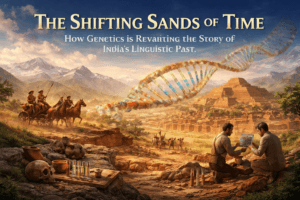
The Shifting Sands of Time: How Genetics is Rewriting the Story of India’s Linguistic Past
For decades, the story of how Indo-European languages, including Sanskrit and its modern descendants like Hindi and Bengali, arrived in the Indian subcontinent was considered relatively settled. The dominant narrative, pieced together from philology, textual analysis, and archaeological conjecture, spoke of a migration of steppe pastoralists around 1500 BCE. These mobile, horse-riding, chariot-using peoples were thought to have brought their Indo-European tongue to the northwestern gates of India, setting in motion a linguistic and cultural transformation that would shape the subcontinent for millennia.
But science, by its very nature, is not a static collection of truths. It is a dynamic process of refinement, challenge, and occasionally, radical revision. A compelling example of this process is currently unfolding in the pages of the European Journal of Human Genetics, where a scholarly exchange is doing more than just debating dates—it is illuminating how the powerful new tools of archaeogenetics are forcing a fundamental rethink of one of history’s most profound human migrations.
This ongoing dialogue, captured in a recent series of letters, highlights a pivotal moment in Indology, linguistics, and population genetics. At its heart is a debate not just about when Indo-European languages appeared in India, but about the very nature of scientific consensus and how we reconcile new, often disruptive, evidence with long-held theories.
The Polite but Powerful Exchange
The conversation began with a paper by Sequeira, van Driem, and colleagues, which identified a “novel 4400-year-old ancestral component” in a modern Dravidian-speaking tribe. This finding, rooted in the analysis of ancient and modern DNA, opened a window into the deep and complex genetic history of the subcontinent, a history far more intricate than previously imagined.
This prompted a response from Ramakrishnan Sitaraman, a biotechnology researcher at the TERI School of Advanced Studies in New Delhi. In his initial letter, Sitaraman gently probed the chronological frameworks used by the authors, questioning the absolute certainty of the timelines for the presence of Indo-European languages.
The reply from van Driem et al. was gracious but firm, pointing out that they had, in their original paper, simply cited the “current consensus” within the research community. And there, the matter might have rested—a simple clarification of scholarly citation.
But Sitaraman’s follow-up letter, the basis of this article, elevates the exchange from a minor correction to a masterclass in scientific philosophy. He acknowledges the consensus but then elegantly dismantles the idea that consensus is, or should be, the final word. He draws a powerful parallel to the theory of evolution, reminding readers that when Darwin published On the Origin of Species in 1859, he did so without any knowledge of genetics—the very mechanism that would later become the cornerstone of his theory.
“In extreme cases, the old model may even have to be discarded, or its scope restricted within set limits as an outcome of fresh research,” Sitaraman writes.
This is the crux of the matter. The established model of an Indo-European migration into India, often colloquially (and contentiously) referred to as the “Aryan Invasion Theory,” and its more nuanced successor, the “Indo-Aryan Migration theory,” was built on a tripod of linguistics, textual analysis (particularly the Rigveda), and archaeological interpretations of material culture, such as the Andronovo culture or the Bactria-Margiana Archaeological Complex (BMAC). For generations of scholars, this tripod seemed stable.
The Uninvited Guest at the Table: Ancient DNA
The new “fresh research” Sitaraman alludes to is archaeogenetics. The ability to extract, sequence, and analyze ancient DNA (aDNA) from human remains has provided a fourth, incredibly powerful leg for the scholarly stool—or perhaps, more accurately, it has revealed that the original tripod was standing on uneven ground.
Key findings from the past half-decade have sent ripples through the academic pond. The 2019 study on an ancient Harappan genome from the Rakhigarhi site, led by Vasant Shinde and others, was a landmark. It revealed that the individual from this major Indus Valley Civilization (IVC) city lacked ancestry from steppe pastoralists. This was a stunning result. It meant that the sophisticated, urban IVC population, which thrived for centuries, was genetically distinct from the people who would later be associated with the spread of Indo-European languages. It didn’t disprove migration, but it fundamentally altered the picture of who the “original” inhabitants were and who the “newcomers” might have been.
Further complicating the timeline is work by researchers like Moorjani and colleagues, which uses patterns of allele sharing to reconstruct the history of founder events. Their work, cited by Sitaraman, suggests that the genetic admixture between Ancestral North Indians (ANI) and Ancestral South Indians (ASI)—the two primary ancestral populations that mixed to form most modern South Asians—occurred in a complex, multi-layered fashion over thousands of years, not as a single, late event.
This is where the 4400-year-old ancestral component identified by van Driem’s team becomes so significant. If a distinct genetic signature can be dated to 4400 years before present (around 2400 BCE) in a Dravidian-speaking group, it forces us to consider that the linguistic and genetic landscapes of the subcontinent were already deeply stratified and complex long before the proposed steppe migrations of 3500 years ago (1500 BCE).
Refining the Narrative, Not Just the Dates
So, what does this mean for the “current consensus”? It does not necessarily mean it is entirely wrong, but it almost certainly means it is incomplete and chronologically fuzzy.
The old model, in its broadest strokes, posited that after the decline of the IVC, groups of Indo-European-speaking pastoralists from the Central Asian steppe moved south, entering the subcontinent through the northwest. Their language, culture, and social structures (including the Vedic religion) gradually became dominant, influencing or displacing the existing populations.
Genetic data broadly supports a steppe migration into India. We can see this ancestry in many modern South Asian populations, particularly among those traditionally associated with upper castes and Indo-European speakers. However, the new data refines this picture in several critical ways:
- It Pushes the Timeline Back and Makes it Messier: The simple “1500 BCE entry” date is looking increasingly like a broad average rather than a firm boundary. The genetic data suggests a prolonged period of contact and admixture, potentially beginning earlier and lasting much longer. The presence of a distinct genetic component in Dravidian speakers from 2400 BCE shows that the populations who would later mix were already distinct and in place for centuries.
- It Complicates the Mechanism of Language Spread: Did the language spread primarily through a massive demographic replacement, where invading hordes replaced the existing population? The genetic evidence strongly argues against this. The steppe ancestry, while significant, is only one component of a complex South Asian genetic tapestry. This lends far more weight to models of elite dominance and cultural and linguistic assimilation. A smaller, but politically or technologically dominant, group could have imposed its language on a larger population over time, a process well-attested in history (e.g., the spread of Latin in the Roman Empire). The chariot burials found at Sanauli, near Delhi, dated to around 1900 BCE and cited by Sitaraman via the work of Asko Parpola, could be archaeological evidence of such an elite group with connections to Indo-Iranian languages, predating the traditional timeline.
- It Challenges Binary Racial Models: Sitaraman explicitly notes that early binary models of “white invaders versus dark aborigines” have been discarded. The genetic data annihilates this simplistic and racist framework. It reveals a spectrum of ancestry, with admixture happening in both directions over millennia. The “invaders” and the “natives” mixed to create something new. The modern Indian population is not a pure descendant of one group or the other but a product of their long and intimate coexistence.
The Value of Dissent and the Human Story
What makes this exchange in the European Journal of Human Genetics so valuable is not just the scientific one-upmanship, but the transparent display of how knowledge progresses. Sitaraman’s gentle challenge is not an attack on his colleagues, but an essential part of the scientific process. He is the loyal opposition, ensuring that consensus does not calcify into dogma.
He reminds us that all models are, to some extent, provisional. They are the best explanations we have given the current data, but they are always vulnerable to being “adjusted,” “restricted,” or “discarded” in the face of new evidence.
This has profound implications beyond the academic. The question of “who came first” is deeply entangled with modern identity, politics, and social structures in India. For decades, these questions have been weaponized by various political and social groups. A dispassionate, data-driven approach, grounded in the messy and complex reality revealed by genetics, offers the only path toward a more nuanced and truthful understanding.
Ultimately, this debate is about us—about the deep, ancestral past that lives on in our DNA and our languages. The story it tells is not one of simple invasions or clean replacements. It is a story of migration and meeting, of conflict and cooperation, of assimilation and innovation. It is the story of how, over thousands of years, a dizzying array of peoples with different tongues and different genes came together on the Indian subcontinent to create one of the world’s most enduring and diverse human tapestries.
The refinements proposed by Sitaraman and the data presented by van Driem and countless other geneticists are not just about pinning a date on a map. They are about adding color, texture, and depth to the portrait of our own origins, revealing a past far more fascinating and complex than any simple consensus could ever capture. The sands of time are shifting, and with each new ancient genome sequenced, we get a clearer, more honest view of the human story they have buried for millennia.
You must be logged in to post a comment.