
The Shifting Line: How Gaza’s ‘Yellow Line’ Redefines Territory and Trauma
The so-called “Yellow Line” in Gaza represents a de facto internal border where Israeli forces withdrew following the October 2025 ceasefire, retaining control over approximately 58% of the territory and creating a shifting military buffer zone that extends up to 6.5 kilometers inside Gaza’s eastern boundary. This unmarked but lethal demarcation, enforced by concrete blocks, drones, and the threat of gunfire, systematically squeezes Palestinians into an ever-shrinking area, dictating safety, mobility, and survival while leading to repeated forced displacements, the loss of farmland and livelihoods, and a profound humanitarian crisis.
Beyond the physical destruction and restricted access to aid, the line imposes a pervasive psychological trauma, particularly on children who must learn new “maps” of danger, normalizing a state of constant hyper-vigilance and uncertainty. Despite its portrayal as a temporary security measure, the line’s systematic expansion through the movement of barriers and destruction of civilian infrastructure suggests a strategy of long-term territorial control, effectively reshaping Gaza’s geography and the daily reality of its inhabitants under the shadow of a border defined by fear rather than formal agreement.
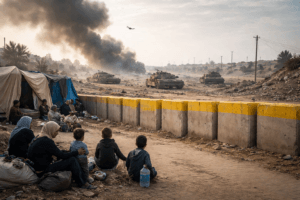
The Shifting Line: How Gaza’s ‘Yellow Line’ Redefines Territory and Trauma
In Gaza, a boundary marked not by natural geography or formal agreement but by yellow-painted concrete blocks is reshaping every aspect of human existence. Known as the “yellow line,” this demarcation represents where Israeli forces withdrew following the October 2025 ceasefire agreement . On military maps, it shows Israel retaining control of roughly 58 percent of the Gaza Strip, stretching between 1.5km and 6.5km inward from the eastern border with Israel . For the more than 2.3 million Palestinians living in its shadow, this line is a powerful, unyielding force that dictates safety, mobility, and survival in a territory already devastated by years of conflict. It is a de facto internal border that is dynamic, often unmarked, and enforced with lethal consequence .
For residents like Zaid Mohammed, a displaced father of four sheltering in a tent just meters from the blocks in eastern Gaza City, the line is a constant, tangible threat. “Shelling and gunfire continue around the clock,” he explains, pointing to the eastern horizon where dust rises from explosions . The sound of drones and the sight of tanks near the yellow barriers are part of daily life, creating an environment where “it’s dangerous to move even a few steps beyond this area” . This reality transforms the landscape into a map of fear, where neighborhoods that felt safe one day can become deadly overnight, forcing families into repeated, traumatic displacements .
From Map to Reality: The Systematic Expansion of Control
While the ceasefire agreement created a mapped line for withdrawal, evidence on the ground reveals a different, more aggressive reality. Analysis of satellite imagery shows that Israel has repeatedly moved the physical yellow blocks deeper into Gaza, effectively expanding its area of control beyond the agreed-upon boundary .
This territorial engineering is systematic. In the al-Tuffah neighborhood of Gaza City, troops moved at least seven already-placed blocks between late November and late December 2025, pushing the line an average of 295 meters deeper into Palestinian-held territory . Similar movements have been documented in Beit Lahia and Jabalia. BBC Verify mapped over 200 markers, finding that more than half were placed significantly deeper inside Gaza than the official line on maps .
In some areas, this expansion is followed by the methodical destruction of civilian infrastructure. In eastern Gaza City, satellite imagery shows hundreds of buildings were leveled up to the initial block positions. The blocks were then moved forward, and further destruction followed . This pattern suggests a strategy of creating “facts on the ground.” As Middle East security expert Prof. Andreas Krieg describes it, this is a “tool for territorial engineering,” allowing Israel to shift where Gazans may live and farm without formally announcing a border change .
The table below summarizes key patterns in the yellow line’s expansion:
| Location | Nature of Expansion | Consequences |
| Al-Tuffah, Gaza City | Blocks moved ~295m deeper; subsequent building demolitions | 40+ residential buildings destroyed in newly expanded zone |
| Eastern Khan Younis | Forward blocks placed 220-390m beyond mapped line; earth berm construction | Displacement of thousands; dismantling of IDP camps |
| Beit Lahia, North Gaza | Construction of 2km+ earth berm along the line | Physical barrier severing roads and access |
| Bani Suheila | Aerial leaflets ordering immediate evacuation east of the line | Forced displacement of 400+ families with minimal warning |
The movement creates dangerous confusion. A 23-year-old man near Khan Younis described becoming trapped after soldiers suddenly moved blocks beyond the mapped line. “We are now living inside the Yellow Line, [but] behind the yellow blocks, with no idea what our fate will be,” he said . This ambiguity is lethal. Defense Minister Israel Katz warned that anyone crossing the Yellow Line would be “met with fire,” and troops have shot at people near the line on dozens of occasions since the ceasefire .
The Human Cost: Life in the Shadow of the Line
The humanitarian consequences of this dividing line are catastrophic and multi-layered. The most immediate impact is on physical safety and survival. Despite the ceasefire, violence persists. According to UN data, 449 Palestinians were killed and 1,246 injured between the October ceasefire and mid-January 2026 . The UN Children’s Fund (UNICEF) reported that more than 100 children have been killed in Gaza since the ceasefire took effect—roughly one child every day . Many deaths occur near the yellow line, including incidents where children gathering firewood or families near a school were hit by strikes or gunfire .
Beyond direct violence, the line strangles livelihoods and access to aid. Farmers cannot reach their land, and jobs vanish as workplaces fall within restricted zones . The Food and Agriculture Organization has documented extensive loss of farmland due to restricted access and military activity . Aid delivery, while improved since the ceasefire, remains severely hampered. The line cuts off access to humanitarian facilities and public infrastructure in the Israeli-controlled zone . UNRWA, the primary UN aid agency in Gaza, reports that many of its facilities are located behind the yellow line, making operations “incredibly difficult” . The agency is also banned by Israeli authorities from bringing in its own supplies .
For a population already subjected to massive displacement—with over 80% of Gaza’s buildings damaged or destroyed—the shrinking space creates a secondary crisis of overcrowding and environmental hazard. Most displaced people live in tents or bombed-out buildings, and recent heavy rains have flooded thousands of tents, placing nearly 800,000 people in flood-prone sites at heightened risk . A UN official has stated it will take more than seven years to clear the over 60 million tonnes of rubble in Gaza .
A Psychological Frontier: Trauma and the “Normalization of Danger”
Perhaps the most insidious effect of the yellow line is psychological. Its shifting, often invisible nature forces a state of permanent hyper-vigilance. “In many areas across the Strip, there are no clear markers or visible signage,” notes an Al Jazeera report. “Palestinians must rely on instinct, sound and memory” . This constant uncertainty fuels what aid workers describe as deep anxiety, exhaustion, and trauma, particularly for children .
Children have adapted by learning internal “maps” of safety—which streets are forbidden, which directions to run during shelling . Mental health professionals with the WHO and UNICEF consistently report high levels of anxiety, insomnia, and trauma linked to this unpredictable environment . This “normalization of danger” is expected to have severe long-term psychological consequences, embedding the realities of conflict into an entire generation’s worldview .
Parents, like Zaid, watch helplessly as their children absorb these harsh lessons. At night, the darkness is intermittently shattered by military flares, a stark reminder that no place is truly beyond the line’s reach . The line shapes not just physical movement but mental horizons, defining a future where fear is the primary constant.
The Strategic and Legal Landscape: Buffer Zones and “Facts on the Ground”
The yellow line did not emerge in a vacuum. It is the latest manifestation of a long-standing Israeli policy to create security buffer zones inside Gaza’s perimeter. As early as April 2025, CNN reported on Israeli soldiers’ testimonies describing the systematic destruction of Palestinian property to create a 1-kilometer-wide “wasteland” along the border . Soldiers spoke of methodically demolishing homes, factories, and farmland to establish a clear line of sight, with orders coming from high command .
International law experts questioned the legality of these actions at the time. Janina Dill of Oxford University argued that such widespread destruction of civilian property likely failed to meet the bar of “military necessity” required by international humanitarian law and could constitute a war crime . The yellow line effectively consolidates and extends this logic deeper into the territory.
The current actions also fit into a broader political context. The ceasefire is part of a U.S.-brokered “Comprehensive Plan,” with a second phase envisioning further Israeli withdrawal tied to the “demilitarisation” of Hamas and the deployment of an International Stabilization Force . However, Israeli officials have sent mixed signals. While the military’s chief of staff called the yellow line “a new border line,” Defense Minister Israel Katz has stated Israel will not fully withdraw and will retain a “broad security corridor” . This posture suggests the temporary demarcation may harden into a permanent partition.
International Response and an Uncertain Future
The international community’s response has been fragmented. The UN Security Council adopted resolution 2803 in November 2025, welcoming the U.S.-proposed peace framework and the creation of a “Board of Peace” . However, the resolution’s implementation remains uncertain. At the same time, UN agencies and humanitarian organizations are sounding alarms about the immediate catastrophe, urging that reconstruction talks “must not distract from massive needs” .
A letter from the State of Palestine to the UN in January 2026 accused Israel of using measures like the yellow line to enact “colonial, racist and genocidal policies,” aimed at making life unbearable and driving people from their land . It criticized the international community for allowing such actions to continue “without consequence” .
On the ground, the line is becoming more physically entrenched. Beyond the movable blocks, the Israeli military has begun constructing large earth berms—raised mounds of dirt—along stretches of the boundary. These berms, some over two kilometers long, physically cut roads and sever Palestinian access, transforming the conceptual line into a tangible, landscape-altering barrier .
As winter rains flood makeshift camps and the threat of violence remains ever-present, the yellow line continues to dictate the terms of existence for millions. It is a border of fear, a boundary of exclusion, and a powerful symbol of a conflict that has re-drawn the map of human suffering. Its final form—whether a temporary security measure or a permanent new border—remains to be seen. What is clear is that for the people of Gaza, the line is already etched indelibly into their daily lives and their foreseeable future, a constant reminder that for them, the cartography of safety is always subject to change.
You must be logged in to post a comment.