
The SHANTI Bill and India’s 100 GW Nuclear Ambition: Unlocking Private Capital and SMR Innovation
The SHANTI Bill and India’s 100 GW Nuclear Ambition: Unlocking Private Capital and SMR Innovation
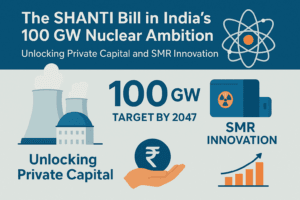
India’s Union Cabinet has approved the Atomic Energy Bill 2025, known as the SHANTI Bill, a transformative reform poised to end the state’s seven-decade monopoly over nuclear energy. This legislative shift is the cornerstone of a staggering national ambition: to scale nuclear power capacity from about 8.9 GW today to 100 gigawatts (GW) by 2047. Achieving this more than eleven-fold increase is not merely an energy goal; it is a calculated strategic necessity for powering a developed “Viksit Bharat,” securing energy independence, and meeting climate commitments.
The Scale of Ambition and the Strategic Drivers
The 100 GW target is monumental. For perspective, it surpasses France’s current entire fleet (~65 GW) and equals the present capacity of the United States. Reaching it requires India to add an average of over 4 GW of new nuclear capacity every year for the next 22 years—a pace unprecedented in its history.
This aggressive push is driven by a confluence of critical needs:
- Baseload for a Renewable Future: India is championing a massive renewable energy (RE) expansion. However, the intermittency of solar and wind poses a growing challenge to grid stability. Nuclear energy provides continuous, carbon-free baseload power, essential for balancing a grid with high RE penetration and supporting relentless economic growth.
- Beyond Coal and Capital Constraints: While coal remains dominant, it is environmentally and politically constrained. The government recognizes that the colossal capital investment required for 100 GW—estimated in the hundreds of billions of dollars—far exceeds the funding capability of the public exchequer alone. The SHANTI Bill is fundamentally designed to unlock private and foreign investment to bridge this finance gap.
- Realizing Strategic Partnerships: Nearly two decades after the landmark Indo-US Civil Nuclear Deal, its commercial potential remains underutilized, primarily stalled by liability concerns. These reforms, now a part of broader US-India trade negotiations under the COMPACT initiative, aim to finally activate international collaboration for building US-designed reactors in India.
A Three-Pronged Strategy to Bridge the 100 GW Gap
India’s plan to meet its target relies on a multi-actor strategy that moves beyond the sole domain of the state-owned Nuclear Power Corporation of India Ltd. (NPCIL). The following table outlines the key contributors to this expansion:
| Actor & Role | Planned Contribution & Strategy | Key Projects & Status |
| NPCIL (State Incumbent) | Lead developer, retains ~50% of target capacity. Focus on indigenous 700 MW PHWRs and new projects with public sector JVs. | 17 reactors currently under construction. New JVs like “Anushakti Vidhyut Nigam Ltd.” with NTPC for projects like Mahi Banswara. |
| Public Sector Giants (e.g., NTPC) | Strategic pivot to clean baseload. Leveraging capital, project management, and existing infrastructure for nuclear expansion. | NTPC targets 30 GW of nuclear capacity. Has formed NPUNL subsidiary and a JV with NPCIL. Actively seeking global partners for 15 GW of PWR technology. |
| Private & Foreign Capital | Finance, innovation, and speed. Bill allows up to 49% equity in projects. Expected to fund a significant portion of the remaining capacity gap. | At least six major industrial groups (Reliance, Tata, Adani, etc.) have shown formal interest in SMRs for captive use. Aims to unlock stalled foreign projects (e.g., Kovvada with Westinghouse). |
Pillars of the New Era: SMRs and Liability Reform
Two elements of the SHANTI framework are particularly revolutionary: the bet on Small Modular Reactors (SMRs) and the long-awaited reform of nuclear liability.
SMRs: The New Strategic Pillar India is making a substantial strategic investment in SMRs, allocating ₹20,000 crore to operationalize at least five indigenously designed units by 2033. Unlike traditional gigawatt-scale reactors, SMRs are compact, factory-fabricated units typically under 300 MWe, offering modular deployment and lower upfront capital risk.
- Indigenous Designs: The Bhabha Atomic Research Centre (BARC) is developing multiple designs, including the 200 MWe Bharat SMR (light-water based) and a 55 MWe SMR. Lead units are planned for Tarapur, Maharashtra, and a Visakhapatnam campus.
- Targeted Applications: SMRs are envisioned not just for the grid but for industrial decarbonization—providing carbon-free steam and power for steel, cement, and chemicals plants—and for hydrogen production. This model is attracting private players who seek long-term, clean captive power.
Tackling the Liability Bottleneck The Civil Liability for Nuclear Damage Act (CLNDA) of 2010, specifically its “right of recourse” against suppliers (Section 17(b)), has been a primary deterrent for foreign reactor vendors like Westinghouse and EDF. The SHANTI Bill proposes critical amendments to align India’s regime with international conventions, likely through insurance pools or government-backed indemnification to cap supplier liability. Resolving this is the key to unlocking the “full realization” of the Indo-US nuclear pact.
Navigating the Path Ahead: Inherent Challenges
The ambition is clear, but the path is fraught with challenges that demand meticulous management:
- Social Legitimacy and Safety: Public perception of nuclear risk remains a significant hurdle. Strengthening independent regulatory oversight and ensuring transparent communication about safety and waste management will be critical for social license.
- Project Execution at Scale: Nuclear projects are notorious for complexity and delays. India must streamline regulatory approvals, build a robust domestic supply chain, and secure diversified fuel sources to avoid bottlenecks.
- Commercial Viability: For private investment to flow, the government must create a bankable environment with predictable tariffs, clear risk-sharing mechanisms, and potentially, green classification for nuclear power to access favorable finance.
Conclusion: A Calculated Gamble for Development and Security
The SHANTI Bill represents more than a sectoral reform; it is a calculated national gamble on high-tech, capital-intensive infrastructure to secure the nation’s future. By strategically opening the sector, India aims to fuse public oversight with private capital and innovation, positioning nuclear energy as the indispensable, stable backbone of its energy transition.
If successfully implemented, this framework can transform nuclear power from a marginal player contributing about 3% of electricity today into a cornerstone of a developed India. It promises to enhance energy sovereignty, catalyze a high-tech industrial ecosystem, and provide a reliable path to decarbonization. The journey to 100 GW is a marathon of technical, financial, and social challenges, but with the SHANTI Bill, India has fired the starting shot on one of the world’s most ambitious energy transformations.
You must be logged in to post a comment.