
The Shannon Loophole: How Ireland’s Neutrality Crumbles Under the Weight of US Military Flights
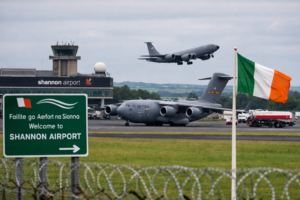
Despite Ireland’s official policy of military neutrality and its vocal support for Palestinian rights, Shannon Airport has become a critical transit hub for US military flights, with over 1,300 such aircraft passing through since early 2024—dozens directly to or from Israel. Irish law prohibits foreign military planes from carrying munitions through its airspace without authorization, yet investigative reports have revealed numerous unauthorised weapons flights by carriers like El Al and Omni Air International, prompting only limited government action and no routine physical inspections. Activists who have staged disruptive protests at the airport—crashing barriers and spraying aircraft—now face criminal charges, highlighting a growing disconnect between Dublin’s pro-Palestinian rhetoric and its continued facilitation of military logistics that critics say make Ireland complicit in conflicts abroad.
The Shannon Loophole: How Ireland’s Neutrality Crumbles Under the Weight of US Military Flights
For decades, Ireland has cultivated an international identity built on a foundation of moral clarity. It is a nation that speaks of its own history of colonization with a unique gravity, often positioning itself as a steadfast ally of the oppressed. In recent years, this self-image has crystallized around the Palestinian cause. Dublin was one of the first European states to recognize the State of Palestine, its parliamentarians vocally supported South Africa’s genocide case against Israel at the International Court of Justice, and its citizens have welcomed medical evacuees from Gaza with open arms.
Yet, on the windswept western coast of Ireland, at Shannon Airport, a different reality unfolds—one that activists argue renders the government’s moral posturing hollow. Beneath the rhetoric of neutrality and solidarity lies a critical infrastructure loophole that, critics say, makes Ireland a silent logistics partner in conflicts it publicly condemns.
On a cold February morning in 2025, protesters gathered outside the airport’s perimeter. They held signs condemning the transit of weapons, their silhouettes stark against the grey Atlantic sky. A few months earlier, three activists from a group called Palestine Action Eire had taken a more drastic step. Using a modified van to crash through a barrier, they drove onto the tarmac and sprayed green paint on a parked US military Boeing 737-700. It was a visceral act of frustration, aimed at disrupting what they view as the Irish state’s complicity in what the UN and international legal bodies have termed potential war crimes in Gaza.
According to flight data tracked by the open-source intelligence group Shannonwatch, over 1,300 US military and contracted aircraft have passed within 60 kilometers of Shannon since January 2024. At least 45 of those flights were directly traveling to or from Israel.
The Legal Paradox: Neutrality on Paper, Logistics in Practice
To understand the tension at Shannon, one must first understand Ireland’s unique legal framework regarding military neutrality. Unlike other European nations that are full members of NATO, Ireland maintains a policy of non-alignment. This is enshrined not just in political tradition but in the public consciousness; the Irish military (the Defence Forces) are known for peacekeeping, not power projection.
Under Irish law, the rules seem strict. Foreign military aircraft are not permitted to land unless they are unarmed and not carrying munitions. Civilian aircraft carrying weapons or ammunition must apply for an exemption from the Department of Transport before they can traverse Irish airspace. On paper, these regulations appear to align with a neutral state that wishes to keep its sovereign territory clear of foreign weaponry.
In practice, however, the enforcement mechanism is nearly nonexistent.
As John O’Brennan, director of Maynooth University’s Centre for European and Eurasian Studies, points out, the government has historically adopted a strategy of strategic ambiguity—or as critics call it, “looking the other way.” Since the Iraq War, when over two million US soldiers passed through Shannon, the airport has served as a crucial transit hub for the US military. It is a logistical goldmine: a European refueling stop outside of NATO’s formal umbrella that allows the US to project power into the Middle East and beyond.
The legal loophole is the distinction between “transit” and “landing.” As long as the weapons are not physically unloaded from the plane—or as long as the Irish authorities do not physically inspect the aircraft to verify the cargo—the flights can proceed under a diplomatic fiction that Ireland is not facilitating the transport of arms.
The Evidence of Illegality
This fiction began to crumble in late 2024. Investigative journalism site The Ditch published documents obtained via Freedom of Information requests by the Belgian anti-war NGO Vredesactie. The findings were explosive: at least nine unauthorized flights had carried munitions through Irish airspace bound for Israel since October 2023. Subsequent reporting suggested the number was higher, implicating a mix of commercial carriers and military contractors, including Israel’s El Al, US carriers like FedEx Express and Omni Air International, and even Germany’s Lufthansa.
In one particularly damning revelation, the Irish government was forced to admit that it had granted an exemption for a US military-chartered Omni Air International flight to carry munitions to the Israeli military’s Nevatim Airbase in southern Israel. It was the first time since 2006 that Dublin officially acknowledged authorizing an Israel-bound weapons flight to refuel at Shannon.
For activists like Conan Kavanagh, who is currently awaiting trial for his role in the runway protest, this is not a bureaucratic oversight; it is active facilitation.
“I took part in the action out of a general frustration with the Irish establishment and society,” Kavanagh told reporters after his release on bail. For him, the marches and speeches—while noble—have become ritualistic. They allow the public to feel solidarity without demanding structural change. “A lot of Palestinian activism in Ireland is centred around marches, speeches and rallies,” he said. “We need to escalate to more actively disruptive protests if we hope to actually force the hands of the state.”
The Price of Dissent
The state’s response to these disruptions has been swift and severe. Kavanagh and his co-accused face charges of criminal damage and, more significantly, interfering with the “operation, management or safety of an airport.” The legal consequences are daunting. Aine Ni Threinir, who participated in a separate incursion in 2024, notes that the government is eager to make an example of those who disrupt the logistics chain.
“There are people, myself included, who have done actions at Shannon, who are now being criminalised and dragged through the courts by the Irish state,” Ni Threinir said. She laments that while the Irish public overwhelmingly supports Palestinian rights, there is a hesitancy to confront the physical infrastructure that enables the conflict.
This disconnect is stark when viewed through the lens of history. For many Irish people, the comparison between their own struggle for independence and the Palestinian plight is deeply resonant. Yet, the country’s economic reality complicates this solidarity. Shannon Airport is a major employer in the mid-west region. Furthermore, Ireland’s economic model relies heavily on foreign direct investment, particularly from the United States. The government’s caution regarding Shannon is often viewed through the lens of not wanting to provoke Washington, which hosts a massive Irish diaspora and is a critical trading partner.
The UN and International Condemnation
The international community has begun to take notice of this dichotomy. In an October 2025 report, Francesca Albanese, the UN Special Rapporteur on the occupied Palestinian territory, explicitly named Ireland among the countries that permitted weapons transfers through ports and airports, indicating “an intent to facilitate Israeli crimes.” In an interview with Irish broadcaster RTE, she directly urged the government to stop the transit of weapons.
Data from the Irish Department of Transport reveals the scale of the issue. In 2024, the department approved 1,354 applications for civil or Irish-registered aircraft to carry military weapons or ammunition through Ireland—a 14 percent increase from the previous year. Only two applications were refused.
Alice Mary Higgins, a member of the Irish Seanad (Senate), points out that the largest number of exemptions are sought by Germany and the United States. She argues that the government’s refusal to conduct routine physical inspections renders the law meaningless. “While the full records of all the flights are not available,” she said, “it is known that the largest number of exemptions have been sought by the US.”
When pressed, Irish Prime Minister Micheál Martin has offered defenses that are often more revealing than reassuring. After the US and Israel launched attacks on Iran, Martin stated that Shannon was “not being used to assist that war.” However, he admitted that while there was not “strong evidence” that US military weapons were being transported, it was difficult to “intervene” or “investigate” if there were any “transgressions” of the rules. For critics, this admission is a confession of willful ignorance.
Beyond Shannon: The Occupied Territories Bill
Shannon is not the only point of friction between Ireland’s stated values and its actions. The Occupied Territories Bill, which would ban trade with illegal Israeli settlements in the West Bank, has languished for years. Despite passing through the Seanad and enjoying broad public support, the government has delayed its implementation, citing concerns about EU single market regulations and potential trade retaliation from the US.
Eoghan McNeill, editor at The Ditch, argues that the Shannon issue and the stalled Occupied Territories Bill stem from the same root cause: a reluctance to bear the economic and diplomatic costs of aligning policy with rhetoric. “The unauthorized flights were operated by a mix of military contractors and commercial carriers,” McNeill noted, highlighting how deeply embedded the weapons logistics are in routine commercial aviation.
A Nation at a Crossroads
For Ireland, the controversy over Shannon Airport represents a fundamental challenge to its national identity. The country prides itself on being a force for peace and a principled actor on the world stage. It has leveraged its history to speak for colonized peoples and has used its EU membership to advocate for human rights.
But Shannon is the infrastructure where that identity meets reality. The US military’s use of the airport is a legacy of the post-9/11 era, codified through bilateral agreements that successive Irish governments have been unwilling to revisit. While the government points to the handful of investigations it has launched or the new laws it has “pledged” to introduce allowing random physical inspections, activists like Kavanagh see these as stalling tactics designed to outlast public outrage.
As the protests continue—regular demonstrations now take place outside Shannon, rain or shine—the court cases against the activists proceed. The three men who sprayed green paint on the Boeing jet face the possibility of significant prison time. Their argument is simple: they were trying to stop what they believe is a crime. The state’s argument is equally simple: no individual has the right to breach the security of a civilian airport, regardless of their moral convictions.
In March 2026, the controversy was reignited when The Guardian reported that Palestinians arrested in the US were being deported to the occupied West Bank on flights chartered by US Immigration and Customs Enforcement that refueled at Shannon. The image of Shannon facilitating the deportation of Palestinians back to a war zone—using the same runways that once facilitated the Iraq War—was a potent symbol of the airport’s enduring role in US military and security operations.
For a country that once saw itself as a beacon of anti-colonial resistance, Shannon has become a mirror reflecting the uncomfortable compromises of a modern, globally integrated economy. Whether Ireland can reconcile its conscience with its logistical convenience remains an open question. For now, the jets continue to land, the paint continues to dry on the protest signs, and the courts continue to decide the fate of those who try to stop the flow.
You must be logged in to post a comment.