
The Shadow War Ignites: Is America Fighting for Its Own Interest or Israel’s?
The article explores the central debate surrounding the Trump administration’s decision to launch a regime-change war in Iran, questioning whether the U.S. acted primarily on behalf of Israel or for its own strategic interests. Analysts at a J Street conference presented competing views: some argued the war was the direct result of a lobbying campaign by Israeli and pro-Israel figures to eliminate a threat to Israel, not the U.S., while others contended it reflects a shared U.S.-Israeli vision of American military hegemony in the Middle East, with Israel acting as the regional “sheriff.” As Congress debates reining in the conflict, Democrats are politically divided and wary of appearing weak on national security, while the human and economic consequences—including American casualties and the potential blockade of the Strait of Hormuz—underscore the high stakes of a war whose true motivation remains fiercely contested.
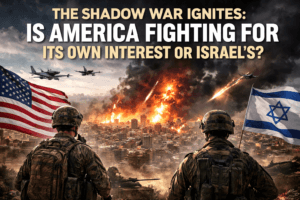
The Shadow War Ignites: Is America Fighting for Its Own Interest or Israel’s?
For decades, the road to war in the Middle East has been paved with unambiguous ultimatums and dramatic public relations campaigns. In 2003, the Bush administration took its case for invading Iraq to the world stage, complete with PowerPoint presentations and Colin Powell’s address to the United Nations. The threat—weapons of mass destruction—was clear, even if it was ultimately a mirage.
The road to war with Iran in 2026 looked nothing like that. There was no galvanizing “Mission Accomplished” moment, no congressional debate, and no clear, singular justification broadcast to the American people. Instead, the conflict simmered for months, a slow burn of proxy clashes and escalating rhetoric that finally erupted into full-blown conflagration. Now, with Iranian Supreme Leader Ali Khamenei confirmed dead and the regime in Tehran teetering on the brink of collapse, the United States finds itself in the middle of its most significant Middle Eastern entanglement in two decades. The pressing question, debated fiercely by analysts and policymakers as the bombs continue to fall, is not just “what happens now?” but a more uncomfortable one: Why are we here?
The Unasked Question in the Room
At a weekend conference held by J Street, the progressive pro-Israel advocacy group, this question took center stage. The gathering, typically focused on promoting a two-state solution and a diplomatic approach to the region, was jolted by the sudden eruption of war. Panelists, ranging from conservative commentators to progressive policy advisors, grappled with the motivations behind President Donald Trump’s decision to launch a regime-change operation.
For Harrison Berger of The American Conservative, the answer was stark and unequivocal. “There’s nothing about this that was done on behalf of the United States,” he argued. “This was all on behalf of Israel.”
Berger’s assertion cuts to the heart of a decades-old suspicion held by a significant portion of the American public: that U.S. foreign policy in the Middle East is often held hostage to the security concerns of its closest ally. He pointed to the logic of the threat itself. Iran’s missile program, while advanced, poses little direct danger to the American homeland. Its nuclear ambitions, even if realized, would lack the intercontinental reach to strike the U.S. for years.
“Why would the average American in Kansas or Ohio be worried about an Iranian nuclear weapon?” Berger posited. “The only reason we hear that Iran’s nuclear program is a threat to the United States is to provide a pretext for the war that we’re now doing.” He framed the conflict as the culmination of a relentless lobbying campaign by pro-Israel figures in media and politics, specifically pointing to Trump megadonor Miriam Adelson, a long-time advocate for a hardline U.S. posture against Tehran. The subtext of Berger’s argument is that the U.S. is fighting a war of choice, at great cost in blood and treasure, to eliminate a threat to Israel, not to itself.
This view finds substantial support in recent reporting. A Washington Post piece, cited during the panel, detailed a “weeks-long lobbying effort” by Israeli and even Saudi officials designed to convince a skeptical Trump to greenlight the offensive. Israeli Prime Minister Benjamin Netanyahu did little to dispel this notion. In a televised address following the initial strikes, he appeared to confirm his personal investment, stating that Trump had helped him accomplish “what I have yearned to do for 40 years.”
The “Sheriff” and the “Deputy”: A More Complex Calculus
However, pinning the entire conflict on Israeli manipulation struck many at the conference as a convenient oversimplification. Matt Duss, a former adviser to Senator Bernie Sanders and now executive vice president at the Center for International Policy, pushed back against what he called an “analytically wrong” framework.
“It kind of lets the U.S. off the hook,” Duss argued. The problem, in his view, is not that a foreign power is pulling the strings of a hapless American giant. Instead, it is the product of a deeply entrenched, bipartisan faction within the U.S. foreign policy establishment that shares a specific vision with its Israeli counterparts: a Middle East dominated by American military hegemony, with Israel acting as the primary enforcer.
“This group sees Israel as essentially the U.S.’s sheriff in the region,” Duss explained. From this perspective, the U.S. isn’t a reluctant participant being dragged into a war; it is a senior partner acting in what it perceives as its own strategic interest: maintaining primacy over a vital region, controlling energy flows, and preventing the emergence of a regional power hostile to both the U.S. and its allies.
While acknowledging that “Israel’s concern about the ballistic missiles” was the “proximate cause” for the attack—since “they don’t threaten the U.S.; they threaten Israel”—Duss insisted that the deeper driver is a shared ideological commitment to a U.S.-led order. The relationship is symbiotic. Israel needs American firepower to eliminate its existential threats, and the United States needs a reliable, powerful proxy like Israel to project power and manage the region without committing massive numbers of its own ground troops. The war in Iran, in this reading, is not a favor; it’s a joint venture.
The Politics of War: A Tightrope for Democrats
This debate is more than an academic exercise. As the U.S. military campaign intensifies, it lands with explosive force on the floor of Congress. Lawmakers are scrambling to respond, with progressive Democrats pushing for a War Powers Resolution to rein in the president’s authority.
The political calculus is treacherous. Republicans have largely lined up behind Trump, framing any opposition as weakness in a time of war. Democrats, meanwhile, are deeply divided. House Minority Leader Hakeem Jeffries has left the door open to supporting the war, contingent on the administration providing a clear rationale based on direct U.S. interests.
This is precisely the opening that concerns anti-war advocates. Amy Rutkin, a former longtime aide to Rep. Jerrold Nadler, warned her fellow Democrats against walking into a political trap. While she affirmed that opposing the war is the right stance, she cautioned against adopting the rhetoric that the conflict is purely for Israel’s benefit.
“It is super dangerous for anybody to suggest, no offense, that Iran didn’t present a material threat,” Rutkin said, directly challenging the argument made by Berger. “We are deeply vulnerable to Republican attacks when we don’t talk about that.”
Rutkin’s point underscores a political reality: ceding the ground on national security is a losing battle for Democrats. By framing the war as solely about Israel, critics risk appearing indifferent to a genuine threat, allowing Republicans to paint them as weak on defense and soft on a regime that has chanted “Death to America” for decades. For many voters, the distinction between an Iranian missile aimed at Tel Aviv and one aimed at a U.S. naval vessel in the Persian Gulf is a matter of degrees, not absolutes.
A Roll of the Dice with American Lives
Senator Chris Van Hollen (D-Md.) offered a more forceful rebuttal to the administration’s actions, cutting through the geopolitical nuance to focus on the immediate human cost. Speaking at the same J Street conference, he made an impassioned plea for his colleagues to stand against the war.
“We should not be sending Americans to war for the political ambitions of Prime Minister Netanyahu and the Saudi crown prince,” Van Hollen declared, his words landing like a thunderclap in the hushed conference room. He pointed to the casualties already being reported—American pilots lost, special operations forces on the ground in harm’s way.
“President Trump put American lives at risk and lost American lives on this huge roll of the dice,” he continued. “Americans are dying and people need to be held accountable for their votes for this war of choice.”
Van Hollen’s framing refocuses the debate on the central moral question: are American interests so directly threatened that they justify the sacrifice of its service members? If the primary beneficiary is Israel, and the primary motivation is the decades-long ambition of a foreign leader, then the cost becomes impossible to justify for many. He effectively argued that regardless of the long-term strategic visions of think-tank factions, the immediate, tangible reason for the war was to secure Israel’s regional dominance, not to protect American soil.
The Human Dimension: Beyond the Geopolitics
As the analysts debate in Washington conference rooms, the reality of the war is unfolding in terrifying fashion on the ground. In Tehran, families huddle in basements, listening to the thunder of distant explosions. The death of Supreme Leader Khamenei has created a power vacuum that rival factions are already fighting to fill, plunging the country into the chaos the U.S. and Israel hope will lead to a friendly new government.
Meanwhile, the conflict is metastasizing. Hours after the first strikes, the Iranian Revolutionary Guard Corps issued a chilling warning to vessels in the Persian Gulf: “No ship is allowed to pass the Strait of Hormuz.” This narrow channel, through which 20% of the world’s oil flows, is now a potential chokepoint. A full blockade could send global oil prices spiraling from $66 a barrel to over $120, triggering a worldwide economic shock that would hit American consumers and businesses within days.
This is the true face of the debate. It is not merely about “putting Israel first” versus “U.S. hegemony.” It is about American families facing higher gas prices, about the potential for a wider war that could engulf the entire region, and about the young men and women in uniform whose lives are on the line.
The decision to attack Iran was a monumental one, with consequences that will reverberate for a generation. Whether it was made in Jerusalem, Washington, or a combination of both, the American people are now left to bear its weight. As Congress prepares to vote, the fundamental question posed by the J Street panel remains: is this our war, or is it someone else’s? The answer, whatever it is, will be written not in policy papers, but in the blood of those who fight it.
You must be logged in to post a comment.