
The Shadow War: How an Indian Man’s Guilty Plea Exposed a Global Assassination Plot on American Soil
An Indian man, Nikhil Gupta, has pleaded guilty in a New York federal court to plotting the murder-for-hire of Gurpatwant Singh Pannun, a US-based Sikh separatist leader and advocate for the Khalistan movement, admitting to charges that carry up to 40 years in prison; US prosecutors allege Gupta was directed by an Indian government official to carry out the assassination on American soil, a claim that has ignited a major diplomatic crisis by exposing an alleged pattern of state-sponsored violence against diaspora activists, linking this case to the separate killing of another Sikh leader in Canada and forcing a complex geopolitical balancing act as the US and its allies must weigh their strategic partnership with India against the violation of sovereignty and the protection of free speech.
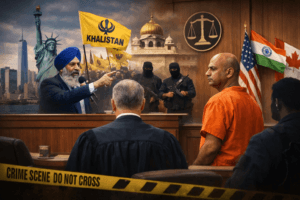
The Shadow War: How an Indian Man’s Guilty Plea Exposed a Global Assassination Plot on American Soil
A Conspiracy Unravels in a New York Courtroom
On a humid June afternoon in 2024, Nikhil Gupta stood before a federal judge in Manhattan, his fate hanging in the balance. The 54-year-old Indian national, dressed in a plain jail-issued jumpsuit, spoke quietly but clearly as he uttered words that would send shockwaves through diplomatic circles on three continents: “Guilty.”
With that single admission, Gupta transformed from an obscure figure into the central character in an international drama that has fundamentally altered the relationship between the world’s largest democracy and its Western allies. The charges against him read like the plot of a spy thriller—murder-for-hire, conspiracy to commit murder-for-hire, and conspiracy to commit money laundering—but the implications reach far beyond any single courtroom.
The target was Gurpatwant Singh Pannun, a dual US-Canadian citizen and outspoken advocate for Khalistan, a proposed independent Sikh homeland. The alleged mastermind, according to US prosecutors, was not some rogue criminal operator but an Indian government official. And the setting for this planned assassination was not some distant conflict zone but the streets of New York City.
The Man at the Center of the Storm
To understand how we arrived at this moment, we must first understand the man whose guilty plea has thrown a spotlight on the shadowy intersections of diplomacy, intelligence operations, and transnational activism.
Nikhil Gupta was not a career spy or a hardened criminal mastermind. By most accounts, he was an ordinary Indian citizen who somehow found himself entangled in an extraordinary conspiracy. The indictment paints a picture of a man who became a conduit—someone who received instructions from above and passed them down the chain, believing he was facilitating the assassination of a man his country considered an enemy.
Gupta’s journey from anonymity to infamy began in May 2023, when prosecutors allege he was recruited by an Indian government employee named Vikash Yadav. The two men reportedly met in Delhi to discuss a plot that would cross oceans and borders. Yadav, according to court documents, worked for India’s Cabinet Secretariat—the administrative home of the Research and Analysis Wing (RAW), India’s foreign intelligence service.
What followed was a classic intelligence operation gone wrong, or perhaps gone exactly as counterintelligence operatives hoped. Following Yadav’s orders, Gupta reached out to a contact who could help arrange the killing in New York. That contact, unbeknownst to Gupta, was a government informant. The informant then introduced Gupta to someone who presented himself as a hitman but was actually an undercover agent with the US Drug Enforcement Administration.
The Khalistan Movement: A Wound That Won’t Heal
To grasp why an Indian government official would allegedly authorize an assassination on American soil, one must understand the deep historical wounds and ongoing political sensitivities surrounding the Khalistan movement.
The call for an independent Sikh homeland dates back to before India’s independence from British rule in 1947, but it gained violent momentum in the 1970s and 1980s. The movement’s most traumatic moment came in June 1984, when then-Prime Minister Indira Gandhi ordered the Indian Army to storm the Golden Temple in Amritsar—the holiest shrine in Sikhism—to flush out armed militants demanding Khalistan. The operation, codenamed “Blue Star,” resulted in hundreds of deaths and widespread damage to the temple complex.
Five months later, Gandhi was assassinated by her two Sikh bodyguards in an act of vengeance. The assassination triggered anti-Sikh riots across northern India that left thousands dead, mostly Sikhs targeted by mobs. These events created a wound in the Sikh collective consciousness that has never fully healed.
Today, the Khalistan movement has little political traction within India itself. Sikhs, who make up about 2% of India’s population, participate fully in Indian democracy, serve in the highest offices of government, and have produced prime ministers, presidents, and military leaders. Even in Punjab, the only Indian state with a Sikh majority, mainstream political parties—including those led by Sikhs—have rejected the demand for Khalistan.
But the movement found fertile ground abroad. The Sikh diaspora, particularly in Canada, the United Kingdom, and the United States, became a repository for Khalistani sentiment. Far from the complexities of Indian politics, some expatriate Sikhs maintained a romanticized vision of an independent homeland and kept the dream alive through advocacy, cultural events, and political organizing.
The Two Faces of Activism
Gurpatwant Singh Pannun represents the most visible and controversial face of this diaspora activism. As a US citizen, Pannun enjoys the full protection of American constitutional rights, including the First Amendment right to free speech that US Attorney Jay Clayton emphasized in his statement following Gupta’s plea.
Pannun’s activities have made him a hero to some Sikhs and a villain to the Indian government. He has organized referendums on Khalistan in Sikh communities abroad, appeared at protests outside Indian diplomatic missions, and used legal and media platforms to advance his cause. In 2020, India designated him a terrorist under its Unlawful Activities (Prevention) Act, a designation he dismisses as politically motivated.
“I am an activist, not a terrorist,” Pannun has repeatedly stated, emphasizing that his methods are political and legal, not violent. His advocacy operates entirely within the bounds of American and Canadian law, protected by the very democratic principles that India claims to share with its Western partners.
This tension—between India’s sovereign right to protect its territorial integrity and the rights of diaspora communities to advocate for political change in their homelands—lies at the heart of the current crisis. When does legitimate activism cross a line that justifies extraordinary response? And what are the limits of a nation’s reach when pursuing those it considers enemies?
The Nijjar Connection
The plot against Pannun cannot be understood in isolation. It is inextricably linked to another killing that sent shockwaves through international relations: the murder of Hardeep Singh Nijjar.
On June 18, 2023, Nijjar, a 45-year-old Sikh leader and Canadian citizen, was shot and killed by masked gunmen outside a gurdwara in Surrey, British Columbia, a suburb of Vancouver with a large Sikh population. Nijjar had been a vocal advocate for Khalistan and had organized an unofficial referendum on Sikh independence among diaspora Sikhs.
The murder immediately raised suspicions. Nijjar had been designated a terrorist by India in 2020, though he denied the charges and no evidence was ever presented publicly to support the designation. Canadian officials began investigating whether the Indian government had a hand in the killing.
According to prosecutors, shortly after Nijjar’s murder, Gupta made a chilling comment to the purported hitman he was coordinating with for the Pannun plot. Referring to Nijjar, Gupta allegedly said that he was “also the target,” adding ominously, “we have so many targets.”
This statement, if true, suggests that the two killings were not isolated incidents but part of a broader campaign. It transforms the narrative from a single rogue operation to something more systematic—a pattern of state-sponsored violence reaching across international borders to silence critics.
The Diplomatic Earthquake
When Canadian Prime Minister Justin Trudeau stood in the House of Commons in September 2023 and announced that there were “credible allegations” linking Indian agents to Nijjar’s murder, he set off a diplomatic crisis of the first order. India angrily denied the allegations, expelled a Canadian diplomat in retaliation, and accused Canada of harboring terrorists and interfering in India’s internal affairs.
The United States found itself in an extraordinarily delicate position. As India’s closest strategic partner in the Indo-Pacific, Washington had invested heavily in the relationship, viewing New Delhi as a crucial counterweight to China’s growing influence. President Joe Biden and Prime Minister Narendra Modi had repeatedly hailed the deepening partnership between the world’s two largest democracies.
But the US also had its own evidence of Indian involvement in a murder plot on American soil. When the indictment against Gupta was unsealed in November 2023, it confirmed the worst fears of those who worried that India’s counterterrorism operations had crossed an unacceptable line.
The US response was notably more measured than Canada’s. While publicly expressing concern and raising the matter privately at the highest levels, American officials sought to contain the damage. National Security Advisor Jake Sullivan traveled to India for discussions. The two countries announced a joint review of their security cooperation. No Indian officials were publicly sanctioned, and Vikash Yadav, the alleged mastermind named in the indictment, remains free in India.
This calibrated response reflected the uncomfortable reality of modern geopolitics: sometimes strategic interests must be balanced against principles. India is simply too important to the United States’ vision of Asia’s future to allow this incident to derail the relationship entirely. But the incident has introduced a new level of wariness and complexity into the partnership.
The Legal Dimensions
Nikhil Gupta now faces up to 40 years in federal prison—a sentence that would effectively end his life as he knows it. His guilty plea, while avoiding the uncertainty of a trial, also forecloses any possibility of exoneration.
The legal theory underpinning the prosecution is straightforward: conspiracy to commit murder-for-hire in violation of US law, regardless of where the conspiracy was hatched. The fact that the target was a US citizen exercising constitutional rights on American soil gave the Justice Department both jurisdiction and motivation to pursue the case aggressively.
What makes the case legally novel is the alleged involvement of a foreign government official. While Vikash Yadav has not been charged and remains beyond the reach of US law enforcement, the indictment’s detailed description of his role sends an unmistakable message: the United States knows what happened, and it holds the Indian government responsible at the highest levels.
The money laundering charge adds another dimension to the case. Prosecutors allege that Gupta engaged in financial transactions to further the murder plot, crossing another legal line that triggered federal jurisdiction. This charge also opens the door to investigating the financial networks that support such operations—a potentially fruitful avenue for future inquiries.
The Human Story
Amid the geopolitical maneuvering and legal technicalities, it’s easy to lose sight of the human beings at the center of this drama. Pannun continues his activism, though now under the shadow of knowing that his government believes someone tried to have him killed. His statement following Gupta’s plea—that it represents “judicial confirmation that India’s Modi government orchestrated a structured murder-for-hire assassination plot on American soil”—reflects both vindication and ongoing fear.
Gupta, meanwhile, sits in American custody, his future reduced to a mathematical calculation of years and months. What motivated a seemingly ordinary man to involve himself in such an extraordinary conspiracy? Was he a true believer in his country’s cause against Khalistani separatists? Was he motivated by money or patriotism? Or did he simply find himself caught in circumstances that spiraled beyond his control?
These questions may never be fully answered. Gupta’s guilty plea, while resolving his legal case, leaves the deeper mysteries unsolved.
The Future of the Relationship
Where do India, the United States, and Canada go from here? The path forward is uncertain and fraught with difficulty.
For India, the challenge is to address allied concerns without appearing to bow to pressure or acknowledge wrongdoing. New Delhi has established an inquiry committee to investigate the allegations, though its findings—if any are ever made public—are unlikely to satisfy critics. The government must also consider how to prevent similar incidents in the future, recognizing that the long arm of Indian intelligence, when it reaches into allied nations, can cause catastrophic diplomatic damage.
For the United States, the challenge is to maintain strategic cooperation with India while holding firm to principles about sovereignty and the protection of dissident voices. The Biden administration appears to have chosen a path of private pressure and public restraint, hoping that quiet diplomacy will prevent future incidents without derailing the broader relationship.
For Canada, the situation is more complicated. With a large and politically active Sikh population, domestic pressure to hold India accountable is intense. Trudeau’s government cannot simply let the matter drop, yet it lacks the leverage that the United States possesses. The result has been a prolonged chill in Canada-India relations that shows no signs of thawing.
Lessons and Implications
The Gupta case offers several lessons for the international community. First, it demonstrates that in an interconnected world, no nation can pursue its security interests in isolation. Actions taken in Delhi have consequences in New York and Vancouver, and those consequences can ripple outward in unpredictable ways.
Second, the case highlights the particular vulnerability of diaspora communities engaged in homeland politics. When people leave their countries of origin but continue to advocate for political change there, they occupy a precarious space—protected by their new homes’ laws but still within reach of their old homes’ long arm.
Third, the incident reveals the tension between counterterrorism cooperation and respect for sovereignty. India has legitimate concerns about diaspora groups that advocate for its breakup and, in some cases, have historical ties to violence. But the remedy for speech, even speech one finds threatening, cannot be assassination in allied countries.
Finally, the case underscores the importance of legal and diplomatic mechanisms for resolving such disputes. If nations cannot trust each other to respect their sovereignty and their citizens’ rights, the entire structure of international relations begins to crumble.
Conclusion
Nikhil Gupta’s guilty plea closes one chapter of this international drama but opens others. The legal case against him may be resolved, but the political and diplomatic questions it raised will linger for years. How far may a nation go to protect itself from perceived threats? What recourse do diaspora communities have when their advocacy puts them in danger? And how do allies maintain trust when one partner is accused of plotting murder in another’s territory?
As Gupta awaits sentencing, as Pannun continues his activism, and as diplomats work behind the scenes to repair damaged relationships, these questions remain unanswered. What is clear is that the world has changed. The barriers that once protected dissidents and activists from their home countries’ reach have grown permeable. And the consequences of that permeability—for individuals, for communities, and for the relationships between nations—are only beginning to become clear.
In the end, the story of Nikhil Gupta is not really about one man’s guilty plea. It is about the shadow wars that nations fight, the lines they cross, and the prices they pay when those lines are crossed on foreign soil. It is a cautionary tale for our interconnected age, when a conspiracy born in Delhi can end in a New York courtroom, and when the echoes of a decades-old conflict in Punjab can still be heard in the streets of Surrey and the chambers of Manhattan federal court.
You must be logged in to post a comment.