
The Shadow War: How Alleged Israeli False-Flag Attacks Are Reshaping the Gulf
Iranian officials have accused Israel of carrying out some of the drone strikes on Gulf energy and civilian sites, alleging that these attacks are false-flag operations designed to provoke Arab states into joining the US-led war against Tehran, while sources claim Mossad has been operating inside Iran to facilitate such strikes and that Tehran has directly communicated to Saudi Arabia that it was not behind attacks on critical infrastructure like the Ras Tanura refinery, viewing the escalation as an Israeli effort to sabotage the painstaking diplomatic rapprochement Iran has built with Gulf neighbors in recent years, leaving regional capitals trapped between suspicion of Iranian denials and the fear of being manipulated into a broader conflict that serves Israeli strategic interests rather than their own.
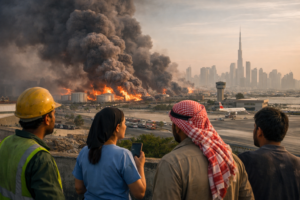
The Shadow War: How Alleged Israeli False-Flag Attacks Are Reshaping the Gulf
Smoke on the Horizon
The black smoke rising over Sharjah’s industrial district on March 1, 2026, told a story far more complex than any official statement could capture. For the thousands of Filipino nurses, Indian engineers, and Pakistani laborers who call the United Arab Emirates home, the plumes represented something terrifying: the collapse of an unspoken promise that had lured them to the Gulf for decades.
Here, your money is safe. Here, your family is safe. Here, politics stops at the border.
That promise now burns alongside storage tanks and airport terminals.
“What do we tell our children when the sirens wake them?” asks Fatima al-Mansouri, a 34-year-old Emirati teacher whose apartment in Dubai’s Jumeirah district shook from a nearby explosion last week. She spoke to me over coffee in a café that had emptied within minutes when news of another strike broke. “We told them this was the safest place in the Middle East. Now I don’t know what to tell them.”
Her confusion mirrors that of an entire region. Five days into a conflict that began with the assassination of Iran’s Supreme Leader and has since spiraled into the most significant regional war in decades, the certainties that once defined Gulf life have evaporated. And at the center of this uncertainty lies an accusation so incendiary that it threatens to reshape alliances built over years of painstaking diplomacy.
Iran is now alleging that Israel—not Tehran—has been behind some of the drone strikes on Gulf energy infrastructure, a calculated provocation designed to drag Arab states into a war many never wanted.
The Fingerprints of Deception
In a Tehran office building, away from the press conferences and official statements, an Iranian foreign ministry official leaned forward and lowered his voice. “I can categorically say that some of the attacks were not carried out by us,” he told Middle East Eye.
The admission is remarkable not for its denial—Iran has consistently claimed it only targets US and Israeli assets—but for what it implies about the fog settling over the Gulf. Someone else is striking Saudi refineries, Omani ports, Emirati civilian infrastructure. And according to Tehran, that someone is Israel.
The official declined to specify which attacks bore Israeli fingerprints. But the list of potential candidates is extensive: the Prince Sultan Air Base, struck twice in three days. The Ras Tanura oil refinery, Saudi Arabia’s largest domestic processing facility and a critical export terminal. The US embassy compound in Riyadh. Oman’s Duqm Port, a strategic hub where the US Navy has maintained regular access since 2019.
Each target, viewed through Tehran’s lens, represents an opportunity for provocation. Hit a Saudi energy facility, and Riyadh faces domestic pressure to respond. Strike near US personnel, and Washington’s demands for Gulf cooperation intensify. Target civilian infrastructure, and the region’s carefully cultivated image of stability crumbles.
“This is an Israeli effort to sabotage regional peace and alliances between neighbours,” a second Iranian source told MEE, speaking of the Ras Tanura attack specifically. “We made a clear statement to Saudi Arabia that we were not behind it.”
The Mossad Factor
The allegations grow more specific—and more troubling—when Iranian sources describe Israeli operational capabilities inside their country. Two sources told MEE that Mossad, Israel’s foreign intelligence agency, has been detected operating on Iranian soil, using warehouses to store drones for cross-border operations.
“We would not be surprised if there are such warehouses and operational rooms in other countries in the region that Israel would use to target our Gulf neighbours from,” one source said.
The claim is not far-fetched. Mossad’s track record inside Iran reads like spy fiction rendered real: the assassination of nuclear scientist Mohsen Fakhrizadeh using a remote-controlled machine gun mounted on a pickup truck; the theft of an entire archive of nuclear documents from a Tehran warehouse; the repeated infiltration of Iran’s most secure facilities.
But extending those operations to include attacks on Gulf states would represent an escalation of breathtaking proportions—one that treats the region’s Arab capitals as chess pieces in a larger game.
For Gulf citizens watching from the sidelines, the implications are dizzying. “First they tell us Iran is attacking us,” says Abdullah al-Otaibi, a Kuwaiti businessman whose family has lived in the region for generations. “Then they say maybe it’s Israel pretending to be Iran. Who do we believe? Who do we fight?”
The Human Cost of Confusion
The attacks have already exacted a tangible toll. In Sharjah, the plumes of smoke rose from industrial areas where thousands of migrant workers live in crowded labor camps. In Ras Tanura, the refinery complex employs tens of thousands of Saudis whose livelihoods depend on uninterrupted operations. In Dubai, the empty hotels and canceled conferences represent not just lost revenue but shattered confidence in a economic model built on stability.
“I came here in 2015 because Syria was no longer safe,” says Ahmed, a Damascus native who works as a driver in Dubai. He asked that his full name not be used, fearing repercussions. “Now the war follows me. My mother calls every night crying, begging me to come home. But where is home when everywhere is burning?”
His story echoes across the Gulf’s expatriate communities. Indians who remit billions in earnings back to Kerala and Punjab. Pakistanis whose families depend on monthly transfers. Filipinos who left their children with grandparents to build better lives abroad. For them, the conflict isn’t about geopolitics or regional hegemony—it’s about whether to stay or flee, whether to trust official assurances or trust their instincts.
“We are used to wars in the Middle East,” says Priya Nair, a nurse from Kerala working at a Dubai hospital. “But we are not used to wars in the Middle East. Here was different. Here was safe. Now I don’t know what here is anymore.”
The Saudi Dilemma
The kingdom has found itself in an impossible position. Struck at least five times by drones and missiles, Saudi Arabia faces mounting domestic pressure to respond decisively. Yet officials have repeatedly counseled restraint, urging Gulf allies to avoid steps that could trigger broader escalation.
“Saudi Arabia has spent years rebuilding its relationship with Iran,” explains Dr. Lina al-Hathloul, a Riyadh-based political analyst. “The Chinese-brokered détente in 2023 was supposed to end the proxy conflicts, restore diplomatic relations, create a new framework for regional cooperation. Now that entire project hangs by a thread.”
The Saudi dilemma reflects a deeper truth about Gulf security: the United States remains the ultimate guarantor, but Washington’s reliability has never been more questioned. When Iranian strikes target facilities hosting US personnel, American pressure on Gulf states to join the war effort intensifies. When attacks appear to come from multiple directions, the certainties that once guided Saudi decision-making dissolve.
“There are forces that want the council’s states to become directly embroiled with Iran,” warned Qatar’s former prime minister, Hamad bin Jassim bin Jaber al-Thani, in recent days. “But a direct clash between the council’s states and Iran, if it occurs, will deplete the resources of both sides and provide an opportunity for many forces to control us.”
His words carry weight. The Gulf Cooperation Council states collectively control vast energy resources, sovereign wealth funds totaling trillions of dollars, and strategic positions that global powers have courted for decades. A war with Iran would not merely be regional—it would reshape global energy markets, international finance, and the balance of power across the Middle East.
Tehran’s Balancing Act
For Iran, the accusations against Israel serve multiple purposes. They provide diplomatic cover for attacks that have damaged Gulf infrastructure, offering skeptical Arab capitals an alternative explanation for strikes they might otherwise attribute to Tehran. They reinforce Iranian narratives about Israeli perfidy, casting the conflict as one between regional stability and external manipulation. And they create space for continued engagement with Gulf states even as hostilities escalate.
But the strategy carries risks. If Gulf intelligence services possess evidence contradicting Iranian denials, Tehran’s credibility could suffer irreparable damage. And if Israeli provocation succeeds in drawing Arab states into direct confrontation, Iran would face a multi-front war it has spent decades trying to avoid.
“Iran’s own approach toward Gulf states in recent years has generally been more calibrated,” notes Sina Toosi of the National Iranian American Council. “Tehran has incentives to pressure US interests and demonstrate regional reach, but it has also invested heavily in repairing relations with Gulf neighbours.”
Those investments now face their severest test. The Chinese-brokered rapprochement between Iran and Saudi Arabia, finalized in March 2023, represented a tectonic shift in regional politics. For the first time in decades, the Gulf’s two dominant powers were speaking directly, coordinating on security matters, exploring economic cooperation. Israeli officials watched with alarm as their strategy of isolating Iran through Arab normalization faced potential collapse.
“Israel is intent on destroying the bilateral relations that Iran has built up with Gulf Arab countries,” says Seyed Emamian of Tehran Polytechnic University. The logic is straightforward: a unified Gulf that includes Iran as a diplomatic partner, rather than an enemy, would represent an existential threat to Israeli strategic doctrine.
The View from Washington
American officials have watched the crisis unfold with growing alarm, though their public statements reveal little of internal debates. The assassination of Iran’s Supreme Leader, conducted jointly with Israel, triggered the current escalation—but Washington’s Gulf allies were given no warning, no consultation, no opportunity to prepare.
“There is deep anger in Gulf capitals,” confirms a former US diplomat who served in the region for decades, speaking on condition of anonymity. “They were blindsided. Their security was jeopardized by an operation they had no part in planning and no ability to influence. And now they’re being asked to join a war they never wanted.”
The Trump administration’s approach to the Gulf has consistently prioritized Israeli interests over Arab concerns, according to multiple current and former officials. The Abraham Accords, expanded under Trump’s second term, created unprecedented public cooperation between Israel and several Gulf states. But that cooperation presumed a shared threat assessment—Iran as the common enemy—rather than a recognition that Gulf states might have independent interests that diverge from Israeli priorities.
“Israel has long sought to align Gulf states more directly against Iran,” Toosi explains. “From that perspective, any escalation that pulls Gulf actors into direct confrontation with Iran would serve Israeli strategic interests by regionalizing the conflict and further isolating Tehran.”
The question facing Washington is whether that alignment remains sustainable when Gulf citizens watch their cities burn and question who holds the match.
False Flags and Historical Memory
The concept of false-flag operations—attacks conducted by one party but designed to appear as the work of another—carries particular weight in Middle Eastern politics. The region’s modern history is littered with examples: the Lavon Affair of 1954, when Israeli operatives bombed Egyptian and American targets in Cairo to sour US-Egyptian relations; the various plots and conspiracies that have shaped public trust in official narratives.
“When you grow up in this region, you learn to question everything,” says al-Otaibi, the Kuwaiti businessman. “The official story is never the whole story. But this—if Israel is really attacking us to make us fight Iran—this is different. This is treating us like pawns in a game we never agreed to play.”
His skepticism reflects a broader regional reality: Gulf publics have watched their governments navigate between US security guarantees, Israeli intelligence cooperation, and Iranian regional ambitions for decades. The current crisis, whatever its origins, threatens to shatter the careful balance that has preserved relative stability since the 1991 Gulf War.
For younger generations, the stakes feel particularly personal. “My grandfather fought in the Gulf War,” says 27-year-old Emirati engineer Khalid al-Rashid. “He told me stories about Scud missiles falling on Riyadh, about the fear, about the uncertainty. I grew up thinking those days were over. Now I’m downloading air raid alert apps on my phone.”
The Diplomatic Tightrope
Gulf foreign ministers have walked an increasingly narrow line since the conflict began. Meeting via video conference, they’ve issued statements affirming the “option to respond to Iranian attacks” while privately urging restraint. Public rhetoric emphasizes self-defense and regional solidarity; private communications stress the need for de-escalation and diplomatic solutions.
“The council’s states have no choice but to act as a single, unified hand in confronting any aggression against them,” Hamad bin Jassim argued. But unity becomes elusive when the source of aggression remains contested.
Iranian President Masoud Pezeshkian sought to address Gulf concerns directly in a statement that mixed reassurance with defiance: “Your Majesties, heads of friendly and neighboring states, we have strived alongside you and through diplomacy to avoid war, but the American-Zionist military aggression has left us no choice but to defend ourselves. We respect your sovereignty, and we believe that the security and stability of the region must be achieved through the collective efforts of its states.”
The message was carefully calibrated: respect for Gulf sovereignty, rejection of external interference, willingness to cooperate—but also a warning that Iran’s self-defense would continue regardless of Gulf reactions.
For Saudi Arabia and its neighbors, the calculation grows more complex by the hour. Joining the US-Israeli war effort would fulfill American expectations and align with years of anti-Iranian rhetoric. But it would also sacrifice the diplomatic gains of recent years, potentially trigger domestic unrest, and commit Gulf states to a conflict with unpredictable duration and costs.
Staying out carries its own risks: US pressure could intensify, Israeli provocations could continue, and Iran’s retaliatory strikes could expand regardless of Gulf neutrality.
The Regional Reckoning
As the conflict enters its second week, a deeper reckoning looms. The post-2023 order—characterized by Saudi-Iranian dialogue, Gulf-Israeli normalization, and reduced US military commitment—has collapsed into chaos. The certainties that guided regional policy for years have evaporated, replaced by questions that admit no easy answers.
Who speaks for the Gulf’s interests when external powers treat the region as a battlefield? How do small and medium states preserve sovereignty when great powers wage war by proxy on their territory? What remains of the social contract between Gulf governments and their citizens when the promised stability proves illusory?
These questions will outlast the current crisis, shaping regional politics for years to come. And at their center lies the accusation Tehran has leveled: that Israel, frustrated by diplomatic progress between Iran and its Arab neighbors, has chosen to burn the region rather than accept its reconfiguration.
“I firmly believe that the Zionist entity wants to drag these countries into the war for more destruction, to strike the economy, and to undermine security and stability in the region,” said Abdulaziz Altuwaijri, the veteran Saudi politician. His words, remarkable for their directness from a figure associated with the Saudi establishment, suggest the depth of suspicion now circulating in Gulf corridors of power.
Human Stories Amid Geopolitics
In a Sharjah hospital, Dr. Ahmed Mansour treats burn victims from the latest strikes while his phone buzzes with messages from family in Egypt. “They see the news, they see the smoke, they think I’m in the middle of a war zone,” he says, exhaustion evident in his voice. “I tell them it’s fine, it’s under control, the government knows what it’s doing. But do I believe that? I don’t know anymore.”
Nearby, construction workers from Bangladesh gather at a tea stall, their conversation a mix of Bengali and broken Arabic. They’ve been here for years, building the skyscrapers and shopping malls that define Dubai’s global image. Now they wonder whether to send their savings home now, before banks close or transfers become impossible.
“We came here because there is no work at home,” says Mohammed, a 40-year-old father of three who hasn’t seen his family in two years. “If we die here, who will tell our children? Who will explain why we never came back?”
His question hangs in the air, unanswered. In the geopolitics of great power conflict, such human dimensions often go unremarked. But for the millions who call the Gulf home—citizens and expatriates alike—the crisis is not abstract. It is the smoke on the horizon, the school closures, the cancelled flights, the midnight calls from worried relatives.
It is the realization that the safe haven was never as safe as they believed.
The Path Forward
As diplomatic efforts continue—backchannel communications between Tehran and Riyadh, urgent consultations among GCC capitals, frantic messaging between Washington and its allies—the region holds its breath. Another strike could trigger the very escalation all parties claim to want to avoid. A miscalculation could transform limited conflict into total war.
The Iranian accusations against Israel, whether proven or not, have already achieved one thing: they have introduced doubt into a narrative that might otherwise have united Gulf publics against Tehran. When citizens question who is really attacking them, governments lose the ability to mobilize support for retaliation. When suspicion spreads, alliance structures weaken.
For Israel, the strategic logic of provoking Gulf-Iran confrontation is clear. But the risks are equally evident. If Gulf states conclude that Israeli actions, rather than Iranian aggression, represent the primary threat to their stability, the normalization achievements of recent years could reverse with startling speed. And if Iran’s accusations gain traction in international forums, Israel could find itself diplomatically isolated even as it achieves military objectives.
For the Gulf’s people—the teachers and nurses, the drivers and engineers, the families who built lives in a region that promised stability—the path forward leads through uncertainty. They will watch the smoke, check the alerts, make the calculations that families in conflict zones have always made: when to stay, when to go, when to believe official assurances, when to trust their instincts.
And they will wonder, as the sun rises over damaged refineries and closed airports, whether anyone in the corridors of power truly considers their lives when making the decisions that shape their world.
The answer, as the smoke rising over Sharjah suggests, may be more disturbing than they want to acknowledge.
You must be logged in to post a comment.