
The Shadow Over the Summit: As Carney Flies to India, a Canadian Sikh Leader Faces a ‘Credible Threat’ at Home
As Prime Minister Mark Carney prepares for a high-stakes trade mission to India, Canadian Sikh leader Moninder Singh has received a police warning about a “credible threat” against his life and family—the latest in a series of such alerts since his friend and fellow activist Hardeep Singh Nijjar was assassinated in 2023, allegedly by Indian agents working through the Lawrence Bishnoi crime syndicate. Singh believes he is being targeted for his advocacy of the Khalistan movement and criticism of India’s human rights record, accusing the Indian government of using transnational repression to silence dissenters in Canada. The situation underscores a profound diplomatic dilemma: while Carney seeks to diversify trade partnerships amid U.S. tariff pressures, many in Canada’s Sikh community feel betrayed, viewing the prime minister’s engagement with India as a prioritization of economics over accountability for what Canadian intelligence calls a pattern of state-sponsored violence on Canadian soil.
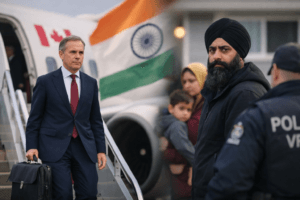
The Shadow Over the Summit: As Carney Flies to India, a Canadian Sikh Leader Faces a ‘Credible Threat’ at Home
The timing could not be more fraught. As Prime Minister Mark Carney prepares to embark on a high-stakes trade mission to India this week, aiming to secure economic partnerships in the shadow of an unpredictable Trump administration, a very different kind of message is being delivered on the doorsteps of British Columbia. For Moninder Singh, the head of the Sikh Federation of Canada, the prime minister’s journey feels less like a diplomatic breakthrough and more like a profound betrayal.
On a quiet Sunday, a member of the Vancouver Police Department arrived at Singh’s home in Surrey, B.C., with a chilling warning. The message, delivered in person and based on intelligence from a confidential informant, was stark: there is a “credible threat” against Singh’s life. This time, the threat was not limited to the activist himself. It explicitly included his wife and children.
For Singh, this was not a new reality, but a terrifying escalation. He has been here before. In 2022, he and fellow activist Hardeep Singh Nijjar were the first to receive such “duty to warn” notices from police. The following year, Nijjar was gunned down in the parking lot of the very Surrey gurdwara where he worshipped. His alleged killers are believed to be hitmen working at the behest of the Indian government. The ghost of that murder now hangs heavy over every subsequent threat, every police warning, and every diplomatic overture between Ottawa and New Delhi.
“From time to time, the VPD conducts what is called a ‘Duty to Warn’ when we receive information regarding a threat to someone,” a police spokesperson confirmed, while declining to comment on the specifics of Singh’s case, citing an ongoing criminal investigation. But for Singh, the source of the threat is not a mystery. It is, he believes, the latest chapter in a long and bloody campaign by the Indian state to silence its critics in the diaspora.
A Pattern of Transnational Repression
Singh’s suspicion is rooted in a growing body of evidence that has fundamentally altered the relationship between Canada and India. He is an outspoken advocate for the Khalistan movement, which calls for a separate Sikh homeland in India’s Punjab region. While the movement’s armed insurgency in India faded decades ago, it retains significant emotional and political support among segments of the Sikh diaspora. For the Indian government of Prime Minister Narendra Modi, these advocates are not just political opponents; they are terrorists and a threat to national sovereignty.
What was once a matter of diplomatic friction has, in recent years, been recast as a national security crisis for Canada. Following Nijjar’s assassination in June 2023, Prime Minister Trudeau made the explosive allegation in the House of Commons that there were “credible allegations” linking agents of the Indian government to the killing. The diplomatic fallout was immediate and severe, with India expelling Canadian diplomats and denying any involvement.
But the revelations did not stop there. Across the border, the U.S. Department of Justice uncovered and foiled a separate plot to kill Gurpatwant Singh Pannun, a Sikh separatist leader and American citizen, on New York soil. An Indian intelligence officer was charged in connection with the conspiracy. The message was clear: India’s campaign of transnational repression was not confined to Canada; it was being waged across the West.
Back in Canada, RCMP Commissioner Mike Duheme later painted an even more disturbing picture. He accused Indian diplomats and agents of engaging in “clandestine activities”—essentially, intelligence-gathering on the South Asian community in Canada. This information, according to National Security Advisor Nathalie Drouin, was then allegedly used to “direct the commission of serious criminal activities against Indo-Canadians.” The alleged conduit for this violence? The Lawrence Bishnoi organized crime network.
The Gangster’s Gambit
The nexus between state actors and organized crime is one of the most alarming aspects of this crisis. Lawrence Bishnoi, a notorious gang leader currently incarcerated in India, is accused of running a sprawling criminal empire that reaches into Canada. According to RCMP intelligence, the Bishnoi gang has been “acting on behalf of the Indian government,” using its established networks to carry out assassinations, extortion, and threats.
This syndicate is now linked to a wave of violence plaguing Canadian cities, from Lower Mainland shootings to extortion schemes targeting South Asian business owners in Ontario and Alberta. What was once a law-and-order problem is now inextricably linked to international diplomacy. Singh believes this is precisely the mechanism being used to target him.
“India uses criminal syndicates, gangs in Canada, to carry out their dirty work for them,” Singh told Global News. “India taps them and then they go out and carry these political assassinations out.” He points to the killing of Nijjar, allegedly carried out by Bishnoi gang members, as the ultimate proof of concept. Now, he fears he is next on the list, targeted not for any illegal activity, but for “political expression, my support for a Sikh homeland, Khalistan, or unveiling India’s horrible human rights record.”
A Question of Evidence and Accountability
From the Indian High Commission in Ottawa, the narrative is starkly different. High Commissioner Dinesh Patnaik, who replaced the previous envoy expelled by Canada, deflects the allegations back onto Ottawa. He insists that the burden of proof lies with the accuser, not the accused. If Canada provides evidence of Indian government involvement in criminal activity on its soil, Patnaik vows that action will be taken, even if it implicates senior officials.
“The burden of proof lies on the accuser, not on the accused,” Patnaik stated. He also turned the tables, pointing to Indian intelligence reports that accuse Canada of harboring and supporting separatist movements. For every Canadian report citing Indian interference, he suggests there is an Indian report citing Canadian complicity in fomenting Khalistani extremism.
When questioned about the Bishnoi gang’s operations in Canada, he framed it as a domestic policing matter. “You have to deal with it. If you start pointing fingers outside, that’s a different matter. It’s very easy to point fingers outside.” This stance—denial, deflection, and a demand for unimpeachable proof—has become the hallmark of India’s response, leaving Canadian officials and community leaders in a frustrating stalemate.
Carney’s Conundrum: Trade Versus Security
It is into this volatile mix that Prime Minister Mark Carney is stepping. Facing the urgent need to diversify Canada’s trade relationships away from an increasingly protectionist and erratic United States, India, with its massive market and growing economy, is a logical target. A successful trade mission could unlock billions in economic activity. But for many in Canada’s 770,000-strong Sikh community, the optics are devastating.
Carney’s visit comes with no public assurance from New Delhi that the violence will stop, no commitment to cooperate with Canadian law enforcement, and no acknowledgement of the RCMP’s findings. To Singh and others, this represents a prioritization of commerce over the safety of Canadian citizens.
“There’s a lot of unfinished business,” Singh said, his voice heavy with frustration. He views the prime minister’s trip as a profound insult. “It’s a bit of a slap in the face of the Sikh community that we have all these ongoing issues and we’re talking to a country that’s behind all of that. We’re not holding them accountable in any which way.”
His sentiment underscores a painful dilemma for the Canadian government. Can it, and should it, pursue normal economic relations with a nation that its own intelligence agencies accuse of orchestrating violent crime on Canadian soil? Does a trade deal implicitly condone the targeting of Canadian citizens for their political beliefs? These are the uncomfortable questions that Carney’s delegation must now navigate.
The Human Cost of Geopolitics
For Moninder Singh, the geopolitical maneuvering in Ottawa and New Delhi is not an abstract debate. It is the backdrop to a very personal crisis. The threat against his family has forced him to reconsider his daily life, his activism, and the safety of his loved ones. The duty to warn is a legal procedure, but for him, it is a chilling confirmation that his voice has made him a target.
The recording of the police visit, the photo of the officer’s business card—these are not just evidence for a news story; they are the artifacts of a life under siege. As he watches the news coverage of Carney’s plane touching down in India, he is left to wonder if his own government understands the real-world consequences of the path it is now taking. The pursuit of economic prosperity is one thing. But for Singh, and for a community still grieving the loss of Hardeep Singh Nijjar, the message from the prime minister’s trip is clear: business is booming, but justice can wait.
You must be logged in to post a comment.