
The Settler Violence Paradox: How AIPAC-Backed Democrats Are Trapped Between Donors and a Shifting Electorate
As Israeli settler violence escalates in the West Bank, a group of AIPAC-backed Democrats—including Ritchie Torres, Daniel Goldman, and Jacky Rosen—have broken their usual silence to condemn the attacks, reflecting a growing political liability for unconditional support of Israel amid a dramatic shift in the Democratic electorate, where two-thirds now sympathize with Palestinians. Facing competitive primaries and a voter base increasingly critical of the occupation, these lawmakers are attempting to navigate between the pro-Israel donors who fund their campaigns and the constituents demanding accountability, condemning settler violence without challenging Israeli state policy—a tightrope walk that highlights how the brutality of the occupation is reshaping U.S. politics even among Israel’s staunchest allies.
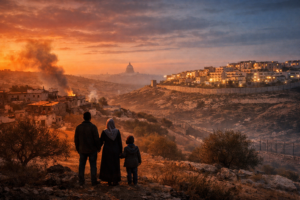
The Settler Violence Paradox: How AIPAC-Backed Democrats Are Trapped Between Donors and a Shifting Electorate
For years, the political calculus for mainstream Democrats regarding Israel was simple: support was a prerequisite. It was a matter of party orthodoxy, a firewall against accusations of antisemitism, and a necessity for securing the deep-pocketed backing of organizations like the American Israel Public Affairs Committee (AIPAC). But as Israeli settler violence in the West Bank escalates to crisis levels, that calculus is fracturing in real-time—exposing a profound and uncomfortable paradox for some of the most prominent pro-Israel voices in Washington.
In recent days, a wave of coordinated attacks by Israeli settlers against Palestinian civilians has swept across the occupied West Bank. Homes and vehicles have been torched. At least ten Palestinian civilians have been killed since the start of the month, including two young brothers and their parents returning from a Ramadan shopping trip. The violence, often occurring with Israeli forces standing by or, as critics argue, acting in concert, has forced a rare public reckoning among Israel’s staunchest defenders in the United States.
The reactions from a specific cohort of Democratic legislators—those with voting records and donor lists saturated with pro-Israel funding—reveal a political class caught in a vise. They are attempting to navigate a minefield: how to maintain the financial support of major pro-Israel lobbies while responding to a Democratic voter base that has, for the first time in a generation, shifted its sympathies decisively toward Palestinians.
The Tightrope Walk of Ritchie Torres
Few figures embody this tension more acutely than Rep. Ritchie Torres (D-NY). Known in Congress as perhaps the most unapologetically pro-Israel member of the progressive caucus, Torres has built a reputation for dismissing critics of Israeli policy and defending the state with a fervor usually reserved for the Republican right.
Yet this week, facing a competitive primary where his opponents have weaponized his support for Israel against him, Torres issued a statement that would have been unthinkable from his office just a year ago. He declared that “the crisis of extremist settler violence in the West Bank must be confronted,” calling for “zero tolerance for violent extremism, no matter what form it takes.”
This is not a softening of his support for the Israeli state, but rather a surgical condemnation of a specific subset of Israeli actors. It is a political maneuver designed to signal to his increasingly pro-Palestinian electorate that he is not blind to the abuses occurring under the banner of the U.S.-Israeli alliance. It is also a calculated risk: Torres has received millions in campaign support from AIPAC. His condemnation does not challenge the occupation or the settlements themselves—only the “extremist” violence.
Torres is not alone. He is joined by a chorus of other AIPAC-backed Democrats facing re-election or seeking to future-proof their careers. Rep. Daniel Goldman (D-NY), another recipient of AIPAC’s largesse, condemned the violence as an “outrage,” even urging House Speaker Mike Johnson to bring sanctions legislation against violent settlers to the floor. Sen. Jacky Rosen (D-NV) framed the issue not through a humanitarian lens, but a strategic one, calling settler violence a “national security threat to Israel.”
These carefully worded statements—aimed at donors in the boardroom and voters on the doorstep—represent a high-wire act rarely seen in Washington. They are trying to reclaim the moral high ground on an issue where the optics have become disastrous.
The Shifting Landscape: From Asset to Liability
The political pressure forcing this shift is immense. A recent NBC News poll revealed a tectonic shift in the Democratic base: two-thirds of Democrats now say their sympathies lie more with Palestinians than with Israelis. This is a dramatic inversion of historical trends and carries massive implications for the party as primaries and midterms loom.
Yousef Munayyer, head of the Palestine/Israel program at the Arab Center DC, describes this phenomenon as a “trap” for politicians like Torres and Goldman. “Israel’s backers in the United States, especially among liberals and Democrats, understand how much of a political liability supporting Israel has become,” Munayyer told the Guardian. “They are trapped between the money they’ve relied on to make their campaigns work and the voters they actually need to win.”
This explains the sudden urgency in the condemnations. For years, settler violence was a footnote in mainstream U.S. political discourse—an unfortunate side effect of the conflict that was rarely mentioned on the floor of Congress. But as the Israeli government has accelerated settlement expansion and as the war in Gaza and tensions with Iran have kept the region in the headlines, the brutality of the occupation has become unavoidable.
The Guardian’s own analysis published this week underscored the impunity fueling the violence: Israel has not mounted any prosecutions of its citizens for killing Palestinian civilians in the occupied West Bank since the start of this decade. Settlers operate with what critics call “army protection,” allowing for coordinated attacks that eviscerate Palestinian communities with near-total legal immunity.
The AIPAC Conundrum and Republican Silence
The role of AIPAC in this dynamic cannot be overstated. The organization has spent heavily in recent cycles to defeat progressive candidates critical of Israel, flooding primaries with cash to ensure that pro-Israel centrists survive. Yet, that strategy is now colliding with political reality.
While AIPAC-backed Democrats are scrambling to distance themselves from the most extreme manifestations of Israeli policy, Republicans remain largely silent. Despite the surge in violence—violence that directly undermines U.S. foreign policy goals and the stated ambition of a two-state solution—no major Republican figures have commented on the latest string of settler attacks. This silence highlights the partisan chasm on the issue: Republicans, 68% of whom sympathize with Israel according to the NBC poll, see no political liability in ignoring Palestinian suffering.
The contrast is stark. On one side, you have Democrats like Rep. Shontel Brown (D-OH) accusing the Trump administration of “green-lighting settler violence.” On the other, you have an administration that recently rescinded the sanctions against violent settlers that were implemented under Joe Biden. Reports of a heated exchange between Vice President JD Vance and Prime Minister Benjamin Netanyahu over the violence were swiftly denied by Vance’s office, suggesting an unwillingness to publicly break with the Israeli government’s handling of the issue.
The Depth of the Crisis
To understand why this issue is breaking through the political noise, one must look at the ground truth in the West Bank. A recent United Nations report warned that the Israeli government has accelerated the expansion of illegal settlements over the last year, forcibly displacing roughly 36,000 Palestinians. The report found that violence accelerated with “Israeli authorities playing the central role in directing, participating in or enabling this conduct.”
This is not merely a matter of rogue individuals. It is a systemic crisis. When settlers torch homes and the Israeli military does not intervene—or, as documented in numerous human rights reports, actively escorts the attackers—it signals to the perpetrators that they have the backing of the state. For Palestinians, it means living in a state of constant siege, where the shopping trip for Ramadan can end in a massacre.
This brutality is what is now filtering into American living rooms. The images of Palestinian families being driven from their homes by armed settlers, often while wearing the insignia of the state, are becoming impossible to ignore. They challenge the narrative that Democrats like Torres have long propagated: that Israel is a beacon of liberal democracy in a hostile region.
A Path Forward or a Political Pivot?
The condemnations from Torres, Goldman, and others represent a crack in the dam. Whether it is a genuine shift in policy or merely a tactical pivot to survive an election remains to be seen. Condemning settler violence is, as Munayyer points out, the “easy” path. It allows a politician to express discontent with Israeli actions without challenging the legitimacy of the occupation or the Israeli state itself.
The real test will come if these politicians are re-elected. Will they use their influence to push for conditioning U.S. aid to Israel—which remains the largest recipient of U.S. foreign aid—on an end to settler violence and the prosecution of perpetrators? Will they support legislation that holds individual settlers accountable, or will they allow the issue to fade from the agenda once the election is over?
For now, the drama unfolding in the Democratic Party offers a rare moment of accountability. The old guard, backed by the might of AIPAC, is finding that money cannot buy its way out of a moral crisis. As the electorate shifts and the reality of the occupation becomes undeniable, the political cost of silence has become too high.
The settler violence in the West Bank is not just a crisis for Palestinians or for Israel; it has become a crucible for the American Left. It is forcing a generation of politicians to choose between the donors who fund their campaigns and the voters who determine their survival. And for the first time in a long time, the voters are winning.
You must be logged in to post a comment.