
The Sanctions Strategy: How the U.S. Targets Hamas’s Hidden Financial Lifelines
In January 2026, the U.S. Department of the Treasury sanctioned six Gaza-based charities and a Palestinian diaspora group, accusing them of being a clandestine financial and logistical network for Hamas’s military wing.
The action, based on documentary evidence seized from Hamas after the October 2023 attacks, alleges that these ostensibly independent nonprofits—including the Waed Society and Al-Salameh Society—are formally staffed by Hamas security forces and used to divert overseas donations to fund terrorist operations. Simultaneously, the U.S. sanctioned the Popular Conference for Palestinians Abroad, a U.K.-linked group it describes as a Hamas front involved in organizing blockade-running flotillas.
Officials stated the move aims to cripple Hamas’s ability to exploit the financial system while ensuring legitimate humanitarian aid reaches Gaza, highlighting the ongoing challenge of distinguishing between genuine civil society and militant infrastructure in the region.
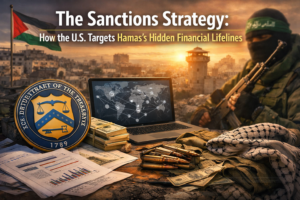
The Sanctions Strategy: How the U.S. Targets Hamas’s Hidden Financial Lifelines
In a significant move highlighting the enduring complexity of counter-terror finance, the U.S. Department of the Treasury recently imposed sanctions on six Gaza-based organizations and a diaspora group, accusing them of acting as a clandestine support network for Hamas’s military wing. This action, announced in January 2026, is not merely another entry on a sanctions list; it represents a deeper, more nuanced battle being waged in the shadows of the Israeli-Palestinian conflict—a battle over money, influence, and the very soul of civil society in Gaza.
At the heart of this development is a troubling accusation: that Hamas has systematically built a parallel governance and financial structure hidden behind the façade of independent, humanitarian nonprofits. According to the Treasury, groups with names like the “Waed Society” and “Merciful Hands,” which evoke images of community support and compassion, are in fact integral cogs in the machinery funding the Izz al-Din al-Qassam Brigades.
Decoding the Strategy: Why Nonprofits?
To understand the gravity of these sanctions, one must first grasp the strategy they aim to disrupt. For organizations designated as terrorist groups, like Hamas, accessing the formal global financial system is nearly impossible. Traditional banking channels are closed, and large international transfers are flagged. This has necessitated a shift toward more opaque methods.
Nonprofits and charities present a perfect vector. They operate on compassion and trust, often garnering donations from well-meaning individuals across the globe who wish to alleviate the profound suffering in places like Gaza. By embedding its operatives within these organizations and controlling their activities, Hamas can divert a portion of these funds, or use the organizations to provide direct logistical and material support to its fighters and their families. This creates a “dual-use” civil society, where a soup kitchen might also be a recruitment hub, and a children’s charity might funnel money to weapons procurement.
As Tommy Pigott, principal deputy State Department spokesman, carefully noted, the U.S. goal is twofold: to dismantle these illicit networks while ensuring “humanitarian aid can be delivered by reliable and safe organizations.” This statement underscores the delicate tightrope walk facing policymakers. Overly broad sanctions can cripple legitimate aid and further impoverish civilians, playing into the propaganda of extremist groups. Precision is therefore paramount.
The Evidence: A Paper Trail from the Battlefield
A critical detail in the Treasury’s announcement is the source of its intelligence: “documentary evidence taken from Hamas offices after Oct. 7, 2023.” This date is pivotal. The aftermath of Hamas’s attacks on that day led to Israeli military operations in Gaza, during which troves of internal documents were reportedly seized. This evidence, the U.S. claims, paints a detailed picture of bureaucracy and intent.
The documents allegedly show that Hamas fighters are given formal instructions on how to navigate the group’s own administrative procedures to request services from these affiliated charities. This isn’t a loose, informal connection; it is institutionalized. For example, the Treasury states that members of Hamas’s internal security forces are formally assigned to work within the Waed and Al-Salameh societies. This transforms the charity office from a mere front into an official extension of the militant apparatus, blurring the lines entirely.
The International Dimension: The Diaspora Front
Beyond Gaza, the sanctions also targeted the Popular Conference for Palestinians Abroad (PCPA) and one of its UK-based officials, Zaher Khaled Hassan Birawi. This highlights the international reach of these support networks. The PCPA, according to the U.S., is not a independent advocacy group but a “front organization” that operates on directives from Hamas’s Bureau of International Relations.
Its role in organizing flotillas aimed at breaking Israel’s maritime blockade of Gaza is particularly telling. Such missions generate high-profile media attention, position Israel in a negative light, and rally political support. For Hamas, this is a form of asymmetric warfare—using international activism to apply pressure where military force cannot. Sanctioning this group is an attempt to cut off not just a funding stream, but a key channel for political influence and propaganda.
The Human Dilemma and the “Callous Disregard”
U.S. Treasury Under Secretary John Hurley’s statement that “Hamas continues to show a callous disregard for the welfare of the Palestinian people” gets to the core ethical dilemma. When militant groups embed themselves within the civilian infrastructure, they make that infrastructure a legitimate military target under the laws of war. This endangers every civilian who relies on those hospitals, schools, or charities for survival.
The strategy, from Hamas’s perspective, is grimly pragmatic. It provides a shield, complicates military responses, and ensures that any attack on Hamas has a high civilian cost, which in turn generates international outcry. It also allows them to claim they are the only true providers for Gaza’s population, despite often diverting resources meant for civilians to military ends. This cycle perpetuates suffering and stalls any possibility for the “lasting and prosperous peace” the U.S. statement envisions.
A Historical Pattern and the Challenge Ahead
This is not a new tactic. From the IRA’s use of legitimate businesses to Hezbollah’s vast network of social services, militant groups have long understood that controlling daily life is as important as controlling territory. It builds loyalty, provides logistical cover, and creates a resilient ecosystem that can survive military pressure.
The challenge for the United States and its allies is immense. Sanctions are a powerful tool, but they are primarily disruptive. They can freeze U.S.-based assets and scare off legitimate international donors from these specific groups. However, they cannot easily rebuild a healthy, independent civil society in Gaza. That requires a political and economic solution that addresses the root causes of extremism and gives Palestinians legitimate hope for the future.
Furthermore, each round of sanctions invites scrutiny and accusations of bias, particularly in the polarized landscape of Middle Eastern politics. The effectiveness hinges on the credibility of the evidence presented and the consistent application of similar principles to other non-state actors globally.
Conclusion: More Than a Financial Transaction
The January 2026 sanctions are a significant data point in a long-running conflict. They reveal a world where charity is weaponized, where compassion is exploited, and where the fight for stability occurs as much in ledgers and NGO offices as on battlefields. For the reader, this story is a stark reminder that in modern conflicts, the most crucial fronts are often the most invisible.
The ultimate success of this strategy will not be measured in frozen bank accounts alone, but in whether it creates space for truly independent, transparent humanitarian actors to thrive in Gaza, offering its people a future unshackled from the agendas of militancy. Until then, the Treasury’s watchful eye and its list of sanctions will remain a key, if controversial, instrument in a profoundly difficult struggle.
You must be logged in to post a comment.