
The Road to Medina: After 45 Pilgrims Are Lost, a City of Hyderabad Asks Why
In a tragic accident on November 17, 2025, a bus carrying 46 Indian pilgrims from Hyderabad to the holy city of Medina, Saudi Arabia, collided with an oil tanker, resulting in the deaths of 45 individuals and leaving a single survivor, Mohammad Abdul Shoaib, critically injured in a local ICU; the disaster has prompted an outpouring of grief in India, with high-level condolences from the Prime Minister and a coordinated crisis response from Indian consular officials and the Telangana government to assist the victims’ families and manage the repatriation of the deceased.
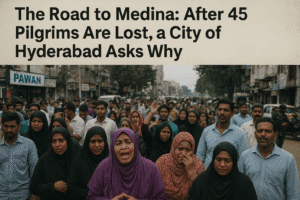
The Road to Medina: After 45 Pilgrims Are Lost, a City of Hyderabad Asks Why
The journey to Saudi Arabia for Umrah, the lesser pilgrimage, is meant to be a spiritual cleansing—a profound act of devotion that brings Muslims closer to God. For 54 individuals who departed from Hyderabad, India, on November 9, 2025, it was the trip of a lifetime. But in the pre-dawn hours of November 17, on a desert highway just 25 kilometres from the holy city of Medina, that journey ended in an unimaginable tragedy. A catastrophic collision between their bus and an oil tanker claimed the lives of 45 of the pilgrims, leaving a single survivor and a community half a world away shattered.
This is more than a news headline; it is a story of faith, fragility, and the frantic international response that follows a disaster.
A Community Bound by Grief: Hyderabad’s Heartbreak
The news did not take long to travel from the arid plains of Saudi Arabia to the bustling streets of Hyderabad, a city with a deep-rooted Islamic heritage. As the sun rose on November 17, a pall of gloom descended, particularly in the neighbourhoods from which the pilgrims had departed. Hyderabad Police Commissioner V.C. Sajjanar’s press conference was not just an official briefing; it was the moment a city learned the devastating scope of its loss.
The victims were not anonymous statistics. They were neighbours, parents, spouses, and friends. Most were from Hyderabad, part of a close-knit group that had saved and planned for this spiritual expedition. The fact that the group had split just hours before the accident—with four taking a car to Medina and four staying behind in Mecca—added a cruel layer of “what if” to the grief. The 46 who boarded that bus were on the final leg of their sacred tour, moving from Mecca to Medina, a journey filled with prayer and anticipation.
In Hyderabad and across the Indian state of Telangana, spontaneous gatherings formed as people sought solace in shared mourning. The state’s Chief Minister, Revanth Reddy, expressed the collective shock, calling the news a source of “intense sorrow.” The setting up of a control room in Delhi’s Telangana Bhavan was a practical step, but it also symbolized a government scrambling to provide answers and support to families feeling helpless and thousands of miles away from their loved ones.
The Lone Survivor and the Anatomy of a Tragedy
In the midst of overwhelming loss, the story of Mohammad Abdul Shoaib stands as a stark testament to both tragedy and hope. Fighting for his life in the ICU of the Saudi German Hospital, Shoaib is not just a patient; he is the sole witness to the final moments of his 45 companions. His survival is a fragile thread connecting the events of that night to the search for understanding.
The early reports point to a collision with an oil tanker. Such accidents on Saudi highways, particularly on routes between holy cities, are tragically not uncommon. These roads, traversed by millions of pilgrims annually, see a mix of high-speed vehicles, massive commercial trucks, and pilgrim buses, often driving through the night. The resulting cocktail of driver fatigue, high speeds, and sometimes challenging road conditions can be deadly. While the exact cause of this specific crash is still under investigation by Saudi authorities, the pattern is a grimly familiar one, raising urgent questions about pilgrim transportation safety standards.
The Diplomatic Machinery: A Consulate in Crisis Mode
In the wake of the disaster, a well-rehearsed but sombre diplomatic protocol swung into action. India’s Consulate in Jeddah, which serves the crucial western region of Saudi Arabia where the holy cities are located, became the nerve centre for the response.
Their statement outlined a multi-pronged effort:
- Coordination with Saudi Authorities: Immediate contact was established with the Saudi Hajj and Umrah Ministry, the primary body overseeing pilgrimage affairs, as well as local hospitals and police. This is vital for cutting through bureaucratic red tape, especially concerning the identification and repatriation of the deceased.
- On-Ground Assistance: Consulate staff, bolstered by volunteers from the vast Indian diaspora in Saudi Arabia, were deployed to hospitals and the accident site. Their role is humanitarian and logistical: translating for survivors (in this case, liaising for the critically injured Shoaib), assisting with paperwork, and providing a familiar face in a moment of absolute crisis.
- A Bridge to Home: The consulate serves as the official link between the Saudi system and the governments of Telangana and India, ensuring a coordinated flow of information and assistance.
The high-level condolences from Prime Minister Narendra Modi and External Affairs Minister S. Jaishankar underscored the national significance of the tragedy. Their messages, while formulaic, serve an important purpose: they assure the public and the grieving families that the full weight of the Indian government is behind the relief effort.
Beyond the Headlines: The Perilous Path of Pilgrimage
To understand the true impact of this accident, one must look beyond the immediate tragedy and consider the institution of pilgrimage itself. Every year, millions of Muslims undertake Umrah, a pilgrimage that can be performed at any time of the year, unlike the Hajj which has fixed dates. This creates a constant, massive flow of people, placing immense strain on Saudi Arabia’s infrastructure.
The buses that ferry pilgrims between Mecca, Medina, and Jeddah are the lifelines of this spiritual economy. While many operators are reputable, the scale of demand can sometimes lead to compromises. Questions about driver training, vehicle maintenance, and enforcement of traffic regulations on these specific routes are now, once again, at the forefront.
For the families in Hyderabad, their loved ones were not just passengers on a bus; they were seekers on a sacred path. The pilgrimage of Umrah is meant to be a return to a state of purity. The profound irony and cruelty of such a violent end on a journey of peace is a theological and emotional shock that will resonate for years.
A Long Road Home: What Comes Next?
The immediate focus is on Mohammad Abdul Shoaib’s recovery and the complex, heartbreaking process of repatriating the 45 bodies. This involves meticulous forensic identification, adherence to international laws for transporting human remains, and navigating the immense emotional toll on the families waiting to perform last rites.
In the longer term, this tragedy will inevitably lead to calls for stricter safety protocols for pilgrimage travel. The Indian government, through its diplomatic channels, may press for audits of Umrah tour operators and heightened safety checks on transport. Within India, particularly in states like Telangana that send large numbers of pilgrims, there may be pushes for better pre-travel briefings and vetting of travel agencies.
The bus accident near Medina is a stark reminder that the path to faith, for all its spiritual glory, is traversed in a fragile, physical world. As Hyderabad mourns, the legacy of the 45 pilgrims will be measured not only in the grief they leave behind but also in the urgent conversations about safety, accountability, and how to protect the sanctity of a journey that means everything to millions. Their pilgrimage was cut short, but their story demands a journey toward meaningful change.
You must be logged in to post a comment.