
The Reluctant Refuge: How a Mystery Flight of Palestinians Exposes a Global Fear of Displacement
In a move highlighting the deep geopolitical tensions surrounding the Israel-Gaza conflict, South Africa has announced it will refuse further chartered flights of Palestinians, labeling a recent arrival of 153 passengers as part of a suspected Israeli “cleansing agenda” to permanently displace Gazans.
The decision follows a controversial flight mired in dispute, with the Palestinian embassy claiming it was orchestrated by an unregistered organization that exploited families, while Israeli authorities asserted South Africa had previously approved the arrivals. South Africa, a longtime supporter of the Palestinian cause, suspects these flights are a coordinated effort to normalize the exodus of Palestinians from their homeland, framing the acceptance of refugees as complicity in a strategy that undermines the right of return and a future Palestinian state, thus prioritizing a political solution over humanitarian rescue to avoid abetting what it fears is a permanent demographic shift.
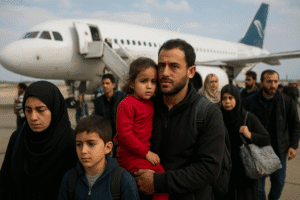
The Reluctant Refuge: How a Mystery Flight of Palestinians Exposes a Global Fear of Displacement
In the shadow of a brutal war, a modern-day mystery unfolded on the tarmac of Johannesburg’s OR Tambo International Airport. A chartered flight, carrying 153 Palestinians from Gaza, became the centre of an international diplomatic storm, laying bare not just the immediate horrors of the conflict but a deeper, more insidious fear: the permanent displacement of an entire people. South Africa, one of the Palestinian cause’s most vocal supporters, found itself cast in an unexpected role—not as a saviour, but as a wary gatekeeper, suspecting that the very act of offering refuge was a trap in a larger geopolitical game.
This is not merely a story about a delayed flight; it is a story about the weaponization of humanitarian corridors, the terrifying ambiguity of the phrase “voluntary migration,” and why a nation that has taken Israel to the International Court of Justice for genocide is now refusing to accept more Palestinians fleeing the very violence it condemns.
The Flight of the Unknown: A Tangle of Contradictions
The facts of the initial event are shrouded in as much controversy as the dense smoke over Gaza. On Thursday, a flight originating from Israel’s Ramon Airport, via Nairobi, landed in South Africa. The passengers, 153 in total, held Palestinian travel documents. Then, the gears of bureaucracy and suspicion ground to a halt.
For over ten hours, the passengers were confined to the aircraft. The official reason, according to South African authorities, was a procedural anomaly: their passports lacked the necessary exit stamps. Yet, this technicality masked a deeper unease. Who were these people? Who had arranged their journey? And why were they coming here?
The answers, depending on whom you ask, are starkly different.
- The Palestinian Embassy in South Africa issued a startlingly frank statement, disavowing any knowledge of the flight. It pointed the finger at an “unregistered and misleading organization” that it accused of exploiting desperate families, collecting money from them, and facilitating “irregular and irresponsible” travel. This paints a picture of a potentially predatory smuggling operation, capitalizing on chaos.
- Israel’s Coordination of Government Activities in the Territories (COGAT), however, presented a clean, official narrative. They stated simply that the residents left Gaza after COGAT “received approval from a third country to receive them.” Later, they explicitly named South Africa as that third country.
This direct contradiction is the heart of the scandal. Either a rogue actor orchestrated a complex international flight without the knowledge of the relevant embassies, or the South African government is backpedaling on an agreement it now finds politically toxic.
“A Cleansing Agenda”: South Africa’s Geopolitical Accusation
South Africa’s Foreign Minister, Ronald Lamola, did not mince words. He labelled the flight part of “a clear agenda to cleanse Palestinians out of Gaza and the West Bank.” This phrase, “cleansing agenda,” is deliberately potent, evoking the darkest chapters of 20th-century history and South Africa’s own apartheid past.
Lamola’s suspicion is not born in a vacuum. It is rooted in a consistent pattern of rhetoric from the highest levels of the Israeli government. Prime Minister Benjamin Netanyahu has repeatedly spoken of facilitating the “voluntary migration” of Palestinians from Gaza. To much of the international community, including South Africa, the word “voluntary” rings hollow when applied to people living under constant bombardment, with no access to food, water, or medicine. In this context, “voluntary” begins to look a lot like coerced, and “migration” looks a lot like permanent expulsion.
This is why South Africa is refusing further charter flights. It is not a refusal born of a lack of compassion, but a strategic one. Accepting these flights, in their view, makes them a complicit partner in what they fear is a long-term Israeli strategy to thin the Palestinian population of Gaza, preventing their right to return and undermining any future Palestinian state. By taking a stand at the airport, they are attempting to draw a line in the sand against what they see as a demographic war.
The Historical Lens: Why South Africa Sees a Ghost of Its Own Past
To understand the ferocity of South Africa’s position, one must look back. The African National Congress (ANC), which leads the South African government, has long drawn a direct parallel between the Palestinian struggle and its own fight against apartheid. Nelson Mandela’s famous words, “Our freedom is incomplete without the freedom of the Palestinians,” are a foundational tenet of the nation’s foreign policy.
This historical lens shapes their interpretation of events. During the apartheid era, the South African government engaged in forced removals and the creation of Bantustans—nominally independent homelands designed to concentrate the Black population and strip them of South African citizenship. The fear is that Gaza and the West Bank are being transformed into the 21st century’s ultimate Bantustans, with “voluntary migration” serving as the mechanism for their gradual dissolution.
Therefore, offering asylum, while a humanitarian impulse, is seen through this political prism as validating a process of displacement. It transforms a political crisis requiring a political solution into a humanitarian one requiring refugee camps. For South Africa, which sees itself as a guardian against this very fate, providing the exits for this process is an unthinkable betrayal of principle.
The Human Cost: Caught Between a Rock and a Hard Place
Amid the high-stakes diplomacy and accusations of “cleansing,” it is crucial to remember the 153 human beings at the centre of this storm. They are not political pawns by choice. They are doctors, students, engineers, and families who have endured unimaginable trauma. Their decision to board that flight was likely born of sheer desperation—a choice between certain death under bombardment and an uncertain future in a faraway land.
Their ordeal did not end when the plane landed. The ten-hour confinement on the tarmac was a brutal extension of their limbo. While eventually allowed entry due to the intervention of the South African charity Gift of the Givers and what President Cyril Ramaphosa called “empathy [and] compassion,” their status remains precarious. Twenty-three of them have already moved on to other destinations, a detail that adds another layer of mystery to their ultimate intentions and the network facilitating their travel.
They are the embodiment of the global refugee crisis—uprooted, their documents in disarray, their stories fragmented, and their futures entirely dependent on the political wills of nations that see them as symbols rather than individuals.
A Global Pattern in the Making?
Minister Lamola hinted at a broader scheme, noting that such flights were being sent to “other countries.” While he provided no details, this assertion raises a alarming possibility: is this an isolated incident or the testing of a coordinated pipeline?
If similar flights are indeed landing in other nations under similarly opaque circumstances, it would suggest a systematic effort to distribute the Palestinian diaspora, normalizing their exodus from their homeland. This plays directly into the deepest fears of those who oppose Netanyahu’s “voluntary migration” plan. Each flight that departs and is accepted by a third country could be seen as a small victory for those who envision a Gaza with a significantly reduced Palestinian population.
Conclusion: A Stand at the Airport is a Stand for Sovereignty
South Africa’s refusal to accept more chartered flights of Palestinians is one of the most politically nuanced and significant stances it has taken in this conflict. It is a declaration that true solidarity is not just about providing shelter, but about safeguarding the right of a people to have a home to return to.
By closing this particular route, South Africa is sending a message to Israel and the world: we will not be made complicit in a process that we believe leads to the permanent erasure of a national identity. They are arguing that the most compassionate act, in the long run, is to keep the pressure for a ceasefire and a political solution, rather than easing the logistical burden of displacement.
The mystery of the flight from Ramon Airport to Johannesburg is more than a diplomatic snafu. It is a microcosm of the entire Israel-Gaza conflict, containing within it themes of desperation, political manipulation, historical trauma, and the fierce global battle over the future of Palestine. The runway at OR Tambo International has become an unlikely front line in that battle, and the 130 Palestinians now in South Africa are the living, breathing evidence of a world struggling to define the line between rescue and ruin.
You must be logged in to post a comment.