
The Release of the ‘Real Phunsukh Wangdu’: What Sonam Wangchuk’s Freedom Means for India’s High-Altitude Frontier
Indian authorities have released prominent Ladakhi activist Sonam Wangchuk after six months of detention under the National Security Act, ending a legal saga that began following deadly protests in the Himalayan region over demands for statehood or constitutional protections for its tribal communities and fragile environment. Wangchuk, an engineer and environmentalist known for pioneering water conservation projects and inspiring a character in the Bollywood film 3 Idiots, was arrested after violence erupted during demonstrations that left four people dead, with the government blaming his speeches for inciting unrest. His release, announced by the Ministry of Home Affairs amid an ongoing Supreme Court petition filed by his wife, is seen as an attempt to foster dialogue, though the underlying tensions over Ladakh’s administrative status and demands for local governance remain unresolved.
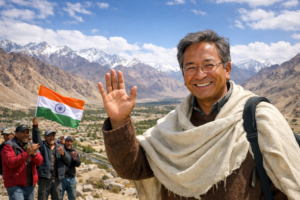
The Release of the ‘Real Phunsukh Wangdu’: What Sonam Wangchuk’s Freedom Means for India’s High-Altitude Frontier
After six months in the shadows of a high-security jail, the man who inspired a generation of Indians to dream of a better, more sustainable future has walked free.
For the people of Ladakh, the news that broke on a Saturday in mid-March wasn’t just a headline; it was a collective exhale. Sonam Wangchuk, the 59-year-old engineer, environmentalist, and activist, was released from a prison in Jodhpur, Rajasthan, ending a 180-day detention that had become a flashpoint for one of India’s most complex and emotionally charged regional movements.
The Ministry of Home Affairs’ decision to revoke his detention under the stringent National Security Act (NSA) came after “due consideration.” But for Wangchuk, his family, and the thousands who had taken to the freezing streets of Leh in support, it was a victory won through sheer resilience—a hunger strike turned into a six-month legal and moral battle with the world’s most populous democracy.
To understand why the release of one man in a remote corner of the Himalayas resonates so deeply, one must look beyond the political jargon of “statehood” and “constitutional safeguards” and see the land, the people, and the unlikely icon at the heart of the storm.
The Anatomy of a Protest: More Than Just a Flag
When Wangchuk began his indefinite hunger strike in September 2025, he wasn’t just demanding a change on a map. He was articulating a deep-seated existential fear shared by the 274,000 people of Ladakh.
Since August 2019, when the Indian government bifurcated the state of Jammu and Kashmir into two separate Union Territories (Jammu & Kashmir and Ladakh), the region has been in a state of administrative limbo. Being a Union Territory directly ruled by the central government in New Delhi means Ladakh has no elected legislative assembly of its own. It lacks the power to make laws on land, jobs, or culture.
For a fragile, high-altitude desert ecosystem bordering China and Pakistan, this isn’t a minor bureaucratic detail—it is a matter of survival. The core demands, which Wangchuk tirelessly articulated even as his health waned during his hunger strike, were twofold:
- Full Statehood: To have a local, elected government that understands the unique challenges of life at 11,500 feet.
- Sixth Schedule Protection: Alternatively, to be included under Article 244 of the Indian Constitution, which provides for autonomous tribal councils to protect land rights, cultural identity, and customary laws.
To the people of Ladakh, these demands are a shield. They fear that without these protections, their land could be opened to unfettered corporate exploitation, their Buddhist-majority culture could be diluted, and their fragile environment—the source of water for millions downstream—could be irretrievably damaged by unregulated tourism and infrastructure.
When the protests intensified in the winter of 2025, the government’s response was swift and severe. Clashes erupted, leaving four young Ladakhis dead and dozens wounded. It was the “bloodiest day” the region had seen in decades. In the aftermath, the administration pointed a finger at Wangchuk, blaming his “provocative speeches” for the violence and slapping him with the NSA—a colonial-era law that allows for detention without charge for up to a year.
The Man They Couldn’t Silence
What makes Wangchuk’s detention—and subsequent release—so significant is the man himself. He is not a typical firebrand politician. He is an innovator.
In a country obsessed with Bollywood, Wangchuk is known to millions as the real-life inspiration behind Aamir Khan’s character, Phunsukh Wangdu, in the blockbuster film 3 Idiots. That character, who believed in “excellence, not success,” was a direct nod to Wangchuk’s own life philosophy.
An engineer from the National Institute of Technology, Srinagar, Wangchuk could have built a lucrative career in India’s corporate sector. Instead, he returned to his cold, arid homeland and founded the Students’ Educational and Cultural Movement of Ladakh (SECMOL) in 1988. His mission was to reform the rigid, fear-based education system that failed local children by teaching in a language (Urdu) they didn’t understand and a curriculum irrelevant to their lives.
He built the SECMOL campus entirely out of mud and sun-dried bricks—a radical “passive solar” structure that stays warm without electricity in a region where winter temperatures plunge to minus 30 degrees Celsius. He pioneered the “Ice Stupa” project, artificial glaciers that store winter water in the form of conical ice towers, which melt in the spring to provide irrigation to farmers. For this, he won the prestigious Ramon Magsaysay Award in 2018, often considered Asia’s Nobel Prize.
This is the man the Indian state held for six months without trial.
The contrast was jarring. Here was a global icon of sustainable living, a man who had devoted his life to peace and education, being treated as a threat to national security. His detention under the NSA—a law originally intended to deal with smugglers and anti-national elements—stunned his admirers worldwide. It turned a regional autonomy movement into a national debate about the limits of free speech and the right to peaceful protest in India.
Life Inside and the Waiting Game
For 180 days, Wangchuk was held in Jodhpur Central Jail, thousands of kilometers from the mountains he calls home. While the specifics of his incarceration were kept private, his wife, Gitanjali Angmo, became the public face of the fight for his freedom. Her petition to the Supreme Court challenging the legality of his detention kept the case alive in the national consciousness.
The government’s statement upon his release spoke of fostering “an environment of peace, stability, and mutual trust” and engaging in “meaningful dialogue with all stakeholders.” The wording suggests a calculated political retreat. Perhaps the sustained legal pressure from the Supreme Court, the growing media scrutiny, or the simmering anger in Leh made his continued detention more costly than his release.
Yet, the release is not a resolution. Wangchuk walked free, but the questions that led to his arrest remain unanswered. The Ladakh Apex Body and the Leh Nutrition Project, the coalitions leading the movement, have made it clear that the protests will continue until their demands are met. The four young men who died are still mourned. The pain is still raw.
What Happens Next? The Road to Ladakh
As Wangchuk returns to his beloved mountains, he steps back into a landscape that is both physically and politically frozen. The winter snows will soon melt, and with the spring, the voices demanding autonomy will likely grow louder again.
His release could be a pivotal moment. If the government is sincere about “dialogue,” Wangchuk is perhaps the only person with the moral authority and public trust to steer that conversation toward a peaceful conclusion. He has spent his entire life building bridges—literally, with his ice stupas, and metaphorically, between traditional knowledge and modern science.
The struggle for Ladakh is a microcosm of a larger global tension: the clash between centralized power and local identity, between economic development and ecological preservation, between security and civil liberties.
For now, the sight of Sonam Wangchuk breathing free air is a relief. But the silence that follows the breaking news is heavy with anticipation. The man who taught India to think differently about education is now asking it to think differently about its borders, its people, and its definition of security. And as he has shown for the past six months, Sonam Wangchuk is a man who can wait, patiently, for the thaw to come.
You must be logged in to post a comment.