
The Red Carpet Beyond Reach: Why the Star of an Oscar-Nominated Film on Gaza Can’t Enter the US
The Red Carpet Beyond Reach: Why the Star of an Oscar-Nominated Film on Gaza Can’t Enter the US
The 98th Academy Awards are set to unfold in Hollywood with all the usual glitz, glamour, and poignant speeches. But for one of the films vying for the industry’s highest honor, the journey to the Dolby Theatre has hit an insurmountable roadblock—not in the form of a logistical mishap or a lack of tickets, but at the border of the United States itself.
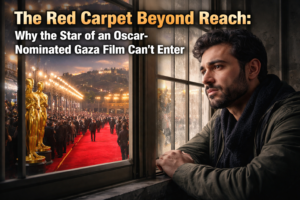
Motaz Malhees, a Palestinian actor with a starring role in the Oscar-nominated film The Voice of Hind Rajab, will be watching Sunday’s ceremony from afar. His absence isn’t a choice; it’s a consequence of a renewed travel ban imposed by former President Donald Trump, which restricts entry for individuals holding Palestinian travel documents. Malhees’ exclusion throws a stark, human focus onto the intersection of geopolitics, art, and immigration policy, turning what should be a celebratory moment into a powerful statement about whose stories are welcomed on the world’s biggest stage.
A Story Born from Tragedy
To understand the weight of Malhees’ absence, one must first understand the film that brought him here. The Voice of Hind Rajab is not a conventional war epic with sweeping battle scenes. It is an intimate, harrowing drama based on a real-life tragedy that shook the world in early 2024. The film recounts the final hours of five-year-old Hind Rajab, who became a symbol of the human cost of the conflict in Gaza.
Trapped in a family car surrounded by the bodies of her relatives, who had been killed by Israeli fire, the terrified girl made a desperate phone call to the Palestinian Red Crescent. For three agonizing hours, she pleaded for help to a call center operator, her small voice a haunting testament to her fear and confusion. The world listened, helpless, as the audio was shared online. In a devastating turn of events, the ambulance dispatched to rescue her was also struck by Israeli military fire, killing the two paramedics on board. Hind’s own fate was later confirmed: she, too, had been killed.
In the film, Malhees portrays the call center operator on the other end of the line—the man who became the last voice to offer Hind a sliver of hope. It is a role that requires immense emotional depth, serving as the audience’s conduit to the unseen horror. The operator’s helplessness, his desperate attempts to guide her to safety, and the traumatic silence that followed are the film’s emotional core. To nominate The Voice of Hind Rajab for Best International Feature Film is to acknowledge not just its cinematic merit, but the profound necessity of its story—a story of innocence, bureaucratic failure, and the stark reality of modern warfare.
The Proclamation That Closed the Door
For Malhees, the path from portraying this story to celebrating its recognition was blocked by a piece of paper signed in December. In a proclamation restricting the entry of foreign nationals, Donald Trump, preparing for his return to the presidency, cited security concerns as the basis for a sweeping measure. He stated his determination to “fully restrict and limit the entry of individuals using travel documents issued or endorsed by the Palestinian Authority.”
The proclamation, which went into effect on January 1, 2026, effectively bars anyone traveling on a Palestinian passport from entering the United States. For Malhees, whose identity is solely tied to this documentation, the door to the Oscars slammed shut. He took to Instagram to share his frustration and sorrow, stating simply, “I am not allowed to enter the United States because of my Palestinian citizenship.” The phrase “it hurts” is a profound understatement for an artist watching his life’s work receive its highest accolade from the other side of a closed border.
This isn’t a case of an individual being flagged for a specific security risk. Malhees is being barred because of his national identity, a blanket policy that makes no distinction between a militant and an artist. It echoes the infamous “Muslim ban” of Trump’s first term, which targeted several majority-Muslim nations and faced years of legal challenges before being upheld in a modified form by the Supreme Court. The current iteration, focused specifically on Palestinian documentation, arrives at a time of heightened global tension and debate over the war in Gaza.
A Painful Irony
The situation is layered with painful irony. The very nation that is honoring a film about a Palestinian child’s death is simultaneously preventing one of its key storytellers from entering its borders. It raises uncomfortable questions for the Academy of Motion Picture Arts and Sciences, which has increasingly positioned itself as a champion of diversity and global voices. How does an institution celebrate a story of Palestinian suffering while its government enforces a policy that silences the Palestinians who lived it?
The Academy has not officially commented on Malhees’ specific case, but the optics are impossible to ignore. The red carpet, meant to be a universal symbol of artistic achievement, has become a boundary line drawn by political decree. While Malhees is barred, other members of the film’s cast and crew, who hold citizenships in other countries, are able to travel. This arbitrary separation based on the document one holds lays bare the uneven application of mobility rights, even among colleagues who share a heritage and worked side-by-side on the same project.
A Broader Pattern of Silencing
Malhees’ predicament is not an isolated incident but part of a larger, more troubling pattern. The article also highlights the case of Leqaa Kordia, a Palestinian woman who lost over 170 family members in Gaza and was detained by U.S. immigration authorities for a year. Despite two previous orders for her release, she remained behind bars until an immigration judge finally ordered her freed on the Friday before the Oscars. Her story, like Malhees’, speaks to a climate where pro-Palestinian voices are increasingly viewed with suspicion and subjected to extraordinary measures.
The Trump administration has made no secret of its intent to deport or exclude foreign nationals it deems sympathetic to the Palestinian cause. This creates a chilling effect, signaling that certain perspectives—particularly those critical of Israeli government policy—are unwelcome in American public discourse. By silencing these voices, the policy aims to control the narrative around the conflict, ensuring that the stories that reach American audiences are filtered through a lens of national security rather than human experience.
What is Lost When a Storyteller is Silenced?
When Motaz Malhees cannot attend the Oscars, the loss is multi-faceted. On a personal level, it is the loss of a dream—the culmination of years of work, the thrill of walking the red carpet, the camaraderie of his fellow nominees, and the potential to connect with a global audience in person. It’s a professional milestone stolen by geopolitics.
For the audience, the loss is more profound. It is the loss of a human connection. Had Malhees been present, his speech, his interviews, and his mere presence would have served as a powerful counter-narrative to the dehumanization that often pervades discussions of conflict. He would have been the living, breathing proof of Palestinian culture, resilience, and artistic achievement. His face would have reminded the world that Palestinians are not just a statistic in a casualty report, but a people with dreams, talents, and stories to tell. His absence leaves a void where that human connection should be.
The Unanswered Question
The U.S. State Department did not immediately respond to a request for comment on Malhees’ specific case. This silence is, in itself, a form of answer. It suggests that the denial of a visa to an artist is not seen as a matter of concern or consequence within the framework of this policy. It is a routine application of a rule, with little regard for the individual caught in its gears.
As the stars gather in Hollywood on Sunday night, The Voice of Hind Rajab will be represented, perhaps by the director or other cast members who hold different passports. They will speak for the film. But the voice of its central actor, the one who channeled the desperation of a man helplessly listening to a child die, will be missing. He will be watching from afar, a Palestinian artist barred from celebrating a film about a Palestinian child, whose own voice was silenced by war and then amplified by his art.
The juxtaposition is a stark and uncomfortable one. It forces us to confront the gap between the stories we choose to honor and the storytellers we choose to keep out. In barring Motaz Malhees, the United States has sent a clear message about who it considers a threat. But in nominating his film, the global film community has sent an equally clear message about whose stories deserve to be heard. These two realities now exist in painful, irreconcilable tension, playing out not on a battlefield, but on the world’s most famous red carpet.
You must be logged in to post a comment.