
The Realme P4 Power: More Than Just a Battery Behemoth? A Deep Dive Ahead of Its India Launch
The Realme P4 Power, launching in India on January 29, 2026, is positioned as a groundbreaking “endurance flagship,” centered around an unprecedented 10,001mAh battery designed to deliver over a day and a half of regular use and exceptional standby time.
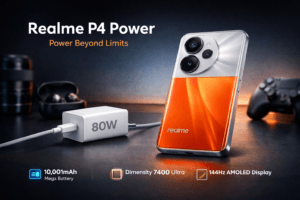
To complement this massive power cell, it expects to balance performance with a MediaTek Dimensity 7400 Ultra processor, a 144Hz AMOLED display, 80W fast charging, and a durable IP68/IP69-rated design developed in collaboration with Pearl Academy. Priced competitively between ₹30,000 and ₹37,999, and backed by a promise of three years of Android updates, the device targets power users seeking to eliminate battery anxiety without sacrificing on speed, display quality, or long-term software support, carving a unique niche in the crowded mid-premium segment.
The Realme P4 Power: More Than Just a Battery Behemoth? A Deep Dive Ahead of Its India Launch
The smartphone landscape is perpetually caught in a tug-of-war between raw power, enduring battery life, and sleek design. On January 29, 2026, Realme throws a monumental contender into this ring with the launch of the Realme P4 Power in India. Promising to redefine the very concept of a “power smartphone,” this device isn’t just another incremental update. It’s a statement piece, built around a staggering 10,001mAh battery, but aims to be far more than just a portable power bank with a screen. Let’s dissect what this launch means for the Indian mid-premium segment and whether the P4 Power truly has the chops to deliver a balanced, powerhouse experience.
The Unmistakable Heart: Decoding the 10,001mAh Promise
Let’s address the elephant in the room first. A 10,001mAh battery isn’t just a spec; it’s a philosophy. In an era where “all-day battery” has become a diluted marketing term, Realme is pushing for a “day-and-a-half-plus” standard for regular users. The claimed 31 days of standby and 2 hours of usage from 3% battery aren’t just numbers—they’re potential game-changers for specific user cohorts.
Who is this for? Imagine the frequent traveler, the on-field sales executive, the content creator shooting all day, or simply the anxiety-ridden user tired of battery percentage dictating their life. For them, this phone could be a liberation. However, the real insight lies in the execution. A battery this large historically meant three things: immense weight, painfully slow charging, and software throttling to manage heat and longevity. Realme’s claimed 80W fast charging is the crucial counterbalance here. If optimised, it could mean going from zero to a significant charge in the time it takes for a coffee break, mitigating the drawback of a full charge cycle taking longer. The true test will be real-world heat management during these charging sessions and the actual longevity of the battery over 2-3 years of such intense charging cycles.
Beyond the Battery: The “Power” in Performance and Craft
A massive battery paired with a mediocre chipset would be a tragic compromise, creating a sluggish, frustrating experience. Realme seems aware of this. The expected MediaTek Dimensity 7400 Ultra processor, coupled with up to 12GB of RAM, positions the P4 Power firmly in the performance-centric mid-range. This chipset should comfortably handle demanding tasks, high-frame-rate gaming (aided by the 144Hz AMOLED display), and seamless multitasking. The inclusion of a “HyperVision” and an AI chip hints at ambitions beyond raw processing—possibly focusing on advanced computational photography, display enhancement, and efficient task allocation to maximise that colossal battery.
The design partnership with Pearl Academy is a fascinating narrative. In a market flooded with derivative designs, this collaboration suggests Realme is aiming for the P4 Power to be a stylistic statement, not just a technical one. The confirmed TransOrange, TransBlue, and TransSilver colourways indicate a potential translucent or gradient aesthetic that could make the device stand out. The promised IP68/IP69 ratings are the final piece of the durability puzzle, suggesting this phone is built to withstand not just a long day, but a rough one.
The Software and Longevity Proposition: A Commitment to Future-Proofing
Running Android 16 out-of-the-box with Realme UI 7.0 places the P4 Power at the forefront of software innovation. However, the more significant commitment is the promised three years of Android version updates and four years of security patches. In the ₹30,000-₹40,000 segment, this is a substantial value proposition. It transforms the device from a short-term purchase into a long-term investment, ensuring that the hardware remains relevant and secure. This move pressures competitors to match such commitments and is a win for consumer rights.
Camera & Display: The Supporting Cast Needs to Shine
While the battery and processor are headliners, the user experience is holistic. The speculated 50MP OIS main camera and 8MP ultra-wide need to be tuned exceptionally well. The challenge for Realme’s software team will be to leverage the AI and HyperVision chips to deliver consistent, crisp images in various lighting conditions, ensuring the camera isn’t an afterthought. The 6.78-inch 144Hz AMOLED display is another critical component. It promises smooth scrolling and vibrant visuals—a necessity for media consumption and gaming. The combination of high refresh rate and a large battery is ideal, as users can finally enjoy buttery-smooth UI without constantly worrying about draining their phone by lunchtime.
Price, Positioning, and the Market Rumble
The expected price bracket—starting below ₹30,000 for a base variant and going up to ₹37,999 for the 12GB/256GB model—places the P4 Power in a fiercely competitive zone. It will clash with the likes of the Nothing Phone (3), the Samsung Galaxy A-series, and Xiaomi’s Redmi Note Pro lineup. Its unique selling proposition (USP), however, is uncontested in this range: no other phone offers this combination of flagship-level battery capacity, high-performance chipset, premium display, and robust update policy.
The Flipkart-exclusive launch strategy is a calculated move, leveraging the platform’s reach during the Republic Day sale period. For the value-conscious Indian consumer, the P4 Power presents a compelling “all-rounder” case, especially for those who prioritise battery life above all else without wanting to sacrifice performance.
Final Verdict Before the Launch: A Calculated Gamble with High Rewards
The Realme P4 Power is not a device for the minimalist or the weight-conscious. It is a purposeful, maximalist tool designed for users whose smartphone is their primary gateway to work, entertainment, and connection. It asks a simple question: What is true power? Is it the fleeting speed of a chipset that dies by evening, or is it the relentless, dependable endurance that lets you forget about outlets and focus on your life?
By betting big on the battery while seemingly not compromising on core performance, display, or software support, Realme is addressing a profound, often unspoken pain point. The success of this gamble hinges on execution—managing the device’s weight and ergonomics, ensuring the fast charging is reliable and cool, and tuning the cameras to be competitive.
As January 29 approaches, the P4 Power stands as one of the most intriguing launches of early 2026. It has the potential to carve out a new niche: the “Endurance Flagship.” If it delivers on its promises, it won’t just be a new phone on the shelf; it could very well shift the industry’s conversation about what a powerful phone truly needs to be.
You must be logged in to post a comment.