
The Quiet Tech Revolution: How a Chinese Farm is Redefining Agriculture’s Value
The Quiet Tech Revolution: How a Chinese Farm is Redefining Agriculture’s Value
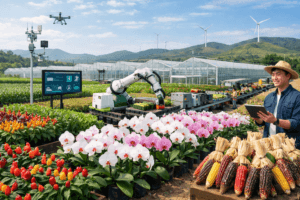
Beyond the rows of moth orchids timed to bloom for the Lunar New Year and the miniature, jewel-toned corn cobs lies a fundamental question: what is farming for? In Rizhao, Shandong Province, one company’s answer is transforming a plot of land into a versatile engine of beauty, nutrition, and economic resilience. This is not a story of isolated innovation, but a glimpse into the future of agriculture—a future being written today in China’s high-tech greenhouses.
More Than a Greenhouse: The Infrastructure of Intelligence
The story of Yilan Biotechnology begins with its products—ornamental peppers and festival-ready orchids—but its foundation is built upon a less visible, more powerful layer: a regional commitment to smart agricultural infrastructure. The farm operates within an ecosystem where technology is the primary input.
In nearby fields, high-standard farm construction projects have turned challenging terrain into connected, intelligent production zones. Farmers who once relied on unpredictable rainfall now manage irrigation with a swipe of a card, triggering systems that deliver water directly to plant roots with 20-30% greater efficiency. This is made possible by a network of soil moisture sensors and climate monitoring stations that feed real-time data into centralized smart platforms. For a nursery like Yilan’s, this means the exacting conditions moth orchids require—specific humidity, temperature, and light—are not left to chance but are continuously calibrated by data.
This technological groundwork extends from the field to the machinery. In the same region, companies are equipping agricultural robots with “smart brains,” developing intelligent transplanting robots and harvesters that reduce labor needs by two-thirds while significantly improving crop quality. When Yilan’s miniature colored corn is ready, it is likely harvested and processed in an environment where artificial intelligence and automation handle the heavy lifting, preserving the perfect, blemish-free appearance that gives it value as both food and decoration.
The table below summarizes the key technological pillars enabling modern, high-value farms like Yilan Biotechnology:
| Technological Pillar | Key Components | Primary Impact on Farming |
| Precision Environment Control | Smart greenhouses, IoT sensors (soil/climate), automated ventilation/lighting | Creates optimal, consistent growing conditions; enables cultivation of sensitive, high-value crops like orchids. |
| Data-Driven Decision Making | Centralized farm management platforms, real-time analytics, predictive modeling | Replaces guesswork with science; allows precise scheduling of irrigation, fertilization, and harvest. |
| Intelligent Automation | AI-powered transplanting/harvesting robots, autonomous guided vehicles (AGVs) | Drastically reduces labor costs and physical strain; improves efficiency and minimizes crop damage. |
| Logistics & Supply Chain Tech | Automated sorting, packaging, and cold-chain systems (inferred from product quality focus) | Maintains product integrity from farm to consumer, essential for premium decorative and fresh-food items. |
The Science of Beauty: Breeding and Timing the Bloom
The most striking symbol of this new agriculture is the moth orchid, a plant whose cultivation is a masterclass in applied biological science. Globally, the Phalaenopsis orchid market is a high-stakes industry led by producers in the Netherlands and Taiwan, with hundreds of millions of plants sold annually. Success hinges on a deep understanding of genetics and precise environmental control.
Conventional breeding through hand-cross hybridization remains central, with breeders selecting parent plants for desirable traits like vibrant color, large blooms, and strong stems. The goal at farms like Yilan is to produce uniform, visually spectacular plants that will reach peak bloom for specific holidays, a process requiring exact control over flowering triggers such as temperature.
Behind the scenes, biotechnology plays a crucial role. Techniques like tissue culture micropropagation allow for the mass production of identical, virus-free plantlets from a single superior specimen. For a company targeting the premium holiday market, ensuring every plant is a flawless, predictable performer is an economic necessity. The advanced greenhouse, often a feat of engineering from specialized firms, provides the stable habitat these laboratory-born plants need to thrive.
A New Business Model: Multi-Use Crops and Cultural Connection
Technology enables new products, but insight into culture and market creates their value. Yilan Biotechnology exemplifies a shift from volume-based to value-based farming. Each product is designed with multiple revenue streams in mind:
- Colorful Peppers: They are marketed not just as vegetables but as living ornaments, their glossy, rich hues offering aesthetic value before they are ever consumed.
- Miniature Colored Corn: This product perfectly encapsulates the model. It is edible, can be dried and painted for home décor, and is bundled into symbolic bouquets for weddings, representing fertility and abundance.
- Festival Orchids: Here, precision farming meets deep cultural tradition. By orchestrating blooms for the Spring Festival, the farm taps into a seasonal market where flowers are central to celebration and gift-giving.
This approach requires more than agronomic skill; it demands entrepreneurial creativity. Farmers and agricultural companies are becoming brand managers and experience creators, understanding that the story behind a perfectly timed bloom or a multi-purpose corn cob can be as valuable as the product itself.
Cultivating a Sustainable Future
The implications of this model extend beyond profit. The intelligent systems that allow for perfect orchid blooms also conserve vital resources. Precision irrigation dramatically reduces water waste. Data-informed fertilization minimizes runoff and soil degradation. Furthermore, by generating higher income per square meter, this form of agriculture can make smaller plots of land economically viable, potentially easing pressure on broader ecosystems.
Perhaps the most significant harvest is the renewed sense of possibility for rural communities. As noted in regional reports, when technology solves problems like irrigation and labor, the hard work of farming becomes a managed, technical profession. This can make agriculture an attractive career for a new generation, ensuring that the knowledge and culture of farming evolve rather than fade.
Conclusion
The quiet revolution in Rizhao is a template for a more resilient, creative, and sustainable agricultural future. It demonstrates that the merger of digital intelligence, biological science, and cultural wisdom can redefine what we grow and why. In this new era, a farm’s success is measured not only by the tonnage of its harvest but by the beauty it nurtures, the traditions it honors, and the innovative spirit it cultivates—proving that with the right tools and vision, even the most traditional field can blossom with new value.
You must be logged in to post a comment.