
The Quiet Erosion: More Than 36,000 Displaced as Israel’s West Bank Settlement Drive Reshapes the Land
A new UN report reveals that over 36,000 Palestinians have been forcibly displaced in the West Bank over the past year due to an accelerated Israeli settlement drive, widespread demolitions, and a sharp increase in organised settler violence that often occurs with Israeli military support or acquiescence. The report, covering the period up to October 2025, describes a systematic pattern of land confiscation and population transfer in Area C, suggesting this amounts to a concerted policy of de facto annexation that human rights officials warn could constitute “ethnic cleansing.” While the world’s attention has focused on Gaza, this quiet erosion in the West Bank—through the destruction of homes, livelihoods, and entire herding communities—is rapidly making a contiguous, viable Palestinian state physically impossible, highlighting the growing chasm between international law and the reality on the ground.
The Quiet Erosion: More Than 36,000 Displaced as Israel’s West Bank Settlement Drive Reshapes the Land
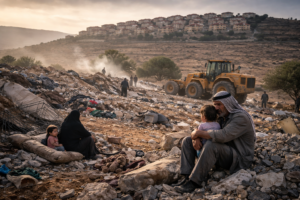
For the world, the occupied West Bank often exists as a headline—a flashpoint in a decades-old conflict, a subject of diplomatic statements and UN resolutions. But for the more than 36,000 Palestinians forcibly displaced over the past year, it is a landscape of loss. It is the specific, heart-wrenching sound of a bulldozer flattening a family home, the chilling sight of armed settlers marching through a neighbour’s olive grove, and the suffocating realisation that there is no safe place left to go.
A new report from the UN human rights office, covering the 12 months to October 31, 2025, has pulled back the curtain on a relentless, accelerating process. It paints a picture not just of conflict, but of a systematic restructuring of the West Bank’s very geography and demography. While the world’s gaze has been fixed on the catastrophic war in Gaza, the West Bank—home to 2.7 million Palestinians—has been undergoing a quiet, or not-so-quiet, transformation. The report details the displacement of over 36,000 people, a surge in settler violence, and the accelerated de facto annexation of land, raising the spectre of a campaign that human rights officials say could amount to “ethnic cleansing.”
Beyond the Numbers: The Anatomy of Displacement
The figure 36,000 is stark, but it is the human stories behind it that reveal the true nature of the crisis. Displacement in the West Bank is rarely a single, dramatic event like the mass exoduses seen in Gaza. Instead, it is a slow, grinding process of attrition—a death by a thousand cuts.
For families in Area C, the 60% of the West Bank under full Israeli military and civilian control, life is a precarious existence on borrowed time. The UN report cites a “concerted policy of mass forcible transfer,” evidenced by the scale and pattern of displacement. This isn’t chaos; it’s a strategy with a clear, bureaucratic playbook.
Take the herding communities in the Masafer Yatta region, in the southern West Bank hills. For generations, Palestinians lived in caves and makeshift structures, moving with their flocks as their ancestors did. In recent years, Israel has designated vast swathes of this land as a military firing zone (Firing Zone 918). The policy is simple: demolish any structure—homes, schools, rainwater cisterns, animal pens—built without a permit. Permits, however, are nearly impossible for Palestinians to obtain. The result is a forced, slow-motion evacuation. Families watch their water supply destroyed, their children’s classrooms reduced to rubble, and their livelihoods scattered. Faced with an unlivable existence, they pack what little they can onto a donkey cart and leave the land their families have tended for centuries. They don’t flee from a sudden assault, but from a methodically engineered emptiness.
This is the daily reality the UN report documents. It speaks of 1,732 incidents of settler violence—a sharp rise from 1,400 in the previous period. But the report makes a crucial, damning observation: this violence occurs in “a coordinated, strategic and largely unchallenged manner,” with Israeli authorities often enabling or participating.
The term “settler violence” itself can be misleading, conjuring images of rogue individuals. The reality on the ground is often far more organised. Armed settlers, sometimes escorted by Israeli soldiers, regularly storm Palestinian villages, particularly during olive harvest season—a time of immense economic and cultural significance. Trees that have been in a family for generations, passed down from father to son, are set on fire or cut down. Crops are torched. Gravestones in village cemeteries are smashed. Palestinians attempting to defend their land are often met with arrest or live fire from the military, whose role is frequently framed as “securing” the settlers rather than protecting the Palestinians.
This is not merely random vandalism. It is a land-grab strategy. The terror inflicted is a tool to force people out. A family whose patriarch is shot and killed while checking on his land, whose son is beaten and arrested, and whose livelihood is incinerated, faces an impossible choice: stay and risk everything, or leave for the relative safety of a city like Hebron or Ramallah. Many, exhausted and terrified, choose the latter, adding their names to the UN’s grim tally of the displaced.
The Architecture of Annexation
Underpinning the violence and demolitions is a relentless expansion of Israeli settlements. The report notes a significant acceleration in what it calls the “annexation of large parts of the West Bank.”
More than 500,000 Israeli settlers now live in settlements across the West Bank, communities considered illegal under international law, a view Israel disputes by citing biblical and historical ties to the land. These are not sparse outposts. They are sprawling suburban communities, complete with industrial zones, shopping malls, and a network of segregated roads that carve up the West Bank, connecting settlements to each other and to Israel while severing Palestinian communities from one another.
A drive through the central West Bank reveals the geography of control. Hilltops are crowned with the red-roofed houses of settlements, gleaming and connected by modern highways. In the valleys below, Palestinian villages are often cramped, their growth stifled by zoning restrictions that forbid building on their own land, and their movement choked by checkpoints and roadblocks.
The new wave of settlement activity, documented in the report up to October 2025, has focused on deepening this control. It’s not just about new homes; it’s about strategic outposts that block Palestinian territorial continuity, seize control of water aquifers, and surround Palestinian cities, cutting them off from their natural hinterland. The goal, as many analysts see it, is to make the possibility of a contiguous, viable Palestinian state a physical impossibility.
This is the context for the UN’s grave warning about “ethnic cleansing.” The term, laden with the historical trauma of the 20th century, is not used lightly. It refers to the use of force to render an ethnically homogeneous area. In the West Bank, the mechanism is clear: the systematic removal of Palestinians from strategic areas—particularly Area C—through a combination of military orders, legalistic hurdles, and organised settler violence, in order to expand and consolidate Israeli civilian control. The report suggests the pattern is not incidental but indicative of a deliberate policy.
A World of Witnesses, A Failure of Action
The response to the UN report has followed a familiar, tragic script. The UN human rights office, based in Geneva, presents its findings. The Israeli mission in Geneva dismisses the report, arguing the office has “lost its credibility,” a refrain used in response to previous criticisms.
The United States, Israel’s closest ally, has historically shielded it from international consequences, including at the UN Security Council. European nations issue statements of “concern” and urge restraint. Human rights organisations like B’Tselem in Israel and Amnesty International publish detailed reports with identical findings. The International Court of Justice (ICJ) is already considering the legality of the occupation.
Yet, on the ground, the bulldozers keep moving, the settlers keep coming, and the families keep leaving. The gap between international law and diplomatic action has never been wider. For the displaced, the world’s statements are meaningless. The only thing that matters is the key to a home that no longer exists, or the memory of a grove of ancient olive trees now reduced to ash.
The Human Cost of a Political Impasse
The UN report is a document of our time, a snapshot of a conflict reaching a critical juncture. The displacement of 36,000 people in a single year is not a footnote; it is a headline. It signals a profound shift in the reality of the West Bank, one where the two-state solution—long the bedrock of international diplomacy—is not just dying but is being actively buried.
As the sun sets over the hills outside Ramallah, a displaced family might be huddled in a rented room, surrounded by salvaged belongings. The father, once a shepherd, now looks for day labour. The children, uprooted from their village school, struggle to adapt to a crowded city classroom. They are not a statistic in a UN database. They are the human consequence of a process that treats land as more valuable than lives, and political ambitions as more important than human rights. The world may have its attention fixed elsewhere, but in the West Bank, the quiet, relentless erosion of a people and their homeland continues, one demolished home, one torched field, one terrified family at a time.
You must be logged in to post a comment.