
The Quiet Dying: How Climate Change is Rewriting the Fate of India’s Ancient Forests
A comprehensive 50-year study of India’s Pachmarhi Biosphere Reserve has revealed that the region lost 13% of its forest cover between 1972 and 2020, driven not only by human pressures like encroachment and extraction but significantly by long-term climate shifts, including rising temperatures (with fire risk spiking above 32°C) and changing rainfall patterns that disrupt the forests’ natural lifecycles; dry teak forests have been hit hardest, losing over 41% of their canopy, and while the reserve’s rich biodiversity offers some resilience, researchers warn that strengthening conservation and adaptive forest management is urgently needed to protect these critical ecosystems that support both wildlife and local communities.
The Quiet Dying: How Climate Change is Rewriting the Fate of India’s Ancient Forests
New 50-year study reveals Pachmarhi Biosphere Reserve has lost 13% of its forest cover, with dry teak ecosystems on the frontlines of a warming world
The forests of central India have always known how to wait. For centuries, their deciduous trees have stood patiently through scorching summers, shed their leaves in dignified surrender, and burst back to life with the first whispers of the monsoon. It was a rhythm written in ancient code—predictable, reliable, timeless.
But the code is breaking.
Standing at the edge of a dry teak forest in Madhya Pradesh’s Pachmarhi Biosphere Reserve, Amit Kumar has spent years watching trees behave in ways that would have seemed impossible to his predecessors. Leaves emerging at the wrong time. Canopies thinning for reasons that have nothing to do with axes or grazing cattle. Fires burning where fires never used to burn.
“What we’re witnessing isn’t just deforestation in the traditional sense,” says Kumar, a professor at Banaras Hindu University and co-author of a landmark new study examining five decades of ecological change in the region. “This is something more insidious. The forests themselves are changing how they live.”
A Half-Century of Silence: What the Data Reveals
Between 1972 and 2020, the Pachmarhi Biosphere Reserve—a 4,900-square-kilometer mosaic of tropical deciduous forests nestled in the Satpura range—lost approximately 391 square kilometers of forest cover. That’s 13% of its wooded landscape, an area larger than the city of Mumbai.
But numbers alone fail to capture what’s being lost.
When Kumar and his colleagues from the Central University of Jharkhand and Banaras Hindu University began analyzing five decades of climate data alongside satellite imagery, they expected to find the familiar fingerprints of human pressure. Encroachment. Illegal logging. The slow creep of agriculture. These forces were certainly present, but they weren’t the whole story.
“We couldn’t find areas that had been recorded as forest patches in 1972,” Kumar explains, his voice carrying the weight of someone who has walked those missing forests. “By 2020, they had either turned into scrub forests or been converted into other types of land use. But when we dug deeper into the climate data, we realized that anthropogenic pressures alone couldn’t explain what we were seeing.”
The climate of central India has been quietly rewriting itself.
Temperatures across the reserve have risen steadily and significantly since 1971, with the most dramatic warming occurring during the post-monsoon period—a critical window when forests traditionally recover from the rains and prepare for winter. Rainfall patterns have shifted too, with precipitation increasingly falling during pre-monsoon months rather than after the monsoon, disrupting the seasonal cadence that deciduous forests depend upon.
These aren’t abstract statistics. They’re the difference between a forest that thrives and one that merely survives.
When 32 Degrees Becomes a Point of No Return
In the Pachmarhi Biosphere Reserve, the number 32 carries special significance.
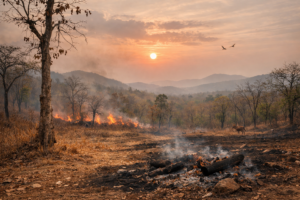
When maximum temperatures climb past this threshold, something shifts in the relationship between fire and forest. The study found that crossing 32°C dramatically increases fire risk—not because of arson or careless travelers, but because the forest itself becomes more flammable. Drier leaf litter. Stressed trees shedding more debris. A landscape holding its breath, waiting for a spark.
The reserve has always experienced fires, but not like this. Not with this frequency. Not with this intensity.
“We observed that higher temperatures were the dominant factor driving fires,” Kumar notes. “When you combine consistent warming with reduced precipitation, you create conditions where fires aren’t just possible—they’re almost inevitable.”
Dry teak forests have suffered most severely, losing 41.26% of their canopy cover over the study period. Dry mixed deciduous forests followed at 19.95%. These aren’t random casualties. They’re the forests that operate closest to their moisture stress thresholds, leaving them with the smallest margin for error in a changing climate.
Moist teak forests, by contrast, have fared somewhat better. Their deeper canopy cover and access to more reliable moisture make them buffer against short-term climate instability—at least for now.
The Unraveling of Ancient Rhythms
To understand what’s being lost, you have to understand how deciduous forests live.
Unlike evergreen forests that wear the same clothes year-round, central India’s tropical deciduous forests are creatures of habit and season. They drop their leaves in the dry months—a strategy to conserve water when the earth hardens and the sky offers no relief. They green again when the rains return, timing their rebirth with a precision that seems almost miraculous.
This phenology—the timing of biological events—isn’t just beautiful. It’s functional.
“When the phenological window gets shorter, it affects the tree’s season for photosynthesis,” explains Rajiv Chaturvedi, lead of the IUCN‘s Forest Ecosystems Specialist Group and associate professor at BITS Pilani Goa. “In a forest, this shorter window can affect productivity, and over the long term, cause their carbon sinks to weaken.”
In other words, when trees can’t photosynthesize for as long, they can’t grow as much. They can’t store as much carbon. They can’t support the same diversity of life. The entire system slows down, becoming less productive, less resilient, less alive.
Beependra Singh, a remote sensing expert with the Wildlife Institute of India who was not involved in the study, has observed these shifts firsthand in his work at Jharkhand’s Dalma Wildlife Sanctuary. Year-to-year observations revealed that Semal trees advanced their leaf development in 2023 compared to 2022—a response to moisture deficit and rainfall shortfall, combined with rising winter and spring temperatures.
“Moist deciduous forests often receive more rainfall and have deeper canopy cover, making them somewhat more resilient to short-term climate instability,” Singh says. “Dry deciduous forests, on the other hand, function closer to moisture stress thresholds, making them more vulnerable.”
The Resilience Paradox: Why Biodiversity Matters Now More Than Ever
Here’s the paradox at the heart of this story: even as the Pachmarhi Biosphere Reserve loses forest cover, it remains extraordinarily diverse.
A study of 62 plots within the reserve, each covering half a hectare, revealed 190 different plant species—85 trees, 23 shrubs, and 82 herbs. Approximately 37% of these species appear on the IUCN Red List, marking them as conservation priorities.
This biodiversity isn’t just a statistic to celebrate. It may be the reserve’s best hope.
“When there’s more diversity in a contiguous forest patch, it’s more likely that there are species which are able to survive structural changes locally,” Chaturvedi explains. “That helps keep the ecosystem intact even as individual species struggle.”
Think of it as an ecological insurance policy. In a diverse forest, when conditions shift beyond what one species can tolerate, another may step in to fill its role. The forest changes, but it doesn’t collapse. The ecosystem bends, but it doesn’t break.
This resilience has limits, of course. The study found an increase in “greening” between 2006 and 2021, likely reflecting government restoration programs like REDD+. But these gains remain fragile, vulnerable to being undone by the same warming temperatures that drive productivity losses.
Beyond the Reserve: What Central Indian Forests Mean for a Nation
The stakes here extend far beyond the boundaries of a single biosphere reserve.
Central India’s forests stretch across more than 40,000 square kilometers—an area roughly the size of Switzerland spanning Madhya Pradesh, Maharashtra, and Chhattisgarh. They’re famous for harboring one of the world’s most robust tiger populations, but their importance runs deeper than charismatic megafauna.
These forests are among India’s largest contiguous wooded tracts, serving as critical carbon sinks, watersheds, and climate regulators for the entire region. Their health influences rainfall patterns, soil conservation, and agricultural productivity across the central Indian landscape.
“The destruction of these central Indian tropical deciduous forests may affect rainfall distributions in a country whose economy is still reliant on agricultural output,” Singh warns.
They’re also lifelines for millions of people. Central Indian forests rank among the country’s most significant sources of minor forest produce and non-timber forest products—the nuts, leaves, fruits, and fibers that sustain rural economies and support communities who have lived alongside these trees for generations.
When forests change, those communities change too. When forests struggle, so do they.
The Path Forward: Adaptation, Restoration, and the Human Element
The Pachmarhi study concludes with recommendations that sound straightforward but will prove extraordinarily difficult to implement: strengthen conservation strategies, promote sustainable land-use practices, and enhance adaptive forest management.
Translation: we need to help these forests help themselves.
For researchers like Kumar, this means building better baselines—understanding exactly what grows where, how it responds to stress, and which species might serve as anchors for ecosystem recovery. The Pachmarhi study is part of a larger project documenting 762 forest plots across the region, creating an ecological foundation for future management decisions.
For forest managers, it means thinking differently about fire. Not as a threat to be suppressed at all costs, but as a force to be understood and managed in a warming world. It means identifying which forests need protection and which may need assistance transitioning to new conditions.
And for everyone else—the policymakers, the conservationists, the citizens who will never walk these forests—it means recognizing that climate change isn’t a future threat to India’s wild places. It’s a present reality, already reshaping ecosystems in ways we’re only beginning to understand.
“There’s an urgent need for evidence-based forest management and climate adaptation measures,” Singh emphasizes. “Understanding how these ecosystems adapt to long-term climatic variability is critical for predicting future changes in vegetation shape, productivity, and forest health.”
Walking the Edge
On a late winter morning in the Satpura hills, the forests of Pachmarhi still look timeless. Sunlight filters through teak canopies, dappling the forest floor where langurs pick their way through the understory. Birds call across invisible territories. The air smells of earth and leaf litter and something older than memory.
But the timelessness is an illusion.
Every tree standing here is making decisions its ancestors never faced. When to leaf. When to rest. How much energy to invest in growth versus survival. How to cope with heat that arrives earlier and stays longer, rains that come at the wrong time or don’t come at all.
They’re learning to live in a world that has shifted beneath them. Whether they can learn fast enough—whether their ancient rhythms can adapt to a climate that no longer follows the rules—is the question that will define the future of central India’s forests.
The answer isn’t written yet. But it’s being written now, in the growth rings of stressed trees, in the patterns of shifting rainfall, in the decisions of communities and policymakers who hold these forests’ fate in their hands.
The forests have always known how to wait. Now, they’re waiting to see what comes next.
You must be logged in to post a comment.