
The Quiet Dismantling: Why Another BIA Reorganization Threatens More Than Just Jobs
The Bureau of Indian Affairs faces yet another round of staff cuts and reorganization—implemented without tribal consultation—that threatens to cripple an already underfunded and understaffed agency. Tribal leaders warn that previous workforce reductions, which reached as high as 29 percent in some regional offices, have caused critical delays in law enforcement, infrastructure projects, and treaty obligations. While the administration frames the cuts as a move toward efficiency and tribal empowerment, critics argue that hollowing out the BIA erodes the federal government’s trust responsibility and severs the institutional knowledge necessary to serve Tribal Nations, leaving essential services and legally mandated programs at risk of collapse.
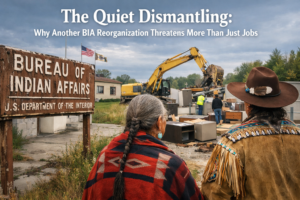
The Quiet Dismantling: Why Another BIA Reorganization Threatens More Than Just Jobs
For decades, the Bureau of Indian Affairs (BIA) has occupied a unique and often contradictory space in the American legal landscape. Established long before the United States adopted its current form, the agency was originally a tool of subjugation and removal. Over generations, through the bloodshed of the Indian Wars and the cruelty of the boarding school era, it has—by force of law and tribal advocacy—grudgingly evolved into a fiduciary hub. Today, it is the entity tasked with upholding the federal government’s trust responsibility to Tribal Nations.
But for those who live and work in Indian Country, the BIA has always been a paradox: an institution that is simultaneously indispensable and perpetually broken. It is chronically underfunded, historically mismanaged, and now, according to recent testimony before Congress, facing another wave of reorganization and staffing cuts that tribal leaders say could push the system past a breaking point.
The announcement, delivered by Mark Macarro, president of the National Congress of American Indians (NCAI) and chairman of the Pechanga Band of Indians, was brief but seismic. During a congressional hearing regarding fiscal year 2027 funding, Macarro revealed that the BIA is planning to implement a reorganization plan that will result in “significant cuts to the staff critical in administering programs and distributing funding to tribal nations.”
The news came without formal consultation. It came without a public plan. And it came just months after agency officials told the Government Accountability Office (GAO) that there were “no plans to reorganize or further reduce the workforce.”
For tribal leaders, this isn’t just bureaucratic whiplash. It is a confirmation of a growing fear: that the federal government, under the guise of efficiency, is systematically hollowing out the infrastructure required to deliver treaty-guaranteed services.
The Numbers Behind the Rhetoric
To understand the gravity of the moment, one must look at the toll already taken. According to GAO data cited by Macarro, the Indian Affairs workforce has already shrunk by 11% since January 2025. But these aggregate numbers hide the devastation in specific regions.
The Pacific Regional Office lost 29% of its staff. The Southern Plains office lost 26%. The Alaska Regional Office lost 22%. The Office of the Assistant Secretary for Indian Affairs—the central nervous system for policy and oversight—lost a staggering 27% of its employees.
These are not just abstract statistics. In the BIA, regional offices are not merely administrative hubs; they are the front lines. They manage law enforcement on reservations where local police forces don’t exist. They oversee the leasing of tribal lands for energy development. They sign off on water rights settlements and infrastructure projects that have waited decades for funding.
When a regional office loses a third of its staff, work stops. Permits sit unsigned. Law enforcement response times increase. And the employees who remain—often carrying the institutional knowledge of specific tribes’ histories, water rights, and land boundaries—are stretched so thin that burnout and error become inevitable.
Cody Desautel, president of the Intertribal Timber Council, highlighted the collateral damage extending beyond the Interior Department. He noted that the Office of Tribal Relations within the USDA has already lost roughly 75% of its staff. That office is the gateway for tribal consultation on everything from forest management to food programs. In an era where co-stewardship of federal lands is heralded as the future of conservation, losing three-quarters of the staff who speak the language of tribal sovereignty is a catastrophic contradiction.
The “Efficiency” Mirage
The administration, through Assistant Secretary for Indian Affairs Billy Kirkland, has framed these cuts as a necessary streamlining. In a statement, Kirkland emphasized a desire to “cut bureaucratic waste” and “empower tribal governments to tailor solutions.”
On its surface, the rhetoric of tribal empowerment is seductive. For generations, tribal leaders have fought against the paternalism of the BIA. The Indian Self-Determination and Education Assistance Act of 1975 was a landmark victory precisely because it allowed tribes to take over BIA-run programs, freeing them from the chokehold of federal bureaucracy.
However, tribal leaders across the political spectrum warn that “empowerment” becomes a cruel fiction when it is paired with disinvestment. You cannot empower a tribe to manage its own law enforcement if the federal government has fired the staff required to transfer the funding or maintain the necessary criminal databases. You cannot empower a tribe to manage its forest if the Bureau of Indian Affairs has eliminated the forestry technicians who must certify the tribe’s management plan.
One tribal leader, speaking during a USDA consultation last fall (as summarized by Government Executive), put it bluntly: “Mass relocations will destroy irreplaceable knowledge about Treaty rights, forest conditions, and working relationships built over decades, and new staff unfamiliar with the land will make mistakes.”
This is the quiet tragedy of the proposed reorganization. It isn’t just about cutting costs; it is about severing institutional memory. The BIA, despite its flaws, is the repository of a living history. It holds the maps that delineate reservation boundaries, the case files that track trust assets, and the knowledge of which elder holds water rights that predate statehood. When that knowledge walks out the door—through termination or retirement—it does not come back.
The Erosion of the Trust Responsibility
The underlying issue here is the trust responsibility, a legal doctrine unique to the relationship between the United States and Tribal Nations. Unlike the government’s relationship with states or municipalities, the trust responsibility implies a higher duty of care. It requires the federal government to act in the best interest of tribal nations, to protect tribal assets, and to provide services in exchange for the lands ceded through treaties.
When the BIA is understaffed, the trust responsibility is breached not with a single, dramatic violation, but with a thousand small failures.
Consider a rural reservation in the Pacific Northwest. A tribal housing authority applies for a grant to repair a failing wastewater treatment plant. That application must be reviewed by a BIA environmental specialist. If that position has been eliminated, the application sits. The plant fails. Raw sewage leaks into a creek that feeds a salmon run—a resource the tribe has a treaty right to protect. By the time the federal government remembers it is supposed to be the trustee, the damage is done.
This is the reality that tribal leaders are trying to communicate to Congress. The GAO report highlighted that officials have yet to analyze the projected cost savings from the cuts because the cuts themselves are creating inefficiencies. They cause “delays in carrying out work” and “critical gaps.” In government accounting, firing a mid-level employee might save a salary line, but if it causes a $10 million infrastructure project to lose its funding window, the net cost to the treasury—and to the tribe—is astronomical.
A Failure of Consultation
Perhaps the most galling aspect of the proposed reorganization for tribal leaders is the manner in which it is being carried out. Consultation is not merely a procedural nicety; it is enshrined in Executive Orders and departmental policies as a prerequisite for any federal action that affects tribal interests.
Yet, Macarro stated plainly that this reorganization is being done “without consultation with tribal nations and without consideration of the impact it will have on the delivery of programs and services.”
This lack of consultation echoes the failures seen in the USDA’s recent attempts at reorganization. During those consultations, tribal leaders accused the department of a “failure to adhere to its own consultation policy.” It paints a picture of an administration moving unilaterally, viewing tribal governments as stakeholders to be managed rather than sovereign nations to be negotiated with.
When a federal agency ignores the consultation requirement, it signals a fundamental misunderstanding of the relationship. It suggests that the agency views the BIA not as a trustee serving sovereign nations, but as an internal department that can be shuffled like any other corporate division.
Looking Ahead
As the hearing concluded, Macarro issued a plea: “We urge the committee to encourage Indian Affairs to reverse course and engage in robust and collaborative consultations with tribal nations before taking any action that would imperil the already understaffed Indian Affairs workforce.”
Whether that plea will be heard remains to be seen. The political winds in Washington favor downsizing and deregulation. The Department of Interior, under Secretary Doug Burgum, has been aggressively pursuing a reorganization agenda across all its agencies.
But for the 574 federally recognized tribes, this is not a theoretical exercise in government efficiency. It is a matter of survival.
If the reorganization proceeds without consultation, if deeper cuts are made to an already decimated workforce, the consequences will not be measured in spreadsheets or budget savings. They will be measured in law enforcement officers who never arrive, in water systems that fail, in schoolhouses that close, and in the slow, grinding erosion of the trust that binds the United States to its first nations.
The BIA has always been a flawed agency. But for all its flaws, it is the only mechanism through which the federal government fulfills its oldest promises. Dismantling it without a plan, without consultation, and without regard for the human cost is not an act of reform. It is an act of abandonment.
You must be logged in to post a comment.