
The Putin Visit Controversy: How an Op-Ed Sparked a Major Diplomatic Crisis in India
A significant diplomatic incident erupted ahead of Russian President Vladimir Putin’s visit to India in December 2025 when the ambassadors of the United Kingdom, France, and Germany jointly authored a newspaper article that forcefully blamed Russia for the war in Ukraine and accused Putin of showing “total disregard for human life.” Indian officials from the Ministry of External Affairs immediately and sharply rebuked the envoys, calling their public intervention “unacceptable and unusual” and a breach of the fundamental diplomatic principle that envoys should not give public advice on their host country’s relations with a third nation.
This strong reaction underscores India’s fierce commitment to its policy of strategic autonomy, particularly as it sought to maintain its crucial historical defense and energy partnership with Russia during a pivotal state visit, while simultaneously navigating its growing ties with Western nations. The clash highlighted the deepening global divide over the Ukraine war, pitting Europe’s public, values-driven diplomacy against the pragmatic, sovereignty-focused approach of major Global South powers like India.
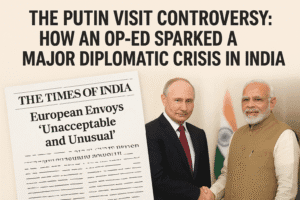
The Putin Visit Controversy: How an Op-Ed Sparked a Major Diplomatic Crisis in India
As Russian President Vladimir Putin prepared to touch down in New Delhi for his first visit in four years, an unexpected diplomatic storm erupted. Ambassadors from three major European powers—the United Kingdom, France, and Germany—jointly authored a newspaper article that accused Putin of a “total disregard for human life” and blamed Russia unequivocally for the war in Ukraine. India’s Ministry of External Affairs (MEA) swiftly labeled the intervention “unacceptable and unusual”, setting the stage for a revealing clash of diplomatic norms, strategic interests, and great power politics.
This incident, which occurred on December 1, 2025, just days before Putin’s scheduled December 4-5 summit with Indian Prime Minister Narendra Modi, provides a fascinating case study in 21st-century diplomacy. It reveals the tensions simmering beneath the surface of India’s delicate balancing act between its historical partner Russia and its growing partnerships with Western nations, all while Ukraine peace negotiations hung in the balance.
The Provocation: A Joint Declaration on the Eve of a Summit
The article, published in The Times of India and signed by British High Commissioner Lindy Cameron, French Ambassador Thierry Mathou, and German Ambassador Philipp Ackermann, represented a coordinated diplomatic move of striking directness. The ambassadors condemned what they called Russia’s “unprovoked war of aggression,” stating the conflict was one that Russia could “end tomorrow”.
They accused Russian forces of daily indiscriminate attacks targeting civilian infrastructure—homes, hospitals, and schools—and asserted that “these are not the actions of someone that is serious about peace”. Their core argument was unequivocal: “Russia is the only nation that wants this war and it is up to it to put a halt to this aggression”.
Table: The Core Accusations and India’s Response
| European Envoys’ Accusations | India’s Official Response | Key Diplomatic Principle Cited |
| Russia launched an “unprovoked war of aggression” | The article was “unacceptable and unusual” | Non-interference in third-country relations |
| Putin shows “total disregard for human life” | “Not an acceptable diplomatic practice to give public advice on third country relations” | Respect for host nation’s sovereign foreign policy choices |
| Russia is “not serious about peace” and commits war crimes | India “has taken note of it” | Diplomatic envoys should operate through private, official channels |
India’s Sharp Rebuke and the Principle of Non-Interference
India’s response was immediate and pointed. A senior MEA official articulated the government’s position clearly: “This is very unusual. It is not an acceptable diplomatic practice to give public advice on third country relations”. This statement cuts to the heart of a fundamental diplomatic norm—the principle of non-interference in the internal or bilateral affairs of a host nation.
The reaction from former Indian diplomats was even sharper. Kanwal Sibal, India’s former foreign secretary who has served as ambassador to both France and Russia, called the article a “diplomatic insult to India”. He argued it breached diplomatic norms by questioning “India’s close ties with a very friendly third country” and accused the envoys of having an “overt propagandist intent”. Another prominent Indian journalist, Sreemoy Talukdar, described the intervention as being in “poor taste” and “an intent to embarrass us before the Russian president”.
A Convergence of Crises: Peace Talks and Strategic Timing
The diplomatic spat did not occur in a vacuum. It unfolded against the backdrop of two other significant geopolitical developments, making the timing and content of the article particularly sensitive.
- High-Stakes U.S.-Russia Peace Negotiations:On the very same day the article was published, U.S. special envoy Steve Witkoff and Jared Kushner, son-in-law of President Donald Trump, were concluding nearly five hours of talks with Vladimir Putin in the Kremlin. These negotiations aimed at ending the war in Ukraine had reached a critical juncture, with the Kremlin stating afterward that while some American proposals looked “more or less acceptable,” others did not suit Russia, and “compromises have not yet been found”. Putin had also just publicly accused Kyiv’s European allies of being “on the side of war” and trying to undermine the peace process.
- Putin’s Strategic Visit to India:President Putin’s visit to New Delhi was his first in four years and came at a crucial time for both nations. The agenda included bolstering trade in Russian oil, missile systems, and fighter jets. This relationship is of immense strategic importance to India, which has emerged as Russia’s top buyer of seaborne oil despite Western sanctions. Just weeks before the visit, Indian refiners had paused new purchases of Russian oil following fresh U.S. sanctions, making the summit essential for stabilizing this crucial economic link.
The European envoys’ article, therefore, appeared not just as a statement on Ukraine, but as a direct, public pressure campaign aimed at influencing India’s stance during a pivotal state visit and amidst fragile peace talks.
Understanding India’s Position: The Delicate Balancing Act
India’s strong objection to the European ambassadors’ public intervention stems from the complex, multi-aligned foreign policy it has meticulously cultivated. Several key factors explain New Delhi’s sensitivity:
- Historical and Strategic Ties with Russia: For decades, Russia has been India’s primary defense supplier. This relationship provides India with strategic autonomy, military technology, and a reliable partner at the UN Security Council. As recently as the week before Putin’s visit, Indian Defence Secretary Rajesh Kumar Singh confirmed that India did “not plan to freeze defence ties with Moscow anytime soon”.
- The Principle of Strategic Autonomy: India fiercely guards its right to make independent foreign policy decisions based on its national interest. A public lecturing from Western powers on whom it should host or how it should manage its relationships is seen as an affront to this sovereignty.
- Energy Security and Economic Pragmatism: The import of discounted Russian oil has been a cornerstone of India’s strategy to manage inflation and ensure energy security since the Ukraine war began. This pragmatic economic relationship is not easily swayed by external moral suasion.
- A Different Historical Perspective: Some Indian strategic thinkers, like former intelligence chief Vikram Sood, echo a narrative more sympathetic to Russian security concerns, pointing to NATO’s eastward expansion as a root cause of the conflict. This perspective, while not the official government line, informs a segment of Indian political thought and creates a more nuanced domestic audience for the Ukraine issue.
The Broader Context: A Fracturing Consensus on Ukraine
The incident highlights a growing divergence in the international approach to the Ukraine war as it drags into its fourth year.
- The European Stance: The joint article by the UK, French, and German envoys represents a continued European commitment to holding Russia accountable. This aligns with broader EU actions, such as establishing a Special Tribunal for the crime of aggression against Ukraine and freezing billions in Russian assets. For Europe, the war remains an existential security issue on its doorstep.
- The U.S. Push for a Deal: The simultaneous peace talks in Moscow, led by Trump’s envoys, signal a Washington increasingly focused on securing a negotiated settlement—even one that has alarmed European allies and raised fears in Kyiv of conceding too much. Ukrainian President Volodymyr Zelensky himself expressed fear that the U.S. could “lose interest in the peace process”.
- The Global South’s Pragmatism: India’s reaction typifies the stance of many major Global South nations. Their primary focus is on national development, economic stability, and maintaining working relationships with all major powers. They are often skeptical of what they perceive as Western-led moral campaigns that can disrupt their pragmatic economic and strategic interests.
Potential Repercussions and the Road Ahead
The fallout from this diplomatic incident is likely to ripple through multiple relationships:
- India-Russia Ties: The immediate effect may be to strengthen the hand of those in India who advocate for a more Russia-friendly position, framing the West as disrespectful of Indian sovereignty. Putin’s visit will likely proceed with a renewed emphasis on the mutual respect characterizing the bilateral relationship.
- India-Europe Relations: A temporary chill is inevitable. While economic and strategic ties between India and the European powers are too significant to be derailed, trust has been damaged. Future cooperation may require more delicate handling and a European acknowledgment of India’s sensitivity to public pressure.
- Diplomatic Norms: The episode raises questions about the evolving rules of diplomatic engagement. In an age of public diplomacy and social media, where is the line between advocating for a principle and improperly interfering in a host nation’s affairs? This incident may prompt quiet diplomatic discussions on these boundaries.
The ambassadors’ article and India’s forceful response reveal a world where the old, tacit rules of quiet diplomacy are colliding with a new era of public, values-driven statecraft. For India, the incident reaffirmed the importance of its strategic autonomy. For Europe, it demonstrated the limitations of public pressure campaigns on a proud, powerful nation with divergent interests. As the world watches for outcomes from both Putin’s Delhi summit and the U.S.-Russia peace talks, this diplomatic spat serves as a potent reminder that in today’s multipolar world, the pathways to peace and the definitions of acceptable diplomacy are more contested than ever.
You must be logged in to post a comment.