
The Prodigal SUV Returns: Can the 2026 Renault Duster, Packed with ADAS & Hybrid Tech, Reclaim Its Throne?
The 2026 Renault Duster marks a strategic and well-equipped comeback for the iconic SUV in India’s fiercely competitive mid-size segment, blending its rugged heritage with modern necessity. Slated for a March price announcement (estimated ₹10-20 lakh ex-showroom), it directly targets rivals like the Hyundai Creta and Kia Seltos by addressing its predecessors’ shortcomings with a premium leatherette interior, a 10.1-inch touchscreen, panoramic sunroof, and ventilated seats.
Under the hood, it offers a multi-pronged powertrain strategy: a 163hp 1.3L turbo-petrol for performance, a 100hp 1.0L turbo for value, and a future-ready 1.8L strong-hybrid arriving by Diwali 2026. Its most significant leap is in safety, becoming Renault’s first model in India with Level 2 ADAS, complemented by six standard airbags and a 360-degree camera, positioning it not just as a nostalgic return but as a technologically assertive contender aiming to reclaim relevance by offering a balanced mix of rugged design, contemporary features, and advanced driver aids.
The Prodigal SUV Returns: Can the 2026 Renault Duster, Packed with ADAS & Hybrid Tech, Reclaim Its Throne?
The mid-size SUV segment in India is a gladiatorial arena, where only the most resilient and well-adapted survive. Into this fiercely contested space strides a familiar name, reborn and rearmed: the 2026 Renault Duster. After years of anticipation and a prolonged absence from its peak popularity, Renault has officially unveiled the third-generation Duster in India. This isn’t just a facelift; it’s a strategic counter-offensive. With a pre-booking token of ₹21,000 and a price announcement slated for March (estimated between ₹10-20 lakh, ex-showroom), Renault isn’t merely launching a car—it’s attempting a legacy revival. But in a market now dominated by the Hyundai Creta, Kia Seltos, and the formidable Tata Sierra, does the new Duster have the right arsenal? Let’s delve beyond the press release to uncover its real potential.
More Than Nostalgia: A Strategic Re-Entry
First launched in 2012, the original Duster was a disruptor. It offered a rugged, no-nonsense SUV posture at a time when the segment was softening. It built a cult following for its go-anywhere capability and tough build. However, as competitors evolved with feature-packed cabins and refined powertrains, the Duster’s appeal faded. Its return, therefore, is calculated. Renault isn’t just selling an SUV; it’s rekindling an emotional connection while aggressively plugging every gap its predecessor had. The key message is clear: we have the heritage, and now, we have the tech.
Exterior Design: Global DNA with a Desi Touch
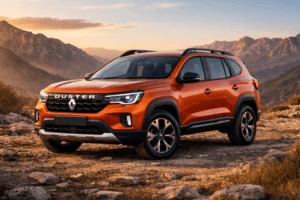
The 2026 Duster for India retains the robust, squared-off silhouette of the global model—a wise move that honors its iconic proportions. However, Renault’s designers have added distinctive Indian-market tweaks. The most notable are the new headlights with eyebrow-shaped LED DRLs that double as turn indicators, giving the front a more expressive, tech-savvy look. The bold grille now proudly wears a ‘Duster’ badge, and the front bumper features a pronounced silver skid plate-esque surround, accentuating its SUV character.
From the side, the signature functional roof rails (with a 50kg load capacity) and the cleverly positioned rear door handles on the C-pillar maintain that distinctive profile. The 18-inch alloy wheels and 212mm of ground clearance are not just aesthetic; they promise the go-anywhere assurance loyalists crave. At the rear, the connected LED tail-lamps and roof spoiler lend a contemporary finish. The design walks a tightrope successfully—it’s modern enough to attract new buyers but retains enough DNA to make old fans feel at home.
Interior & Features: Finally, a Cabin That Competes
If the old Duster’s cabin was its Achilles’ heel, the new one aims to be its crown jewel. The layout is shared with the global model, but material quality sees a significant upgrade with leatherette upholstery on seats, dashboard, and door trims. The centerpiece is a dual-screen setup: a 10.25-inch digital driver’s display and a 10.1-inch touchscreen infotainment system. This immediately brings it to par with segment benchmarks.
Feature highlights are thoughtfully curated for the Indian consumer:
- Panoramic Sunroof: No longer a luxury but a segment expectation.
- Ventilated Front Seats: A critical comfort feature in Indian climates.
- Dual-Zone Climate Control: Adds a touch of premiumness.
- Wireless Phone Charger & Powered Tailgate: Enhancing daily convenience.
- 518-litre Boot: A practical, best-in-class advantage for families.
The cabin seems designed to silence critics who once called the Duster spartan. It now speaks the language of comfort and technology fluently.
Powertrains: The Heart of the Matter – From Turbo to Hybrid
This is where the Duster’s strategy gets multidimensional. Renault is offering a trilogy of engine options, catering to diverse buyer psychographics.
- The Performance Option: 1.3L Turbo-Petrol (163hp/280Nm) Paired with a 6-speed dual-clutch automatic (DCT), this is the engine for the enthusiast—the one who loved the Duster’s fun-to-drive nature. It promises strong acceleration and highway cruising prowess, directly taking on the turbo-petrol offerings from Volkswagen and Skoda.
- The Value Proposition: 1.0L Turbo-Petrol (100hp/160Nm) Mated to a 6-speed manual, this engine will likely be the volume driver and entry point. It’s engineered for efficiency and urban maneuverability, targeting the pragmatic buyer who wants the SUV form factor without the fuel bills of a larger engine.
- The Game-Changer: 1.8L Strong-Hybrid (109hp engine + 49hp motor) This is Renault’s technological flag-bearer, though arriving later (by Diwali 2026). The series-parallel hybrid system, with its 1.4kWh battery and 20hp starter-generator, promises the holy grail of Indian driving: strong low-end torque for city traffic, exceptional fuel efficiency, and reduced emissions. Its success could redefine the segment’s expectations from electrified powertrains.
A notable omission is the All-Wheel-Drive (AWD). While disappointing for hardcore off-road fans, this is a commercial decision. The reality is that over 95% of mid-size SUV buyers in India never engage AWD. Removing it helps Renault optimize cost and focus on the features that matter to the majority.
Safety & ADAS: The Segment’s New Battleground
Here, the Duster makes its most aggressive play. It comes standard with six airbags, disc brakes on all wheels, a 360-degree camera, and an electronic parking brake. But the headline act is the inclusion of Level 2 Advanced Driver Assistance Systems (ADAS).
This makes the Duster the first Renault model in India to offer ADAS. We’re talking about features like:
- Adaptive Cruise Control: Maintains a set distance from the vehicle ahead.
- Lane Keep Assist & Lane Departure Warning: Helps prevent unintended lane drifts.
- Autonomous Emergency Braking: Can detect potential collisions and apply brakes.
- Likely also included: Blind Spot Monitoring, Rear Cross-Traffic Alert.
In a segment where safety is increasingly a primary purchase driver, this isn’t just a feature tick-box. It’s a statement that Renault is serious about modern safety paradigms. It forces rivals to accelerate their own ADAS adoption, ultimately benefiting the consumer.
Pricing, Competition, and the Uphill Battle
The estimated ₹10-20 lakh range places it right in the belly of the beast. Its rivals are formidable:
- Hyundai Creta & Kia Seltos: The dynamic duo known for feature-loaded cabins, refined engines, and strong brand trust.
- Tata Sierra & Harrier: Boasting dominant design and best-in-class structural safety.
- Maruti Suzuki Grand Vitara & Toyota Hyryder: The strong hybrid hegemony with unmatched service networks.
- Skoda Kushaq & Volkswagen Taigun: The driver’s choice with superb dynamics.
The Duster’s strategy must be multi-pronged: Leverage its iconic status, undercut rivals on price for the turbo variants, and position the hybrid as a technologically superior alternative to the Maruti/Toyota hybrids. Its success hinges on Renault’s ability to communicate this value proposition clearly and back it up with an improved ownership experience.
Conclusion: Not Just a Comeback, But a Reckoning
The 2026 Renault Duster arrives as a complete, modern SUV that has learned from its past. It has addressed its historical weaknesses (interior, features) while doubling down on its strengths (robust design, driving character) and injecting crucial new-age technology (ADAS, Hybrid).
It is more than just a new model launch; it’s a litmus test for Renault’s future in India. If priced strategically and marketed effectively, the Duster has the tangible specs and intangible legacy to not just compete but potentially disrupt the segment hierarchy once again. For the Indian consumer, this is an unmitigated win—more choice, better technology, and a nostalgic favorite returning to fight harder than ever. The mid-size SUV arena just got a lot more interesting.
You must be logged in to post a comment.