
The Prisoner Who Could Govern: Marwan Barghouti’s Paradoxical Power
Marwan Barghouti, a Palestinian political leader imprisoned by Israel for over 23 years on terrorism convictions he denies, has become a uniquely powerful and unifying symbol in Palestinian politics from his jail cell. Often called “Palestine’s Mandela,” he is seen by many as a credible advocate for a two-state solution who could bridge the deep divides between factions like Fatah and Hamas, a perception bolstered by his enduring popularity in opinion polls. His situation has grown more severe since the war in Gaza began, with reports of solitary confinement, denied family visits, and alleged physical abuse by prison guards—claims Israel denies—further amplifying his symbolic status. While Hamas demands his release in ceasefire talks and international figures argue he is essential for reviving a credible peace process, Israel refuses to include him in any prisoner exchanges, creating a stark paradox where his imprisonment simultaneously neutralizes a figure Israel deems a terrorist and fuels his mythos as the indispensable, suffering leader who might one day govern.
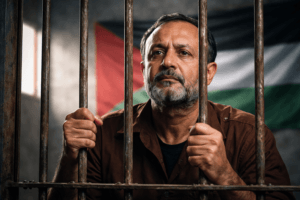
The Prisoner Who Could Govern: Marwan Barghouti’s Paradoxical Power
While Israel’s war in Gaza and political crises dominate headlines, a parallel drama unfolds in an Israeli prison cell. Marwan Barghouti, a man incarcerated for over two decades, has become perhaps the most pivotal—and contested—figure in Palestinian politics. Serving five life sentences plus 40 years for murders committed during the Second Intifada, which he denies orchestrating, Barghouti has paradoxically seen his political stature grow with each year behind bars. This article examines the man many call “Palestine’s Mandela,” exploring how a prisoner became a symbol of unity, the allegations of systematic abuse he now faces, and why his potential release is considered by many a prerequisite for any lasting peace.
The Symbol: From Militant to Mandela
Marwan Barghouti’s transformation in the Palestinian consciousness is remarkable. Once a militant leader of the Second Intifada’s armed wing, he has been reimagined as a unifying statesman-in-waiting. This perception is not merely popular sentiment; it is echoed at the highest levels of international diplomacy.
In late October 2025, a distinguished group of global leaders known as The Elders—including former presidents, prime ministers, and Nobel laureates—issued a powerful statement. They called for Barghouti’s immediate release, describing it as “an important step towards reviving a lasting two-state solution”. They noted that many Palestinians refer to him as “their Mandela,” a figure whose reputation as a supporter of a two-state solution has only solidified during his imprisonment.
His son, Arab Barghouti, acknowledges the comparison with pride but adds crucial context: “We share having an apartheid regime, but at the same time, [South Africans] haven’t been bombarded, killed at the rate that we’ve been killed”. This distinction highlights how Barghouti’s symbolic power is rooted in a very specific, ongoing struggle.
Table: The “Mandela” Comparison
| Aspect | Nelson Mandela | Marwan Barghouti |
| Imprisonment | 27 years for anti-apartheid activism | 23+ years (and counting) for alleged terrorism |
| Political Vision | Multi-racial democracy, reconciliation | Two-state solution, end to occupation |
| International Campaign | Global “Free Mandela” movement | Growing “Free Marwan” campaign with celebrity supporters |
| Perceived Role | Unifier who could transcend conflict | Unifier who could bridge Fatah, Hamas, and other factions |
The Man: A Political Life in Brief
To understand Barghouti’s significance, one must understand his journey. Born in 1959 in the West Bank village of Kobar, his political awakening began early. He joined Fatah at 15 and was first imprisoned at 18 for his involvement with the then-banned organization. During this initial incarceration, he earned his high school diploma and learned Hebrew—skills that would later shape his approach.
After his release and a deportation to Jordan, he returned following the 1993 Oslo Accords. He was elected to the Palestinian Legislative Council in 1996 and became secretary general of Fatah in the West Bank. During this period of relative cooperation, he built a strong rapport with Israeli counterparts who saw him as genuinely interested in peace.
This cooperative phase ended with the collapse of peace talks and the outbreak of the Second Intifada in 2000. Barghouti’s role shifted dramatically. Israeli intelligence came to regard him as the “chief of staff of the Intifada”. He was captured by Israeli forces in April 2002 after they tracked his movements through his mobile phone. At his 2004 trial, which he boycotted, refusing to recognize the court’s authority over a Palestinian from occupied territory, he was convicted on five counts of murder and sentenced to five life terms plus 40 years.
The Prisoner: Allegations of Abuse and Isolation
Barghouti’s conditions of confinement have deteriorated significantly, especially since October 2023. His family and rights organizations report a pattern of systematic mistreatment and isolation.
- Solitary Confinement and Denied Visits: Following the Hamas attacks of October 7, 2023, Barghouti was placed in solitary confinement. His son Arab states that the family has been denied all visitation rights for over three years, a policy that predates the recent war. “I haven’t been able to hug my father in 24 years,” Arab told NPR, emphasizing that his family’s experience reflects that of thousands of Palestinian prisoners’ families.
- Allegations of Physical Assault: Multiple disturbing reports of physical abuse have emerged. In September 2024, his family stated he was beaten unconscious by eight guards during a prison transfer. Later, in December 2025, another son, Qassam, reported receiving a call alleging that guards had broken Barghouti’s ribs and teeth, and cut off part of his ear. The Israel Prison Service has consistently denied these allegations as “false claims” and “propaganda”.
- Political Taunting: In a stark display of the politicization of his imprisonment, far-right Israeli National Security Minister Itamar Ben-Gvir visited Barghouti’s cell in August 2024. A widely circulated video showed Ben-Gvir taunting the prisoner, saying, “You won’t win… we will wipe him out”. The Palestinian Authority condemned the act as “psychological, moral and physical terrorism”.
Table: Key Allegations of Mistreatment vs. Official Denials
| Allegation | Source | Israeli Prison Service Response |
| Beaten unconscious by guards (Sep 2024) | Family testimony from released detainees | “These are false claims (fake).” |
| Broken ribs, teeth; ear partially cut off (Dec 2025) | Son Qassam’s report of a phone call from a prisoner | “Another total lie” and “propaganda” |
| Systemic torture and medical neglect leading to prisoner deaths | Palestinian prisoner rights organizations | Not directly addressed in search results, but Israel generally states it operates within the law |
The Political Heir: The Case for His Release
Despite—or perhaps because of—his imprisonment, Barghouti’s political stock has never been higher. His release is now a central demand in several overlapping contexts.
- Unifying a Divided Polity: Polls consistently show Barghouti as the most popular Palestinian leader across factions, outranking both the current Palestinian Authority President Mahmoud Abbas and Hamas leaders. He is a senior Fatah figure but is also seen as acceptable to Hamas, which has demanded his release in ceasefire negotiations. In a political landscape fractured between Fatah in the West Bank and Hamas in Gaza, and with no elections in nearly 20 years, he is viewed as a rare unifying candidate.
- A Credible Partner for a Two-State Solution: Barghouti has consistently advocated for a negotiated peace based on a two-state solution. From his prison cell, he helped broker the 2006 “Prisoners’ Document,” where factions, including Hamas, agreed to a state within the 1967 borders. The Elders argue that freeing him “would send a signal that Israel is serious about pursuing a peaceful, political path”. Notably, his son states, “My father was planning to run for the presidential elections that were supposed to happen in 2021”.
- A Prisoner Exchange Bargaining Chip: Hamas has placed Barghouti at the top of its list of high-profile prisoners it seeks to free. However, Israel has steadfastly refused to include him in any exchange deals. This refusal is deeply political. Israel’s release of Hamas leader Yahya Sinwar in a 2011 prisoner swap—who later orchestrated the October 7 attacks—has made the current government intensely wary of freeing influential Palestinians. For Israeli leaders like Netanyahu, Barghouti is a “terrorist,” not a statesman.
Conclusion: The Paradox of the Prisoner
Marwan Barghouti embodies a profound paradox. The Israeli state imprisons him to neutralize what it views as a terrorist threat, yet this very act fuels his mythos as a self-sacrificing leader. The worse his conditions become, the stronger his symbolic resonance grows among Palestinians who see their own suffering reflected in his plight.
The international campaign for his release, backed by figures like Margaret Atwood and Javier Bardem, frames him not as a militant but as the indispensable key to peace. Whether this is a realistic assessment or a political narrative is fiercely debated. What is undeniable is that after two decades without elections, with leaderships in Ramallah and Gaza that lack popular legitimacy, Barghouti represents for many Palestinians a path to renewed political agency.
His son Arab articulates this generational yearning: “You’re talking about a political system that has been dysfunctional for almost two decades. If you’re 35 or under in Palestine, you’ve never voted before. That’s wrong”. In the end, the question of Marwan Barghouti transcends the man himself. It is a question about the future of Palestinian governance, the viability of a two-state solution, and whether a figure forged in the crucible of armed struggle and prolonged captivity can lead his people to a peaceful resolution. For now, the answer remains locked away with the prisoner.
You must be logged in to post a comment.