
The Prisoner & The Promise: How Marwan Barghouti’s Captivity Defines a Palestinian Generation’s Lost Politics
Marwan Barghouti, a Palestinian leader imprisoned by Israel for over two decades on terrorism convictions, remains the most potent unifying political figure in Palestinian society, symbolizing both the legacy of armed resistance and the stalled peace process, as his popularity across factional divides highlights the profound crisis of legitimacy facing the current Palestinian leadership and the yearning for a leader who, like a Palestinian Mandela, could potentially revive the moribund two-state solution, yet his continued captivity—and the personal toll on his family, as expressed by his son Arab—serves as a powerful metaphor for the broader Palestinian experience of stalemate, generational trauma, and a future held hostage by the absence of both political freedom and a viable diplomatic horizon.
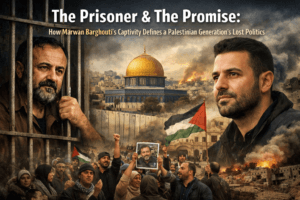
The Prisoner & The Promise: How Marwan Barghouti’s Captivity Defines a Palestinian Generation’s Lost Politics
In the shadowed corridors of Palestinian politics, where legitimacy is fractured and hope is a scarce commodity, the most unifying figure has not walked free in 23 years. Marwan Barghouti, serving five life sentences in an Israeli prison, exists as a paradox: a leader removed from all action, yet whose influence only seems to grow with his absence. A recent NPR interview with his son, Arab Barghouti, did more than provide a family update; it illuminated the profound human and political void at the heart of the Palestinian national movement—a void shaped by incarceration, generational trauma, and a fading two-state solution.
The Leader in Absentia
The current Palestinian political landscape is one of profound crisis. The Palestinian Authority (PA), governing parts of the West Bank, is widely viewed as inefficient, corrupt, and out of touch. Hamas, which controls Gaza, is a designated terrorist organization by many Western powers, and its devastating war with Israel has left the strip in ruins. Elections have been suspended since 2006, the year Hamas won a parliamentary majority. Into this vacuum steps the specter of Barghouti.
Polling consistently shows Barghouti as the most popular choice for Palestinian president, with support cutting across the deep divides between Fatah (the PA’s dominant party), Hamas, and the general populace. This is not despite his imprisonment, but in part because of it. For many Palestinians, his cell in Israel’s Hadarim prison symbolizes steadfastness (sumud) and sacrifice. Unlike the PA leadership, seen as comfortable collaborators with the Israeli security apparatus, Barghouti’s credibility is rooted in his perceived resistance and his severe punishment.
His son Arab’s account to NPR paints a picture of deliberate isolation. Since October 7, Barghouti has been held in solitary confinement—a move his family and supporters see as a political tactic to silence a potent symbolic voice. “Because of his influence and his impact, they wanted to silence him,” Arab stated. The personal cost is staggering: Arab hasn’t hugged his father in 24 years, a reality he emphasizes is shared by “thousands of families who are going through the same suffering.”
The Mandela Comparison and Its Limits
The comparison to Nelson Mandela is one Barghouti’s supporters eagerly encourage and his detractors fiercely reject. For Israel, Barghouti is no moral icon. He was convicted in 2004 on five counts of murder for his role in directing attacks during the Second Intifada, which killed Israeli civilians. Israel views him unequivocally as a terrorist mastermind.
Yet, within the Palestinian narrative and for some international observers, the parallels are compelling: a charismatic leader imprisoned for decades by an occupying power, who advocates for a negotiated two-state solution and retains the moral authority to potentially unite a fractured people. Arab Barghouti acknowledges the pride in the comparison but crucially notes the difference: “We share having an apartheid regime, but at the same time, [South Africans] haven’t been bombarded, killed at the rate that we’ve been killed.”
This distinction is critical. It highlights how Barghouti’s symbolic power is intertwined with the ongoing, violent conflict. His legitimacy among Palestinians is partly derived from his involvement in the armed struggle of the Intifada—a fact that makes him anathema to Israel and a complicated figure for the international community.
The Ghost of a Two-State Solution
Perhaps the most poignant part of Barghouti’s story is his political platform. In his 2004 court statement, he declared, “Security will be achieved by one way, by peace. And peace will be achieved by the end of the occupation.” He has repeatedly expressed support for a two-state solution based on the 1967 lines, a position that once represented the mainstream of both Israeli and Palestinian politics.
Today, that mainstream is a dry riverbed. The Israeli government, under Prime Minister Benjamin Netanyahu, has explicitly rejected the two-state framework. Settlement expansion in the West Bank continues unabated, making a contiguous Palestinian state increasingly geographically impossible. As Arab Barghouti lamented, “You’re dealing with an Israeli government that doesn’t want peace.” His father’s potential negotiating partner exists only in a hypothetical future, requiring a seismic shift in Israeli politics.
Thus, Barghouti represents not just a leader, but a specific, now-nostalgic political outcome that has slipped away. His popularity is a referendum on that lost path as much as it is on his personal charisma.
A Son’s Burden and a Generation’s Inheritance
The interview’s deepest insight comes from Arab Barghouti’s personal reflection. He describes a childhood shattered by conflict: the brief window of normalcy after the Oslo Accords, followed by the terror of the Second Intifada, assassination attempts on his father, and bombardment. “I had some resentment towards the Palestinian cause because… I thought that it took away my dad,” he confesses.
His journey from resentment to embracing his role as an advocate for his father’s release is a microcosm of a generational burden. Palestinians under 35, as Arab notes, have never voted in a national election. Their political identity has been formed entirely in an era of stalemate, separation walls, intermittent wars, and vanished horizons. For them, Barghouti is a legendary figure from a time when political outcomes still seemed malleable. His release is yearned for not just as a family reunion, but as a symbolic reset—a chance to reclaim a political process that died before they could participate in it.
Arab’s own vocation as a life coach is telling. It speaks to a desire to heal and empower on a personal level, in a context where political healing seems impossible.
Conclusion: The Key in the Cell
Marwan Barghouti remains the ultimate “what if?” of modern Palestinian politics. Would his release, as some argue, inject new life into a moribund peace process and unite Palestinian factions? Or would he find himself powerless against the entrenched realities of Israeli settlement policy, Hamas’s militancy, and the PA’s institutional decay?
Israel’s steadfast refusal to include him in prisoner exchange deals indicates it views him as uniquely dangerous. Releasing a convicted murderer of civilians is politically toxic within Israel. But releasing a Palestinian Mandela could alter the geopolitical chessboard entirely.
For now, Barghouti’s legacy is forged in captivity. His physical absence is his political presence. His son’s testimony reminds us that behind the symbol are the eroded years of a family, the stifled potential of a leadership, and the deferred dreams of millions who see in his continued imprisonment the reflection of their own trapped existence. As long as he remains behind bars, he is both a rallying point for Palestinian unity and a stark monument to the peace process that failed, and the one that never began. The key to his cell may well be entangled with the key to any future political solution—a fact that ensures his shadow will loom large over the Holy Land, whether he is freed or not.
You must be logged in to post a comment.