
The Price of Silence: How India’s Muted Response to a Sovereign Assassination Erodes Its Global Stature
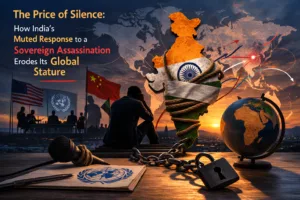
The Price of Silence: How India’s Muted Response to a Sovereign Assassination Erodes Its Global Stature
For decades, the architecture of the post-World War II international order rested on a few fundamental pillars: the sovereignty of nations, the inviolability of diplomatic missions, and the prohibition of one state assassinating the leader of another. These were not merely niceties; they were the barriers erected to prevent the world from descending into perpetual chaos. When a missile strike on another nation’s capital eliminates a foreign head of state during an ongoing diplomatic process, those barriers are not just breached; they are vaporized.
In the aftermath of such a seismic event, the world looks to influential capitals for a response. What stands out equally starkly in this moment of global peril is New Delhi’s silence. It is not a silence of oversight, but one of studied avoidance. This abstention, dissected in a recent, powerful critique by a prominent Indian political leader, raises profound questions not just about a single foreign policy decision, but about the very soul and strategic direction of the world’s largest democracy.
The Anatomy of an Abdication
The critique levelled against the Government of India is not one of mere disagreement, but of a fundamental failure to uphold the principles that have long defined the nation’s diplomatic identity. The sequence of responses, or the lack thereof, paints a damning picture. Initially, as the world reeled from the targeted killing on Iranian soil, the Indian Prime Minister’s response was to sidestep the core violation entirely. Instead, he chose to condemn a retaliatory strike by Iran on the UAE, a move that, devoid of context, appeared not as a plea for peace, but as a tacit alignment with one side of a conflict. It was a moral and chronological inversion of events, treating the symptom while ignoring the cause.
Later, the rhetoric shifted to what many perceive as diplomatic platitudes—expressions of “deep concern” and calls for “dialogue and diplomacy.” The bitter irony, as the critique points out, is that “dialogue and diplomacy” were precisely the tools being employed before being shattered by unilateral military action. When a nation’s response to a clear-cut violation of international law—codified in Article 2(4) of the United Nations Charter, which prohibits the threat or use of force against the territorial integrity of any state—is indistinguishable from its general preference for peace, it ceases to be a principled stance. It becomes an abdication of the responsibility to name the transgressor.
This is where silence ceases to be neutral. In the stark arithmetic of geopolitics, the failure to condemn an act of aggression is often interpreted as consent. For the world’s largest democracy to witness the assassination of a sitting head of state—an act that strikes at the heart of Westphalian sovereignty—and offer no principled objection is to hand a gift to those who seek to normalise the law of the jungle. If this act passes without consequence from a nation that aspires to be a leading voice for the Global South, what moral authority remains to object when the next sovereign border is crossed, or the next leader is eliminated?
The Uncomfortable Optics of Alignment
The unease surrounding India’s stance is compounded by its timing and its context. The Prime Minister’s return from a high-profile visit to Israel, during which he offered unequivocal political support to the incumbent government, came barely 48 hours before the assassination. This occurred against the backdrop of a devastating conflict in Gaza, a humanitarian crisis that has drawn global outrage over the staggering toll on civilian life, particularly women and children.
India has long prided itself on its ability to maintain robust, independent relationships with multiple stakeholders in the complex tapestry of West Asia. It has nurtured civilisational ties with Iran while simultaneously building a deep strategic partnership with Israel in defence, technology, and agriculture. This multi-alignment has been a source of strength, granting New Delhi unique diplomatic space to act as a bridge and a voice of restraint.
However, this space is not a birthright; it is earned through credibility. And credibility is built on the perception that a nation’s foreign policy is guided by principle, not political expediency. When much of the Global South, alongside major powers like Russia and China, have kept a deliberate distance from endorsing the escalatory actions in the region, India’s visible and seemingly unconditional political endorsement of one party appears as a departure from its traditional balancing act. It transforms the image of India from a strategic autonomous actor to one that is, at best, selectively vocal about its principles.
A Debt of Honour and a Legacy Forgot
The critique powerfully reminds us that India’s relationship with Iran is not transactional; it is civilisational. It stretches back centuries, woven through the threads of language, culture, and trade. But beyond this shared history, there is a more recent, strategic debt. In 1994, when hostile elements within the Organisation of Islamic Cooperation (OIC) sought to advance a resolution against India at the UN Commission on Human Rights over the situation in Kashmir, it was Tehran that played a decisive role in blocking the effort. This intervention at a delicate moment in India’s post-liberalisation trajectory helped prevent the internationalisation of the Kashmir issue, buying India crucial diplomatic space.
Furthermore, Iran has been a critical partner in India’s strategic calculus to counter the influence of the China-Pakistan Economic Corridor (CPEC). India’s development of the Chabahar port and its diplomatic presence in Zahedan, near the Pakistan border, are direct counters to the Chinese-built Gwadar port. These are not insignificant gestures; they are the building blocks of strategic autonomy.
The current government’s stance stands in stark contrast to the wisdom of its predecessors. The critique invokes the memory of former Prime Minister Atal Bihari Vajpayee, who, during an official visit to Tehran in April 2001, warmly reaffirmed the deep and abiding ties between the two nations. Vajpayee, a statesman who understood the value of strategic independence, would likely have recognised the folly of allowing a bilateral relationship with one nation to be completely subsumed by the rivalries of another. To ignore this legacy is to govern with historical amnesia, a dangerous ailment in the complex world of diplomacy.
The Strategic Necessity of Moral Clarity
The argument for a principled foreign policy is not a sentimental plea for a bygone era of non-alignment; it is a stark strategic necessity for a nation with India’s global footprint. Nearly 10 million Indians live and work across the Gulf region, forming the bedrock of the economies of the United Arab Emirates, Saudi Arabia, Qatar, and Kuwait. Their remittances are a cornerstone of the Indian economy. In past crises—from the 1990 Gulf War to the evacuation from Yemen in 2015, and the more recent crises in Iraq and Syria—India’s ability to safeguard its citizens has rested on a single, invaluable asset: its credibility as an independent actor.
When Indian officials negotiated with various warring factions for safe passage for its nationals, they were not heard because India was seen as a proxy for any one power. They were heard because India was perceived as a neutral, principled voice with interests, not as an extension of a great power’s agenda. That credibility is now at risk. An uncritical silence in the face of unilateral military action by powerful states signals a retreat from strategic autonomy. It suggests that India’s foreign policy is now more aligned than autonomous, more reactive than principled.
This matters profoundly for India’s present ambitions. For a country that seeks to position itself as the “voice of the Global South” and a leading candidate for permanent membership of a reformed UN Security Council, the optics of acquiescence carry real costs. The Global South is composed of nations that are, by definition, vulnerable to the coercive whims of the strong. They look for leaders who will champion a rules-based international order that protects the weak. If India remains silent when the sovereignty of a fellow nation like Iran is violated with impunity, why should a smaller nation in Africa or Southeast Asia trust India to defend its territorial integrity tomorrow? The argument for a just world order rings hollow if it is not voiced when the test is immediate and politically uncomfortable.
Rediscovering the Conscience-Keeper
The critique concludes with a powerful call for accountability and a return to first principles. The appropriate forum for this national debate is Parliament. The targeted killing of a foreign head of state, the shredding of international norms, and the widening instability in a region directly tied to India’s energy security and its diaspora’s well-being are not peripheral matters. They demand an open, honest, and unflinching debate. Democratic accountability requires that the government articulate its stance with clarity, not just to the nation, but to the world.
Ultimately, this is a moment of choice for Indian diplomacy. It must decide whether to be a transactional power, seeking short-term gains through silence, or a transformational one, aspiring to be, in the words of the critique, the “conscience-keeper of the world.” India has long invoked the ideal of vasudhaiva kutumbakam—the world is one family. This is not a ceremonial slogan for bilateral summits. It implies a commitment to justice, restraint, and dialogue, even—and especially—when it is inconvenient. It means speaking for the sovereignty of a nation even when its government is not your preferred partner. It means defending the principle of non-violence even when the perpetrator is a friend.
That stature, built over decades by leaders who understood the long game, was not accidental. It was forged through a willingness to take a stand. At this moment, as the rules-based order lies visibly strained, silence is not diplomacy; it is abdication. The urgent need is for India to rediscover that moral strength and articulate it with a clarity and commitment that the gravity of the moment demands. The world is watching, and history will judge not by the power of India’s friends, but by the strength of its principles.
You must be logged in to post a comment.