
The Price of a Smile: How War and Blockade Have Stolen Eid from Gaza’s Children
Amid Israel’s tight restrictions on goods entering Gaza, the toy market has collapsed, leaving parents unable to afford gifts for their children during Eid. With imports effectively blocked, toys that once cost a few dollars now sell for triple or quadruple the price, forcing vendors to rely on scarce old stock or risky smuggling. For displaced families already struggling to secure food, the exorbitant costs dash hopes of bringing joy to children who have lost their homes and loved ones in the war. Sellers and parents alike describe the deep emotional toll—children crying over unattainable dolls, vendors dreading their workday, and a holiday tradition stolen by a blockade that extends even to happiness itself.
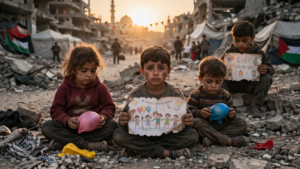
The Price of a Smile: How War and Blockade Have Stolen Eid from Gaza’s Children
In the narrow alleys of Gaza City’s al-Rimal market, the holiday spirit is supposed to be palpable. This is the week of Eid al-Fitr—a time when the air is usually thick with the scent of fresh clothes, the sound of children’s laughter, and the bright plastic sheen of new toys. But for Rania al-Saudi, standing in front of a modest toy stall with her two young daughters, the holiday feels like just another day of loss.
Rania had promised her girls a pair of dolls. It was a small promise, a tiny patch of joy meant to cover the vast wounds of displacement and destruction. Yet, as the vendor calls out prices, Rania finds herself frozen. A doll that cost 15 shekels ($5) before October 2023 now costs 60 shekels ($20). Her six-year-old, Razan, tugs at her sleeve, unable to understand why her mother’s face has turned so pale. Her younger daughter, Lulwa, begins to cry, her small hands reaching for a toy that has become a luxury her family can no longer afford.
“What did our children do to deserve this?” Rania asks, her voice cracking as she tries to soothe her daughters. “Eid holidays are for children’s joy. But our children are deprived of everything.”
Rania’s story is not an isolated moment of disappointment; it is the universal reality of parenting in Gaza during the ongoing war. As the conflict grinds on, the blockade has tightened its grip not just on food and medicine, but on the very concept of childhood. The toy market—once a bustling, colorful sector—has collapsed under the weight of restrictions, smuggling, and economic desperation, leaving a generation of children to celebrate their holidays not with gifts, but with the echo of bombs and the sight of empty hands.
The Economics of Despair
To understand why a simple plastic doll now costs a family’s weekly food budget, one must look at the supply chain that has been shattered by Israel’s restrictions. Since the war began in October 2023, the Kerem Shalom crossing—the primary artery for commercial goods into Gaza—has been subject to total sieges, arbitrary closures, and severe limitations on what is deemed “essential.”
While international pressure has allowed trickles of humanitarian aid (food, water, medical supplies) to enter, recreational goods exist in a legal and administrative grey area. There is no official Israeli decree explicitly banning toys, but the bureaucratic reality is that they are effectively prohibited. Prioritization systems mean that any truck carrying non-essential items is turned away to make room for aid—if aid is allowed in at all.
For merchants like Anwar al-Huwaity, a toy seller of 20 years, this has turned his livelihood into a high-stakes gamble. Before the war, his stall was stocked with affordable goods sourced through formal channels. Today, he scrapes together inventory by hunting down old stock stored in warehouses that survived the bombing, or by relying on a dangerous network of unofficial routes.
“We go from one trader to another, searching,” Anwar explains. “Sometimes we find toys with someone who had them stored, but they sell it at a very high price, up to three times its normal price.”
The logistics of circumventing the blockade have created a layer of middlemen who extract exorbitant fees. Anwar reveals that a small shipment of toys can cost up to 12,000 shekels ($3,870) just to transport through unofficial crossings. If the shipment is confiscated by Israeli authorities—a common occurrence—or destroyed in transit, the trader absorbs the loss. There is no insurance, no safety net.
This war economy has inflated the price of toys by up to 300 percent. A small ball that used to sell for 3 shekels ($1) now costs 30 shekels ($10). A basic toy car that was 40 shekels ($13) last Eid now goes for 150 shekels ($48). For a population where unemployment hovers near catastrophic levels and families struggle to secure basic flour and lentils, these prices are not just high—they are insulting to the very concept of survival.
The Weight of ‘No’
For the vendors, the situation is a moral crucible. Ahmed Ziara, a 24-year-old seller who once looked forward to the holiday rush, now finds himself dreading his workday. He knows that the prices hanging from his stall are a wall between the children and their joy.
“People come to buy toys and beg me to lower the price,” Ahmed says, his eyes reflecting the exhaustion of a man forced to be the bearer of bad news. “They say, ‘This child is an orphan, that child is an orphan … his parents were killed in the war.’ It feels like all children in Gaza have become orphans.”
Ahmed’s words cut to the core of the tragedy. In Gaza, the war has orphaned thousands. The nuclear family structure has been shattered; grandparents are raising grandchildren, aunts are caring for nieces, and siblings are clinging to each other. In these fractured households, a toy is not merely a plaything; it is a symbol of normalcy, a tool for psychological first aid, a physical object that tells a child that their world is not entirely broken.
When parents cannot afford that object, it becomes a second wound—a reminder of inadequacy layered on top of the trauma of war. The holiday season, which used to bring toy sellers between $6,500 and $10,000 in revenue, now yields barely $1,000. But the financial loss is secondary to the emotional toll.
“I have started hating my workday,” Anwar admits. “I know the prices are exorbitant, and when the children and families see the toys, they get upset.”
The Smuggling of Joy
The scarcity has spawned a black market for happiness. Because formal commercial crossings are largely closed to non-essential goods, a shadow economy has emerged. Smugglers hide toys inside shipments of clothes, electronics, or even food. This method is expensive, risky, and contributes to the volatile pricing.
Ahmed Ziara explains that most of the toys currently on the market are not new imports but old stock that has been hoarded and slowly released. “We often have to smuggle them, sometimes hidden inside clothes or other goods,” he says.
This precarious existence means that the selection is random and unpredictable. There are no “new” toys. There are no themed collections for Eid. There is simply whatever was stored in a warehouse that hasn’t been bombed yet, sold at whatever price the market will bear.
For the children of Gaza, this means that the magic of receiving a new toy—the anticipation, the unwrapping, the novelty—has been replaced by a harsh lesson in economics. Six-year-old Razan doesn’t understand the nuances of border closures or the devaluation of the shekel. She only knows that the doll she sees in her mother’s arms remains in the stall, because her mother cannot pay.
Play in the Rubble
When parents cannot buy toys, they improvise. Rania tried to make a doll for her daughters once, but they rejected it. It wasn’t just about the object; it was about the dignity of having something real, something that felt like the life they used to have before their home in Shujayea was destroyed.
In displacement camps and shattered neighborhoods, children have reverted to the oldest forms of play: hopscotch drawn in the dust, hide-and-seek among the ruins, or drawing shapes in the sand. While these games require no money, they also offer no escape. The backdrop of their play is rubble; the sounds of their laughter are often interrupted by the hum of drones or the distant thud of shelling.
Rania notes that all the children in her displacement camp face the same boredom. The lack of structured activities, education, and recreational materials has led to a collective stagnation of childhood. Psychologists warn that the absence of play—specifically the absence of new, engaging stimuli—can exacerbate post-traumatic stress disorder (PTSD) in children. Toys serve as transitional objects that help children process fear and loss. Without them, children internalize the chaos around them.
The Political Economy of Happiness
The restrictions on toys are part of a broader strategy of control that has defined the war. By limiting the import of “non-essential” goods, Israel effectively dictates the quality of life in Gaza. While humanitarian organizations focus on preventing famine, the slow strangulation of the civilian economy ensures that even when families are not starving, they are unable to live.
This is not merely about consumerism. It is about the right to cultural and religious expression. Eid al-Fitr is a celebration that carries deep spiritual and social significance. The exchange of gifts—particularly for children—is a tradition that reinforces community bonds and offers a moment of respite from hardship. By making it impossible for parents to participate in this tradition, the blockade extends its reach into the very soul of society.
For parents like Rania, the failure to provide an Eid gift feels like a failure of parenthood itself. She had hoped to compensate for the lack of new clothes—a basic Eid tradition—by buying dolls. Now, even that consolation is out of reach.
“My daughters will not be happy this Eid,” she says, her voice heavy with resignation. “I wanted to compensate by getting them dolls, but even that is impossible.”
A Glimmer of Resistance
Despite the despair, there is a stubborn resistance in the act of continuing to sell toys. Anwar and Ahmed still open their stalls, even when they know most customers will walk away empty-handed. They do it because, as Ahmed says, “despite everything, we love to bring joy to children, even for a short time.”
It is a paradoxical form of service. They are forced to charge prices that cause pain, yet they remain present because the complete absence of toys would be a total victory for the forces of dehumanization.
Anwar’s fantasy is a simple one: the lifting of restrictions. “If conditions improve and toys are allowed in normally, prices will return to normal, and children and families will be able to enjoy the holiday as before,” he says.
For now, however, the reality is one of scarcity. As Rania walks away from the stall, holding the hands of her crying daughters, the toy vendor watches them go. He knows that behind him, there are hundreds more like them—displaced, impoverished, and desperate to give their children a moment of joy in a landscape defined by loss.
In Gaza, the toys sit on shelves, priced in shekels, but the cost is measured in stolen smiles. This Eid, the sound of children playing is drowned out by the silence of empty pockets and the weight of a blockade that has decided that even happiness is contraband.
You must be logged in to post a comment.