
The Price of a Platform: Why Elle-Máijá Tailfeathers Returned Her Award and Forced a Reckoning in Toronto
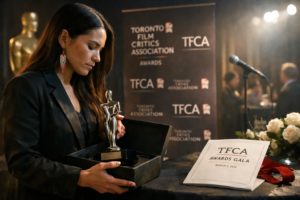
The Price of a Platform: Why Elle-Máijá Tailfeathers Returned Her Award and Forced a Reckoning in Toronto
The envelope is opened. A name is called. There’s a rush to the stage, a gleaming trophy held aloft, tears of joy, and a litany of thank-yous. This is the familiar choreography of awards season, a ritual designed to celebrate artistic achievement within a tightly controlled timeframe. But on March 2, 2026, at the Toronto Film Critics Association (TFCA) Awards Gala, the script was quietly, but forcibly, rewritten backstage. And the fallout from that single edit is now sending shockwaves through the Canadian film industry, forcing a painful and overdue conversation about censorship, moral courage, and the very definition of artistic expression.
At the center of the storm is Elle-Máijá Tailfeathers, a celebrated actor, director, and producer of Cree and Sámi ancestry. She was being honored for her raw, powerful performance in Melanie Oates’ drama Sweet Angel Baby. Unable to attend in person, Tailfeathers submitted a pre-recorded acceptance speech. It was, by all accounts, a typical awards address—until it wasn’t. In a moment of profound personal conviction, she deviated from the standard fare to connect her art to the world’s most intractable conflict.
“When we were shooting Sweet Angel Baby, October 7th happened and it changed everything,” she said in the excised portion of her speech. “I just want to say that my heart continues to be with the people of Palestine who are experiencing this ongoing genocide, and thank you to anyone in this industry who’s been brave enough to say anything.”
For the TFCA’s leadership, those 58 words were a problem. They were deemed expendable, snipped from the broadcast version in the name of logistics. For Tailfeathers, they were the entire point. The subsequent clash has transformed a night of celebration into a referendum on neutrality, power, and the personal toll of speaking truth to power in an industry that often prefers its politics pre-packaged and polite.
The Illusion of the Apolitical Edit
In the aftermath, the TFCA’s now-former president, Johanna Schneller, offered an explanation that was swift, simple, and, to many, deeply insufficient. The edit, she stated, was made purely “to maintain the timing of the awards show.” It was a logistical decision, not a political one. She emphasized that the organization encourages all winners to share their full remarks on their personal platforms.
On the surface, this defense is plausible. Awards shows are meticulously timed productions. Speeches are routinely truncated in the editing suite for broadcast. But this explanation crumbles under the weight of context. The excised portion was not a rambling anecdote or a list of ten obscure agents to thank. It was a concise, 20-second statement on a matter of immense global significance, delivered by an Indigenous woman whose very presence in the room—even by video—was a testament to the industry’s slow march toward inclusivity.
As Tailfeathers herself pointed out in a furious, heartfelt letter to the TFCA membership, the irony was glaring. The gala opened, as so many Canadian events do, with a land acknowledgement—a ritualistic expression of respect and recognition for the Indigenous peoples whose land was stolen. It is a practice designed to acknowledge a historical genocide and ongoing colonial legacy. Yet, in the very same breath, the organization chose to silence an Indigenous artist’s plea for recognition of a contemporary one.
“Neutrality is a form of violence; the choice to be apolitical is political,” Tailfeathers wrote, delivering a line that has since become a rallying cry on social media. “I am profoundly disgusted and ashamed by such an act of censorship. I cannot, in good conscience, accept this award now that it has been tainted by censorship.”
Her decision to return the award—to physically reject the validation of an institution that muted her voice—transformed her from a recipient of an honor into its moral judge. The trophy, meant to symbolize her achievement, had become, in her eyes, a “tainted” object, a hush payment for her silence.
A Resignation and a Reckoning
The response from Schneller was equally dramatic. Within hours, she announced her resignation as president, a move that acknowledged the gravity of the rupture, even if she stopped short of admitting political intent. “That decision was mine as president, and in light of this outcome, I will be tendering my resignation,” she stated.
Schneller’s resignation is a significant scalp for those who see this as a clear case of censorship. But it is unlikely to quell the debate. By framing the issue as a matter of timing and taking sole responsibility, the TFCA’s statement attempts to contain the damage, treating the incident as an error in judgment rather than a symptom of a systemic problem. For critics, this is precisely the issue. The instinct to cut a “controversial” statement to keep the show running smoothly is not an apolitical impulse; it is the very definition of a political act that prioritizes institutional comfort over individual expression.
Tailfeathers’ letter lays bare the deep personal and professional costs of this instinct. She speaks of leaving social media two years ago due to “consistent harassment from numerous industry professionals” over her views on Palestine. She is acutely aware of the “backdoor conversations” and the whispered smears that she believes have “likely impacted my career and livelihood.” Her speech was not a naive, spur-of-the-moment outburst. It was a calculated act of bravery from an artist who knows the price of her principles and was willing to pay it. The TFCA’s edit, in her view, was not just a snip of tape; it was a reaffirmation of the very power structures that had already cost her so much.
This incident is not happening in a vacuum. It is the latest, and most locally devastating, iteration of a global cultural war playing out on the stages of film festivals and awards ceremonies. Tailfeathers’ experience echoes that of Syrian-Palestinian director Abdallah Al-Khatib, whose speech at the Berlinale last month prompted a German cabinet minister to walk out and nearly cost the festival’s director his job. It mirrors the BBC’s controversial decision to cut the phrase “Free Palestine” from its BAFTA awards broadcast.
What ties these events together is the profound discomfort of cultural institutions when faced with the unvarnished human cost of geopolitical conflict. They are built to celebrate art, but art, at its most potent, is rarely comfortable. It is meant to provoke, to bear witness, and to speak for those who cannot. By sanitizing Tailfeathers’ words, the TFCA attempted to neuter the art in service of the institution. They wanted the performance, but not its power.
Beyond the Headlines: A Question of Moral Injury
The most devastating part of Tailfeathers’ letter is her invocation of “moral injury.” It’s a term often used in clinical and military contexts to describe the psychological damage that occurs when someone perpetrates, witnesses, or fails to prevent an act that transgresses their deeply held moral beliefs. For Tailfeathers, the censorship was not just an insult; it was a wound. The organization she trusted to honor her work instead asked her, implicitly, to be an accomplice in her own silencing.
“I do not know how this rupture can be repaired and I’m not interested in receiving an apology,” she wrote. “The moral injury I carry with me can not be undone.”
This is the crux of the matter. An apology from the TFCA would acknowledge a mistake in judgment. But a moral injury requires more than a mea culpa; it demands a fundamental restructuring of the values that led to the injury in the first place. It requires the industry to ask itself hard questions: Why is solidarity with Palestinians treated as a political landmine, while other forms of activism are celebrated on awards stages? Why is the fear of backlash from one side consistently valued over the moral clarity of artists on the other? Why is the “timing of the show” more sacred than the content of a winner’s character?
Tailfeathers’ letter concludes with a powerful appeal to solidarity that transcends the binary nature of the debate. She explicitly condemns antisemitism, acknowledging the pain of her Jewish friends and colleagues. She praises Jewish voices who are “speaking out against the genocide of Palestinians,” recognizing the “incredible risk” they are taking. Her final words, addressed to “my Palestinian kin, especially the artists and filmmakers,” are a quote from Fatma Hassouna: “I put my soul in my hand and walk with you.”
It is a phrase of profound commitment, evoking a willingness to risk everything—one’s career, one’s reputation, one’s very self—for a belief in another’s humanity. By returning her award, Elle-Máijá Tailfeathers did exactly that. She took the soul of her art, placed it in her hand, and walked away from the gilded cage of an institution that tried to silence her.
The Toronto Film Critics Association now faces a choice. It can accept Schneller’s resignation as a sacrificial offering, hoping the storm will pass. Or it can heed the deeper call in Tailfeathers’ letter—a call to examine the moral architecture of its own house, to ask how a celebration of cinematic expression became a place where expression is the first thing cut for time. The industry is watching, and the answer will determine not just the future of the TFCA, but the meaning of the awards it gives out.
You must be logged in to post a comment.