
The Politics of ‘Compromise’: How a BJP Counter-Offensive is Reshaping India’s Political Discourse
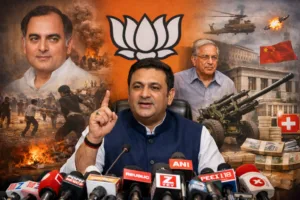
The Politics of ‘Compromise’: How a BJP Counter-Offensive is Reshaping India’s Political Discourse
In the high-stakes arena of Indian politics, where every word is parsed and every gesture is amplified, the Bharatiya Janata Party (BJP) has launched a meticulously crafted counter-offensive. At a press conference at the party’s central headquarters on Saturday, National Spokesperson Shri Gaurav Bhatia didn’t just rebut the opposition’s allegations; he sought to fundamentally reframe the national debate. The target was the Congress party and its leader, Rahul Gandhi, and the weapon was history—a deep, archival dive into the tenure of former Prime Minister Rajiv Gandhi.
The immediate trigger was Rahul Gandhi’s use of the term “Compromised PM” against Prime Minister Narendra Modi. But the BJP’s response, as articulated by Shri Bhatia, was a masterclass in political jujitsu, turning the attack back on its originators by invoking decades of accusations, scandals, and national tragedies. This wasn’t just a press conference; it was the unveiling of a sustained political narrative designed to question the very foundation of the Congress party’s moral authority.
The AI Summit and the Echo of Distortion
The press conference opened on a note of national achievement. Shri Bhatia highlighted the resounding success of India’s recently hosted AI Summit, an event that saw nearly 90 nations endorse the framework proposed by Prime Minister Modi. This, he argued, is the hallmark of a decisive global leader—one whose “positive initiative” has garnered worldwide acceptance. It was a picture of a resurgent India, confident and guiding the global conversation on technology and the future.
This narrative of global acceptance stood in stark contrast to the picture painted of the domestic opposition. Shri Bhatia expressed disappointment that instead of celebrating this diplomatic victory, the Leader of the Opposition, Rahul Gandhi, appeared “disturbed” by it, choosing to focus on a social media post about protest rights. This set the stage for the central argument: a leader whose family has a history of being “compromised” on national security and integrity cannot level such accusations against a prime minister who has strengthened the nation’s hand globally. The contrast was drawn sharply between the “strong and decisive force” of Modi’s India and the “confusion and falsehoods” of the Congress.
“Like Father, Like Son”: Revisiting the Wounds of 1984
The most potent and emotionally charged part of the briefing was the invocation of the 1984 anti-Sikh riots. Shri Bhatia placed the blame for the pogrom, in which an estimated 3,500 Sikhs were killed, squarely at the feet of the then-Prime Minister, Rajiv Gandhi. He quoted Rajiv Gandhi’s infamous remark, “When a great tree falls, the earth shakes,” as a form of justification for the violence—a moment of profound insensitivity that has haunted the Congress party for decades.
By drawing a direct line from father to son, Shri Bhatia attempted to establish a pattern of moral failure. He connected the 1984 riots to recent political protests involving what he described as “indecent and obscene” public conduct. Rahul Gandhi’s reported characterization of those involved in such protests as “Babbar Sher” (brave lions) was presented as a modern-day equivalent of justifying violence and indecency. The argument was powerful in its simplicity: a family that never truly apologized for the massacre of thousands cannot claim the high ground on morality or constitutionality.
This point resonated with a deep, unhealed wound in India’s body politic. For many, especially in the Sikh community, the pursuit of justice for 1984 has been a long and arduous journey. Shri Bhatia seized on this, reminding the audience that Congress leaders like Sajjan Kumar and Jagdish Tytler, accused in the riots, continued to hold high political office for years. It was only under the current Modi government, he asserted, that Sajjan Kumar was finally convicted and sent to jail. This was presented as the fundamental difference in leadership: one that shielded the guilty, and one that delivered justice.
Bhopal, Bofors, and the Swiss Bank Account: The Architecture of ‘Compromise’
The narrative then shifted from communal violence to corporate and national security “compromises.” The Bhopal Gas Tragedy of 1984, the world’s worst industrial disaster, was the next pillar of the argument. Shri Bhatia pointed to the estimated 5,300 deaths and the fleeing of Union Carbide’s Warren Anderson. Citing former Principal Secretary P.C. Alexander, he reiterated that the responsibility for allowing Anderson to escape justice lay with Rajiv Gandhi and the then-Madhya Pradesh Chief Minister, Arjun Singh. The blood of the nearly 8,800 victims of 1984 (combining the riots and the gas tragedy), he charged, “rests on the hands of Rajiv Gandhi.”
This was followed by the inevitable resurrection of the Bofors scandal, the corruption case that defined Rajiv Gandhi’s legacy and contributed to his government’s downfall. Shri Bhatia produced a declassified CIA document, which suggested that investigations into bribes in the howitzer field gun deal were potentially shut down in Sweden to prevent further disclosures that would have “placed the then Prime Minister Rajiv Gandhi in an uncomfortable position.” The implication was clear: this was not just a financial scam, but a compromise of national security for personal or familial gain.
To add a layer of international ignominy, he referenced a 1990 article from the Swiss magazine Schweizer Illustrierte. The article, which discussed dictators and world leaders with Swiss bank accounts, reportedly placed a photograph of a “compromised Rajiv Gandhi” alongside Uganda’s Idi Amin and Iraq’s Saddam Hussein. The magazine speculated on vast sums of money—potentially billions in today’s rupees—linked to the Gandhi scion. This imagery was designed to be devastating: to place a former Indian Prime Minister in the company of brutal dictators on a list of global embezzlers.
The Rajiv Gandhi Foundation: A Web of Donations
The press conference also targeted the Rajiv Gandhi Foundation (RGF), a charitable trust established in his memory. Citing Enforcement Directorate records, Shri Bhatia alleged that between 2005 and 2009, the RGF accepted funds from the Chinese government and its embassy. In the context of ongoing border tensions with China, this was a particularly incendiary charge. The allegations didn’t stop there. He further claimed the foundation received money from controversial Islamic preacher Zakir Naik and wanted economic offenders like Mehul Choksi and Nirav Modi.
The cumulative effect of these allegations was to paint a picture of a political dynasty and its associated institutions as being utterly devoid of principle, willing to accept money from anyone—foreign governments, fugitives, and those accused of dividing society—in exchange for legitimacy or future favors. This, Shri Bhatia argued, is what “compromised” truly means.
A Question of Names and Legacies
The press conference concluded with a poignant and politically potent question: Why do prestigious institutions, airports, and universities across India continue to bear the names of these “compromised minds” that hollowed out the nation’s foundations? This question taps into a larger, ongoing cultural and political debate in India about historical legacy and decolonization. If figures like Vinayak Damodar Savarkar can be debated and criticized, the BJP argues, then why should the Nehru-Gandhi family be immune to scrutiny based on public records and historical facts?
This is not merely an attack on a political opponent; it is an attempt to reshape the national pantheon. By constantly linking Rajiv Gandhi to the 1984 riots, Bhopal, and Bofors, the BJP aims to remove the sheen of sacrifice and tragedy that surrounded his later years and replace it with a narrative of corruption and failure. The call to rename institutions is a direct challenge to the Congress party’s most valuable asset: its legacy.
Conclusion: The Discourse of Duality
Shri Gaurav Bhatia’s press conference was more than a list of allegations. It was a strategic framing exercise. It set up a duality that the BJP hopes will resonate with voters as the 2026 Union Budget session unfolds and the next general election looms. On one side is the “decisive,” “strong,” and globally respected leadership of Narendra Modi, symbolized by surgical strikes, the Balakot airstrike, and a successful AI Summit. On the other is the “compromised,” “brokerage-ridden,” and historically tainted legacy of the Congress, symbolized by inaction after 26/11, the fleeing of Warren Anderson, and the ghosts of Bofors.
By using Rahul Gandhi’s own words against him, the BJP has shifted the burden of proof. The question is no longer just about the current government’s performance; it is also a referendum on the opposition’s past. Whether this historical deep-dive will sway the electorate remains to be seen. But for now, it has successfully injected a new, potent, and deeply personal vocabulary into the political discourse—one where the past is not just prologue, but the very ground on which the future battle for India’s soul will be fought.
You must be logged in to post a comment.