
The Poco M8 5G: Decoding the Hype and What It Really Means for India’s Budget Smartphone War
POCO is poised to shake up India’s budget smartphone market with the imminent launch of the M8 5G, a device teased to be “Designed to Slay” through a Flipkart microsite. Expected specifications suggest it will be a formidable contender, featuring a power-efficient 4nm Snapdragon 6 Gen 3 processor, a smooth 6.77-inch 120Hz display, and a massive 5,520mAh battery with 45W fast charging, all potentially wrapped in an IP65-rated body for durability. This combination represents the continued democratization of premium features, forcing competitors like realme and Samsung to respond and signaling a major win for consumers who now rightly expect a complete, high-performance package at an accessible price point, with the final impact hinging on POCO’s signature aggressive pricing and software tuning.
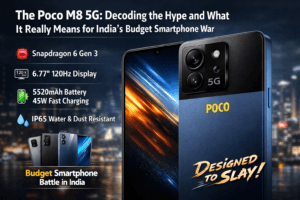
The Poco M8 5G: Decoding the Hype and What It Really Means for India’s Budget Smartphone War
The air in India’s smartphone arena is crackling with anticipation. POCO, the brand that built its reputation on delivering startling value, is sharpening its knives for another strike. The teaser is simple yet bold: “Designed to Slay.” The weapon? The upcoming Poco M8 5G. While the official launch date remains shrouded in “coming soon” mystery, a live Flipkart microsite and a flurry of leaks have painted a remarkably detailed portrait. This isn’t just another phone launch; it’s a strategic move in the hyper-competitive budget segment, and its potential impact warrants a closer, more analytical look.
More Than a Rebrand: A Calculated Market Entry
Let’s address the elephant in the room first. POCO has a well-documented history of rebranding successful Xiaomi/Redmi devices for the Indian market. The teaser video’s design—a dual-tone finish, a distinct squarish camera module—bears an uncanny resemblance to the also-impending Redmi Note 15. This isn’t necessarily a weakness; it’s a strategy. It allows POCO to leverage proven hardware and supply chains to compete on aggressive pricing and focused software.
However, calling it a mere rebrand would be a disservice. POCO’s magic often lies in its software tuning and market positioning. Where a Redmi device might focus on broad family appeal, POCO traditionally sharpens its edge for the performance-hungry, value-conscious youth. The “Designed to Slay” campaign isn’t just marketing fluff; it’s a promise of a device optimized for speed, gaming, and delivering a punch above its price tag.
Under the Hood: Expected Specifications and Real-World Implications
Based on consistent leaks from sources like tipster Sudhanshu Ambhore, the Poco M8 5G’s speculated specs suggest a device engineered to dominate key battlegrounds:
- Processor – The Heart of the Matter: The chipset is the most crucial piece of the puzzle. The standard M8 5G is expected to house the Qualcomm Snapdragon 6 Gen 3. This is a significant detail. The 6 Gen 3 is built on a 4nm process, a first for the 6-series, promising substantial gains in power efficiency and performance over its predecessors. For users, this translates to smoother daily multitasking, capable 5G connectivity, and competent, if not flagship-level, gaming. The rumored Poco M8 Pro 5G, with its alleged Snapdragon 7s Gen 4, would be an even more aggressive play, potentially bridging the gap to the premium mid-range.
- Display – The Window to Content: A 6.77-inch Full HD+ display with a 120Hz refresh rate is the expected standard. In 2025, a high refresh rate is no longer a luxury, even in the budget segment. It’s essential for the fluid social media scrolling, responsive gaming, and overall slickness that defines a modern user experience. This spec alone places the M8 5G directly in the line of fire against competitors from realme, Samsung’s M-series, and Motorola.
- Battery & Charging – The Endurance Game: The reported 5,520mAh battery is a statement. Coupled with the efficient 4nm chipset, this promises a device that can confidently last a day and a half, even for heavy users. When it’s time to refuel, 45W wired fast charging ensures minimal downtime. This combination directly addresses a top consumer anxiety: battery life.
- Build and Resilience – A Step Up: The inclusion of an IP65 rating (for the standard model) is a notable upgrade. The ability to withstand low-pressure water jets and dust ingress makes the device significantly more robust for everyday accidents—a spilled drink, use in the rain, or a dusty commute. If the Pro model achieves an IP68 rating as rumored, it would be a rarity in this price bracket, offering genuine peace of mind.
The Strategic Landscape: Who Should Be Worried?
The Poco M8 5G isn’t entering a vacuum. Its launch will send ripples across the budget segment (likely ₹12,000 – ₹18,000).
- realme Narzo/Number Series: realme has been a consistent champion of value-for-money specs. The M8 5G, with its 120Hz display, large battery, and potential POCO-performance tuning, will force realme to re-evaluate its next move, likely accelerating its own refresh cycles.
- Samsung Galaxy M-Series: Samsung relies heavily on brand trust and after-sales service. However, devices like the Galaxy M35 often lag in specs like charging speed or chipset prowess. The M8 5G will highlight this gap, pressuring Samsung to either add more features or double down on its brand equity.
- Motorola and Nokia: Brands that often emphasize clean software and reliability will find their devices looking starkly underpowered on paper next to the speculated M8 5G specs. Their counter will need to hinge on superior software experience or durability claims.
The Human Insight: What This Means for the Indian Consumer
Beyond the spec sheet war, the arrival of the Poco M8 5G signifies a crucial win for the Indian buyer. It represents the continued democratization of essential features. Five years ago, a high-refresh-rate display, fast charging, and any form of water resistance were premium luxuries. Today, a device poised to be budget-friendly is expected to deliver all three.
This relentless competition forces the entire industry to innovate faster and price more aggressively. The consumer is no longer choosing between a good display OR a big battery; they are rightfully expecting a complete package. The Poco M8 5G, based on expectations, is shaping up to be a benchmark for that “complete package” in early 2025.
The Unanswered Questions and The Final Verdict
The teasers leave room for strategic suspense. The final pricing will be the ultimate decider. POCO’s history suggests it will price the M8 5G to cause maximum disruption. Furthermore, the software experience—how clean, bloat-free, and optimized HyperOS 2.0 (based on Android 15) will be—is crucial. Specs are potential; software delivers the actual experience.
Finally, camera performance remains the big unknown. While a dual-camera setup is expected, its real-world tuning in varied Indian lighting conditions will separate it from being just another phone with a high-megapixel sensor.
In conclusion, the Poco M8 5G is more than a product launch; it’s a declaration of intent. By potentially packing a 4nm processor, a high-refresh-rate display, exceptional battery life, and rugged build into an affordable frame, it is set to recalibrate expectations in the budget segment. For the savvy Indian consumer waiting for their next upgrade, this “Designed to Slay” contender is worth every bit of the wait. It promises not just a new phone, but a new standard for what a budget smartphone must deliver. The battlefield is set, and all eyes are now on POCO to reveal the final specs, the price, and the date that could redefine the rules of the game.
You must be logged in to post a comment.