
The Pit and the Promise: How a Preventable Tragedy Exposes India’s Broken Contract with Its Cities
The drowning of 27-year-old IT professional Yuvraj Mehta in an unmarked, waterlogged construction pit in Noida has ignited national outrage and exposed a catastrophic breakdown in urban governance and civic safety. After his car plunged into the neglected site, Mehta begged for help for hours as his father and emergency responders stood by, with the official response hampered by inadequate equipment, a lack of trained divers, and apparent procedural paralysis.
This preventable tragedy is not an isolated incident but a stark symptom of systemic failures: the pervasive negligence that leaves hazardous, unsecured infrastructure across Indian cities, a reactive culture of accountability that only activates after loss of life, and a profound gap between rapid urban development and the fundamental duty to ensure public safety. The incident has become a powerful allegory for the broken contract between citizens and the state, highlighting how ordinary lives are routinely endangered by apathy, poor planning, and a lack of enforceable accountability, prompting urgent calls for stringent safety protocols and a overhaul of urban management and emergency response systems.
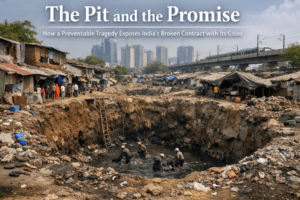
The Pit and the Promise: How a Preventable Tragedy Exposes India’s Broken Contract with Its Cities
The fog that shrouded Noida last Friday night was meteorological, but the obscurity that truly cost Yuvraj Mehta his life was man-made. It was the obscurity of an unmarked, waterlogged pit on a public road; the obscurity of a stalled construction project left as a silent predator; and, most damningly, the obscurity of a system where accountability dissipates like mist until a tragedy forces it to condense. The 27-year-old IT professional’s prolonged, televised death—begging for help for hours before succumbing—is not just a news story. It is a stark, horrifying allegory for the state of urban India, where ambition outpaces duty, and citizens navigate a landscape of latent dangers.
A Narrative of Avoidable Death
The facts, as reported, read like a chilling script. Around midnight, navigating a familiar route home, Mehta’s car hit a low boundary wall and plunged into a deep pit, dug years ago for a construction project that never reached completion. The site, reportedly lacking proper barricades, warnings, or lighting, had become a reservoir of rainwater and neglect. Trapped, Mehta did everything right: he called his father, climbed onto the roof of his sinking car, and used his phone’s torch as a beacon in the darkness.
For nearly two hours, his father, Rajkumar, stood at the edge of that pit, a witness to a nightmare, as his son’s cries echoed. Emergency services arrived, yet a lethal paralysis set in. The response, by multiple accounts, was tragically inadequate. A brave delivery worker, Moninder, tied a rope and plunged in, searching in vain. He reported that official responders were reluctant to enter, citing cold water and submerged debris. No trained divers were reportedly deployed in time. Mehta’s pleas faded into silence long before his body was recovered five hours post-accident.
The Anatomy of a Systemic Failure
This incident is a catastrophic confluence of failures, each layer exposing a different facet of institutional breakdown.
- The Infrastructure of Negligence: At its core is the open pit itself—a raw wound on the city’s skin. It represents the endemic issue of unregulated, abandoned, or poorly managed construction sites that litter Indian cities. These sites are symptoms of a planning and regulatory ethos that prioritizes starting projects over safely maintaining or securing them when stalled. The absence of basic safeguards—reflector tapes, barricades, floodlights—is not an oversight but a standard, tolerated practice. It reflects a culture where citizen safety is an afterthought, an expendable cost in the ledger of urban development.
- The Illusion of Response: The emergency reaction reveals a gaping hole in civic preparedness. The explanations offered by authorities—”zero visibility,” “submerged debris,” “concerns about further casualties”—while possibly containing elements of truth, ring hollow against the backdrop of a life visibly ebbing away. They expose a lack of specialized equipment (like dive teams or thermal imaging) and, more critically, a potential deficit in protocol and will. When a delivery worker shows more initiative than equipped professionals, it points to a deep rot in training, empowerment, and crisis leadership. This wasn’t a complex mountain rescue; it was a water-filled pit in a suburban center near the national capital.
- The After-the-Fact Theater: The subsequent actions—registering cases, arresting one developer, suspending an official—follow a wearyingly familiar pattern. It is the machinery of accountability swinging belatedly into action, driven by media spotlight and public outrage rather than proactive governance. The question every citizen asks is: Would any of this have happened if Yuvraj Mehta had not died? Would that pit have ever been secured? This reactive, rather than preventive, model of administration is what makes Indian roads perennial death traps.
The Human City vs. The Engineered City
Yuvraj Mehta’s story resonates because it taps into a universal urban experience. The comments on social media, sharing tales of near-misses with open manholes, treacherous potholes, and unlit stretches, speak to a collective trauma. India’s cities, especially its booming suburbs like Noida, Gurgaon, or parts of Bengaluru, often feel like engines of economic growth that have forgotten they are also habitats for human beings.
We have built “smart city” command centers but cannot ensure a basic, safe walkway. We engineer magnificent expressways that funnel into local roads resembling obstacle courses. The contract between the citizen and the city has been broken. Citizens pay taxes, follow rules, and contribute to the economy, expecting in return a fundamental guarantee of safety in public spaces. Incidents like this shatter that contract, revealing it to be a one-sided deal.
Beyond Outrage: The Path to Reclaiming Our Cities
Genuine change requires moving beyond cyclical outrage. It demands a structural rethinking:
- Accountability with Teeth: Liability for such incidents must be made personal, severe, and inescapable. It should not stop at a junior site owner or a suspended official. The chain of accountability must travel upwards to the policymakers and senior bureaucrats who allow such lapses to become normalized. Criminal charges of culpable homicide must be pursued rigorously to set a precedent.
- Mandatory Safety Protocols as Non-Negotiable: Every construction or excavation site, active or stalled, must be governed by a publicly visible safety certificate. This includes 24/7 lighting, mandatory barricading, clear signage, and regular inspections. The cost of this must be baked into project approvals. Technology like GPS tagging of such sites and public apps for reporting violations can empower citizens.
- Revamping Emergency Response: City emergency services need specialized, well-equipped units for such scenarios—dive teams, flood rescue units, and advanced recovery equipment. More importantly, they need clear protocols that prioritize immediate action over bureaucratic hesitation. Training with realistic simulations is crucial.
- A Culture of Civic Ownership: Finally, there is a role for public consciousness. The “someone else will fix it” mentality enables neglect. While the primary duty is institutional, neighborhood groups, resident welfare associations, and local media must become persistent watchdogs, documenting and relentlessly reporting hazards before they turn fatal.
Yuvraj Mehta was not just a victim of a pit. He was a victim of apathy masquerading as process, of negligence dressed as inevitability, and of a distorted development model that values concrete over humanity. His final, desperate calls to his father are a metaphor for the citizen’s cry to the state: a plea for basic salvation from preventable danger.
As the fog clears over Noida, the monument to his death should not be just a temporary barricade around a now-notorious pit. It should be a permanent, unwavering commitment to making our cities not just centers of wealth, but sanctuaries of life. The true tribute to Yuvraj Mehta, and countless others lost to similar urban failures, would be a city where no parent has to stand helpless in the dark, listening to their child’s cries fade away, waiting for a rescue that never comes.
You must be logged in to post a comment.