
The Phantom War: As Gaza’s “Ceasefire” Unravels, A Generation Asks, “When Will It End?”
Despite a U.S.-backed ceasefire being in place, the recent Israeli airstrikes that killed 33 Palestinians in Gaza underscore a brutal reality for civilians: the war never truly ended, but has instead transitioned into a lower-intensity “phantom war” of persistent violence, psychological trauma, and a collapsed humanitarian reality, all set against a backdrop of a failing geopolitical stalemate where international peace plans lack viable mechanisms for disarmament, reconstruction, or a political resolution, leaving a generation trapped in a desperate cycle of ruin and fear with no end in sight.
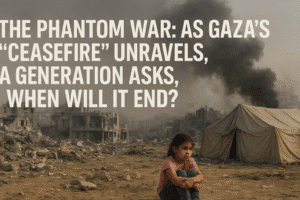
The Phantom War: As Gaza’s “Ceasefire” Unravels, A Generation Asks, “When Will It End?”
Meta Description: An in-depth analysis of the escalating violence in Gaza post-ceasefire, exploring the human cost, the political stalemate, and the desperate reality for civilians trapped between no war and no peace.
The bombs that fell on the tents of al-Mawasi and the homes of Gaza City this week did more than kill 33 people, including at least 12 children. They detonated a fragile illusion—the illusion that the war had ever truly ended. For the two million Palestinians in Gaza, the recent period labelled a “ceasefire” has been nothing more than a war in a lower, more agonizing key.
The headlines scream of escalation, of a “shocking massacre,” and of violated truces. But to understand this moment is to look beyond the explosive crescendos and into the grim, silent baseline of suffering that has persisted uninterrupted. This is not a return to war; for those living it, it is the revelation that the war never left.
The Ceasefire That Wasn’t: A Landscape of Lingering Death
The statistics tell a story of their own. According to Gaza’s health ministry, more than 300 people have been killed by Israeli strikes since the US-backed ceasefire came into effect last month. This averages to over seven deaths a day—a number that would constitute a profound crisis in any other context but is dismissed as a “lull” in the long, bloody saga of Gaza.
The ceasefire, as it was understood by the international community, was always a precarious construct. Its terms, which included increasing aid and returning hostages, have been only partially and inconsistently fulfilled. The result is a purgatorial state described perfectly by Mohammed Hamdouna, 36, displaced to a tent in al-Mawasi: “The intensity of the death toll has decreased, but martyrs and shelling happen every day. We are still living in tents. The cities are rubble; the crossings are still closed, and all the basic necessities of life are still lacking.”
This is the core of the current crisis. The recent airstrikes are not an anomaly but a starkly visible symptom of a deeper, festering disease. The infrastructure of life—homes, hospitals, schools, water pipes—lies in ruins. The Israeli military still controls over half the territory, carving it up with a “yellow line.” Hamas, though battered, remains a force, still holding the remains of three Israeli hostages. The conditions for a return to full-scale conflict were not just present; they were the very fabric of daily existence.
The Psychology of the “Forever War”: A Child’s Question in the Night
Perhaps the most poignant and devastating insight from the recent reporting comes not from a official statement, but from a child’s fearful question. Lina Kuraz, 33, from Gaza City, shared the haunting refrain from her daughter: “Will the war come back?”
This question reveals the profound psychological trauma inflicted upon an entire generation. For children in Gaza, the concept of “peace” is an abstract myth. Their reality has been defined by the roar of jets, the collapse of buildings, and the constant specter of death. The so-called ceasefire offered no therapy, no safe spaces, no return to normalcy—only a different, more anxious kind of fear. When the foundation of your world has been shattered, the brief absence of explosions does not feel like safety; it feels like the calm before the next storm.
This perpetual state of hyper-vigilance erodes resilience. Every night spent waiting for a bomb to fall, every day spent scrambling for food and clean water, reinforces the neural pathways of trauma. The question, “When will this nightmare end?” is not rhetorical; it is a desperate plea for a future that seems increasingly unimaginable.
The Geopolitical Stalemate: A Peace Plan Built on Quicksand
Into this volatile mix arrives the new UN-endorsed plan, a blueprint championed by the Trump administration that envisions an international stabilisation force and a path to a Palestinian state. On paper, it represents a diplomatic step forward. In reality, it confronts a minefield of unanswered, and perhaps unanswerable, questions.
- The Hamas Conundrum: The plan’s most glaring hole is the mechanism for disarming Hamas. No armed group in history has voluntarily relinquished power after a conflict it believes is part of an ongoing resistance. Is the international community prepared to fight a counter-insurgency war against a deeply embedded militant group on behalf of an as-yet-undefined Palestinian authority?
- The Troop Question: Who will comprise this international force? Nations like the UAE have already refused to participate without a clear legal framework, wary of being seen as an occupying power or getting caught in a bloody crossfire. The mission is fraught with risk with no clear exit strategy.
- The Israeli Dilemma: The plan requires Israel to lift its suffocating restrictions on humanitarian aid and cede control. Yet, the Israeli government’s stated justification for the recent airstrikes—responding to fire against its soldiers, even with no casualties—demonstrates a continued policy of overwhelming retaliation. A sovereign Palestine is anathema to the current ruling coalition, making the plan’s ultimate goal a non-starter in Tel Aviv.
Qatar, a key mediator, was swift to condemn the latest Israeli strikes as a “dangerous escalation that threatens to undermine the ceasefire agreement.” Their warning is crucial. Mediators understand that without a political horizon that addresses root causes—the occupation, the blockade, the political status of Palestinians—each violation of the truce brings the entire shaky edifice closer to collapse.
A Regional Tinderbox: Echoes in Lebanon
The violence in Gaza is never an isolated event. The recent barrage of Israeli airstrikes in southern Lebanon and the deadly attack on the Ein el-Hilweh refugee camp are stark reminders that the conflict exists within a regional ecosystem. The ceasefire between Israel and Hezbollah has been tense, and the flames in Gaza inevitably threaten to ignite the border with Lebanon. This interconnectedness raises the stakes exponentially, turning a localised tragedy into a potential regional conflagration.
Conclusion: Beyond the Headlines of the Next Escalation
The story of Gaza today is not simply one of a ceasefire breaking down. It is the story of a ceasefire that was never allowed to become a peace. The temporary reduction in violence was mistaken for a resolution, allowing the world to look away from the ongoing emergency.
The international community now faces a choice. It can continue to manage the crisis in a cycle of truce and escalation, reacting to each new bout of violence with temporary fixes. Or, it can address the underlying pathology: the political vacuum, the humanitarian catastrophe, and the profound, generational despair that fuels the conflict.
When a child in Gaza asks, “Will the war come back?” she is asking the world a question we have failed to answer for decades. The response, thus far, has been the sound of another explosion. Until that changes, the phantom war will continue its grim procession, in loud bursts and in terrible, silent suffering. The nightmare will not end on its own.
You must be logged in to post a comment.