
The Paradox of the Hangman’s Noose: Israel’s Death Penalty Bill and the Erosion of Legal Norms
A proposed Israeli death penalty bill, advanced through the Knesset with broad political support, threatens to shatter Israel’s six‑decade de facto moratorium on executions by imposing mandatory hanging for Palestinians in military courts while sparing Israeli citizens from similar punishment—a discriminatory dual‑track system that human rights groups and the International Centre of Justice for Palestinians condemn as a draconian escalation violating international law, the Fourth Geneva Convention, and the very principle of equal justice, replacing judicial discretion with retributive codification and setting the stage for profound legal and geopolitical fallout if enacted.
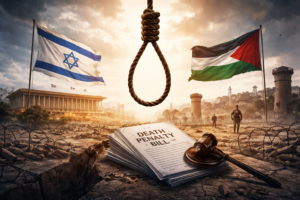
The Paradox of the Hangman’s Noose: Israel’s Death Penalty Bill and the Erosion of Legal Norms
In the landscape of international law, few practices are as controversial—or as final—as capital punishment. For over six decades, Israel has occupied a peculiar position in this global discourse: a country whose statutory law permits the death penalty, yet whose state practice has rendered it a de facto abolitionist nation. That carefully maintained tension, a fragile equilibrium between legal theory and executive restraint, is now facing its most severe test.
The International Centre of Justice for Palestinians (ICJP) issued a sharp condemnation on Monday following the advancement of a proposed death penalty bill through the Knesset. Having undergone its second and third readings, the legislation is no longer merely a provocative draft but a tangible threat to codify a draconian escalation in the administration of justice in the occupied territories. To understand the gravity of this moment, one must look beyond the text of the bill and examine the structural discrimination embedded within it, the historical context of Israel’s relationship with capital punishment, and the profound implications such a law would have for the principle of equal protection under the law.
A Tale of Two Legal Systems
At the heart of the controversy lies a fundamental legal duality. The proposed legislation does not apply uniformly to all people within the jurisdiction of the Israeli state. Instead, it meticulously delineates its victims and its perpetrators.
The bill targets two specific scenarios. First, it seeks to expand death penalty sentencing to the occupied West Bank by amending the Israeli Penal Law 5737-1977 alongside relevant military regulations. Second, it introduces special provisions to establish an ad hoc military court to prosecute individuals allegedly involved in the October 7, 2023 attacks. In both cases, the method prescribed is hanging—a modality of execution that carries with it a grim historical weight.
However, the most legally alarming aspect of the bill is its discriminatory scope. The mandatory death sentence applies to any person who causes the death of an Israeli citizen—crucially, only an Israeli citizen—out of a motive defined as “racism or hostility toward the public,” with the intent to harm the State of Israel or the “revival of the Jewish people in its homeland.”
This language creates a two-tiered system of justice so stark that it challenges the very notion of a rule of law. For West Bank Palestinians accused of such acts, they would face a mandatory death sentence in military courts, where conviction rates have historically been exceedingly high. Conversely, Israeli citizens accused of identical acts—including, theoretically, acts of violence against Palestinians—would likely be subject to lower sentencing standards in civilian courts, where the death penalty has been functionally obsolete for generations.
Órlaith Roe, the ICJP’s public affairs and communications officer, articulated this disparity as part of a broader pattern. “Israel’s targeted killing of Palestinians is part of a longstanding and deeply disturbing pattern,” Roe stated, adding that the bill represents a direct assault on the right to life “in a manner that is both openly discriminatory and grossly disproportionate.”
This is not merely a critique of the death penalty as a punishment; it is a critique of a legal structure that defines whose life is worthy of the highest protection and whose death merits the ultimate retribution.
The Myth of the “De Facto” Abolitionist
One of the arguments likely to be raised by proponents of the bill is that it merely codifies a punishment that already exists in statute, or that the “de facto” abolitionist status of Israel mitigates the danger. This reasoning is deeply flawed.
It is true that Israel has not carried out an execution since 1962, when Adolf Eichmann, a principal architect of the Holocaust, was hanged. That singular execution was viewed by the international community—and by many within Israel—as an anomaly justified by the unprecedented nature of the crimes against humanity. Since then, despite numerous convictions for terrorism and murder, a combination of judicial restraint, executive clemency, and political prudence has prevented the gallows from being used again.
But a de facto moratorium is not a de jure abolition. It is a policy of restraint, not a constitutional guarantee. What the current bill threatens to do is shatter this moratorium by transforming the death penalty from an available but rarely pursued sentence into a mandatory one for specific, politically defined categories of offenses.
When the law mandates a specific punishment, it removes judicial discretion. In the context of military courts in the West Bank—where due process protections are already considered by human rights organizations to fall short of international standards—a mandatory death sentence effectively turns the courtroom into a conveyor belt. It strips the judge of the ability to weigh mitigating circumstances, assess evidence nuances, or consider the broader context of the offense. By making the punishment automatic, the bill ensures that the verdict becomes a foregone conclusion.
Codifying a Doctrine of Collective Retribution
To view this legislation in isolation would be a mistake. It arrives as part of a wave of legal maneuvering that has defined the post-October 7 landscape. Human rights organizations warned as early as January of this year that these bills represented some of the “most extreme and dangerous legislative measures ever employed by Israel against Palestinians.”
The introduction of an ad hoc military court to specifically handle cases related to the October 7 attacks further underscores the punitive, rather than purely judicial, nature of the initiative. The establishment of special tribunals for specific events often raises concerns about retroactive justice, ex post facto laws, and the erosion of procedural norms. When these tribunals are empowered to impose the death penalty as a mandatory sentence, the line between justice and vengeance becomes dangerously blurred.
Furthermore, the bill’s language regarding “negligence” as a trigger for the death penalty is legally terrifying. In most jurisdictions that retain capital punishment, it is reserved for intentional acts of murder. The inclusion of “negligence” suggests a standard of liability so low that it could criminalize accidents or failures of foresight, equating them with premeditated murder and punishing them with the ultimate sanction.
The Geopolitical and International Law Fallout
Beyond the immediate humanitarian concerns, the passage of this bill would place Israel in direct contravention of its international legal obligations. The Fourth Geneva Convention, which governs the conduct of occupying powers, explicitly prohibits the passing of sentences—including the death penalty—against protected persons (those in occupied territories) unless they are pronounced by a “regularly constituted court” affording “all the judicial guarantees which are recognized as indispensable by civilized peoples.”
A mandatory death sentence, applied discriminatorily based on nationality and ethnicity, does not meet the standard of “indispensable judicial guarantees.” International human rights law, as articulated by bodies like the UN Human Rights Committee and the European Court of Human Rights, has increasingly moved toward viewing the death penalty as a violation of the right to life, particularly when applied in an arbitrary or discriminatory manner.
If enacted, this legislation would likely serve as a flashpoint for further international isolation. It would provide substantial ammunition for those seeking to advance cases against Israeli officials at the International Criminal Court (ICC), where the imposition of a discriminatory capital punishment regime could be argued as a crime against humanity, specifically persecution on political, racial, or national grounds.
The Politics of the Gallows
Perhaps the most chilling aspect of the bill is its political viability. The report notes that despite Israel’s historical hesitance to actually execute prisoners, the current legislation enjoys “broad political support across both coalition and opposition parties.” This bipartisan consensus signals a fundamental shift in the Israeli political center of gravity regarding the death penalty.
Traditionally, the opposition to capital punishment in Israel came from a coalition of liberal Supreme Court justices, left-leaning politicians, and security establishment veterans who understood that executing prisoners—particularly Palestinians—would create martyrs and complicate future negotiations or prisoner exchanges. The broad support for this bill suggests that these traditional restraining forces have been weakened, superseded by a political climate defined by retribution in the wake of the October 7 attacks.
For the international legal community, this presents a grim paradox. The Knesset is on the verge of passing legislation that is openly discriminatory, legally retrogressive, and in violation of international humanitarian law, all while enjoying the kind of democratic legitimacy that usually commands respect. It is a reminder that democracy, without the constraints of constitutionalism and human rights protections, can produce profoundly illiberal outcomes.
A Crossroads for Justice
As the bill moves toward a final floor vote, the stakes could not be higher. For the Palestinians of the West Bank, the legislation represents an existential threat: the possibility of being funneled into a military justice system where the only possible outcome for certain charges is a date with the hangman. For Israeli democracy, it represents a test of whether the state can resist the urge to codify vengeance into law. And for the international system, it represents a challenge to the enforceability of the Geneva Conventions and the universality of human rights.
The ICJP’s denunciation is likely just the opening salvo in what will become a concerted international campaign to pressure the Knesset to abandon the bill. Yet, given the political momentum described, the question is no longer whether the bill will be challenged, but whether the traditional guardrails of Israeli jurisprudence—the Supreme Court, the Attorney General, and international pressure—can hold.
For six decades, Israel has been a nation that, despite the harshness of its occupation policies, refrained from using the gallows. To abandon that restraint now is not merely to change a penal code; it is to redefine the character of the state. In the end, a law that mandates death for some but not others is not a law of justice; it is a law of power. And when power is codified in such raw, discriminatory terms, the very foundation of the rule of law begins to crumble.
You must be logged in to post a comment.