
The Paper Tiger: Why India’s Ambitious New Waste Rules Face the Same Old Problem
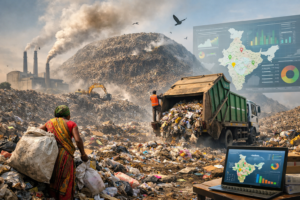
India’s new Solid Waste Management Rules 2026 introduce ambitious measures like four-way waste segregation, stricter responsibilities for bulk waste generators, and a centralized tracking portal, yet experts warn they will likely fail due to the same chronic implementation gaps that have plagued the system for decades, as symbolized by Delhi’s towering, toxic landfills where unsegregated waste continues to pile up and burn. The core problem remains a broken trust between citizens who segregate waste and a municipal system that often remixes it, a misguided reliance on Waste-to-Energy plants that incentivize mixed waste burning, and the continued neglect of the informal recycling workforce, proving that without addressing these foundational governance and human issues, even the most well-crafted policies will remain ineffective paper tigers.
The Paper Tiger: Why India’s Ambitious New Waste Rules Face the Same Old Problem
On paper, it looks like a revolution. In late January 2026, India’s Ministry of Environment, Forest and Climate Change unveiled a sweeping new set of Solid Waste Management (SWM) rules. They are stricter, more detailed, and more ambitious than anything that has come before. They mandate that households sort their trash into not three, but four separate categories. They crack down on bulk waste generators like hotels and large residential complexes. They introduce a central digital portal to track every scrap of garbage from your kitchen bin to its final destination. And they slap heftier fees on cities that continue to dump mixed, unsegregated waste into the country’s overburdened landfills.
The 2026 rules, which take effect on April 1, are a clear signal that the government recognizes the scale of India’s waste crisis. They are a necessary and, in many ways, brilliant framework for a circular economy. But ask anyone who works on the frontlines of this crisis—the waste pickers, the NGO founders, the policy researchers—and they’ll tell you the same thing: a brilliant framework is meaningless if the foundation is cracked.
And the foundation of waste management in India has been crumbling for decades. The proof isn’t in the policy document; it’s in the air you breathe and the mountains of trash you can see from space on the outskirts of its cities.
The Three Towers of Delhi: A Monument to Failure
To understand the gap between policy and reality, you need to look no further than the eastern edge of New Delhi. Here, rising from the flat floodplains of the Yamuna River, are the three infamous landfills of Ghazipur, Bhalswa, and Okhla. They are no longer just landfills; they are “garbage mountains,” towering peaks of unprocessed, decomposing, and often burning waste that have become a permanent, toxic feature of the city’s geography.
They are also the most visible symbols of the old system’s failure. The 2016 SWM rules, which the 2026 version replaces, also promised better segregation and processing. Yet, Delhi continues to generate a staggering 600 grams of waste per person every day. While officials tout that 64% of this is “processed,” that still leaves a monumental 4,241 tonnes of fresh, mixed waste added to these dumpsites daily.
These aren’t just eyesores. They are climate bombs and public health catastrophes. As the article highlights, they are silent contributors to Delhi’s infamous air pollution, second only to vehicles and dust storms in their contribution to deadly PM2.5 particles. When the waste deep inside these mountains decomposes without oxygen, it generates methane—a greenhouse gas 80 times more potent than carbon dioxide over a 20-year period. And on the surface, spontaneous fires, like the one at Bhalswa in 2022, can trigger localized air pollution events that rival the city’s worst winter smogs, spewing a cocktail of nitrogen oxides, carbon monoxide, and cancer-causing furans and dioxins.
Against this backdrop of towering failure, the 2026 rules land with the promise of a technological and administrative fix. But will they be enough?
The Devil in the Details: What the 2026 Rules Get Right
First, it’s important to acknowledge the genuine progress embedded in the new framework.
- Four-Way Segregation: Moving from three bins (wet, dry, hazardous) to four (adding “sanitary” and “special care” for items like diapers, sanitary pads, paint cans, and e-waste) is more than just administrative tinkering. It’s an acknowledgment that different waste streams need entirely different treatment pathways. Mixing a mercury thermometer with a plastic bottle contaminates both.
- Targeting the Big Guys: The new Extended Bulk Waste Generator Responsibility (EBWGR) is a powerful tool. By forcing large waste generators—who are responsible for 30% of all solid waste—to treat their own wet waste or pay for it to be treated elsewhere, the rules aim to decongest the municipal system at its most pressured point.
- Financial Disincentives: Higher landfill fees for sending unsegregated waste directly target the pockets of urban local bodies (ULBs), hoping to force them to improve their collection systems.
- Digital Transparency: The promised central online portal, designed to track waste from generation to disposal, is perhaps the most significant innovation. For the first time, there is a potential for real-time data, accountability, and the ability to see exactly where the system is breaking down.
The Unhealed Wound: Why Implementation Keeps Failing
So, if the rules are better, why the widespread pessimism? Because the primary problem in Indian waste management has never been the rules themselves. It’s the profound disconnect between the policy drafted in Delhi and the reality on the ground in its cities, towns, and villages.
- The Broken Trust Between the Citizen and the StateThe entire edifice of waste management rests on one simple, human action: a citizen segregating their waste at home. But why would anyone do that if they don’t trust the system?
“If a person is being asked to segregate waste at home and they do it properly, there must be assurance that the system beyond them is already in place,” says Dr. Ruby Makhija, an ophthalmologist and founder of the Why Waste Wednesdays Foundation. “What happens too often is that if residents segregate, when the collector arrives and mixes everything again, all that effort goes to waste. That completely erodes trust.”
This is the daily reality for millions of Indians. The sound of the morning garbage truck is often the sound of their civic effort being undone in an instant. The new rules and the fancy portal cannot rebuild this trust. That requires training, supervision, and a cultural shift within the ULBs themselves, many of which are understaffed, underfunded, and lack the political will to enforce fines on influential resident welfare associations (RWAs).
As veteran environmental activist Bharati Chaturvedi of the Chintan Environmental Research and Action Group points out, successful models like Indore work because the state itself became a partner in public awareness, treating NGOs as collaborators. In Delhi, she laments, “NGOs are not seen as partners but as dispensable actors.”
- The Waste-to-Energy DistractionThe new rules, while promoting circularity, continue to bet on Waste-to-Energy (WtE) plants as a key solution. This is a deeply controversial and, many argue, a misplaced priority in the Indian context.
“In India, waste really has calorific value only after proper segregation,” explains Lakshmi P., Head of Impact at the environmental tech company Cleanhub. “But once you segregate, the recycling industry is strong enough to absorb most of that material. The truly non-recyclable fraction is actually very small—maybe 5 to 10 percent.”
The problem is that WtE plants are massive, expensive infrastructure projects that need a constant supply of “fuel” to be financially viable. This creates a perverse incentive for ULBs to keep feeding them mixed waste, undermining the very segregation the rules are trying to enforce. When this unsorted waste is burned at relatively low temperatures, it releases the very toxins—dioxins, furans, heavy metals—that the plants are supposed to neutralize. The infamous case of the Okhla incinerator, found to be releasing dioxins at levels nearly 900% above the legal limit, serves as a chilling warning.
Dr. Makhija is blunt: “It’s a common misconception that technology can fix this. No matter how advanced or expensive the machinery, it will fail if waste is not segregated at source. Nearly 70% of effective waste management depends on segregation, but this is not treated as an investment priority.”
- The Invisible WorkersAny discussion of waste management in India is incomplete without acknowledging the millions of informal waste pickers and recyclers who form the backbone of the country’s recycling rate. They are the ones who currently do the segregation that the formal system fails to do, often working in hazardous conditions for little pay. The new rules, with their talk of central portals and Material Recovery Facilities, remain largely silent on how to integrate, formalize, and protect this essential workforce. A truly just transition to a circular economy cannot happen by rendering invisible the very people who make it possible today.
A Long Way to Go
The 2026 Solid Waste Management Rules are not the problem. They are, in many ways, a sophisticated and well-considered response to a complex crisis. They offer a roadmap. But a roadmap is useless if you don’t have a vehicle, a driver, and a population that wants to reach the destination.
The real test will not be in the language of the notification, but in the months and years after April 1. Will a Resident Welfare Association in Delhi actually be fined for not segregating? Will the new central portal be used to expose failing ULBs or just to create a more polished illusion of compliance? Will the fines on mixed waste be high enough to hurt, or will they be waived as they have been in the past?
Ultimately, cleaning up India’s mountains of waste is not a technological challenge. It is a challenge of governance, of restoring civic trust, and of acknowledging that “waste does not disappear once it leaves the doorstep,” as Dr. Makhija puts it. “It returns through the air people breathe, the water they drink, and the food grown in contaminated soil.” Until this truth is embedded in the hearts of both the policymakers and the public, the new rules, however ambitious, risk becoming just another paper tiger, roaring on the page but silent in the face of the growing, burning mountains at our city gates.
You must be logged in to post a comment.