
The Paper That Beats the Heat: A New Era for Detecting Drug-Resistant TB in Remote India
Researchers in India have developed a ‘Quick DNA’ kit that uses a specialized filter paper called a Trans-Filter to revolutionize the detection of drug-resistant tuberculosis, particularly in remote areas. The device captures TB bacteria from patient sputum samples and allows them to be dried and stored at room temperature for weeks, even in extreme heat, eliminating the need for a reliable cold chain for transport. Once in the lab, a simple five-minute heating process extracts the DNA for analysis, replacing a traditional one-hour procedure. This breakthrough makes advanced testing logistically feasible for rural populations, enabling faster diagnosis and targeted treatment for multidrug-resistant TB, though further research is needed to confirm its effectiveness for samples with low bacterial concentrations.
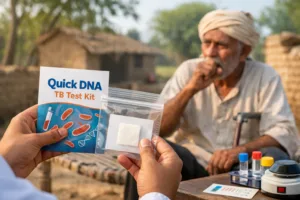
The Paper That Beats the Heat: A New Era for Detecting Drug-Resistant TB in Remote India
Imagine a village in rural India. The nearest city with a proper hospital is a bone-rattling, six-hour bus ride away. A farmer, let’s call him Ramesh, has been battling a persistent cough for weeks. The local clinic suspects Tuberculosis (TB) and sends his sputum sample—a small glass vial of thick liquid—on that same bus journey. But the sample is alive and fragile. By the time it reaches the city lab, the sweltering heat may have degraded it, rendering the test useless. The farmer must be called back to produce another sample, losing another day of work, and another day closer to spreading a deadly, infectious disease to his family.
This logistical nightmare is a daily reality in the fight against Tuberculosis, a disease that still kills over a million people every year. But a recent breakthrough from researchers at the Postgraduate Institute of Medical Education and Research (PGIMER), Chandigarh, and the National Institute of Tuberculosis and Respiratory Diseases, New Delhi, offers a solution as simple as it is revolutionary: a piece of special paper.
This isn’t just any paper. It’s a “Trans-Filter,” the cornerstone of a new ‘Quick DNA’ kit that promises to dismantle one of the biggest barriers to diagnosing drug-resistant TB in the developing world: the “cold chain.”
The Killer in the Cold Chain
To understand why this innovation is a potential lifesaver, we have to understand the journey of a TB test. Tuberculosis is caused by Mycobacterium tuberculosis, a tough, slow-growing bacterium. Diagnosing it, and more importantly, determining if it is the dangerous multidrug-resistant (MDR-TB) form, requires sophisticated lab equipment.
The gold standard for detecting drug resistance is the Line Probe Assay (LPA). This test looks for specific genetic mutations in the bacteria that make them impervious to frontline drugs like rifampicin and isoniazid. But before the LPA can work its magic, you need to get the bacteria’s DNA out of the patient’s sputum and safely to the lab.
For decades, this has been a high-stakes game of beat the clock. The traditional method relies on a “cold chain.” Sputum samples, teeming with live bacteria, are collected in glass vials and must be kept refrigerated from the moment they are produced until they reach the lab. This requires a fleet of refrigerated trucks, a constant and reliable supply of electricity to run the fridges, and a logistics network that operates with military precision.
In a country as vast and climatically diverse as India, this is a monumental task. Power cuts are common in rural areas. Refrigerated transport is expensive and often unavailable. During the scorching Indian summer, when temperatures regularly soar past 40°C (104°F), a sample left on a counter for a few hours can become useless. The bacteria die, the DNA degrades, and the diagnostic window slams shut. The result is a failed test, a delayed diagnosis, and a patient who continues to suffer and infect others, unaware of the ticking clock.
A Microscopic Net and a Zip-Lock Bag
The beauty of the new ‘Quick DNA’ kit lies in its elegant simplicity. The researchers have essentially taken a complex, fragile process and turned it into something as robust and portable as a letter.
At the heart of the system is the Trans-Filter. This isn’t a piece of standard office paper; it’s a sophisticated membrane designed to act like a microscopic net. When a patient’s sputum sample is liquefied and passed through the device, the membrane captures the TB bacteria while letting the rest of the liquid pass through.
But the real magic happens next. The filter, now holding the bacteria, is sterilized and then simply air-dried. This process of dehydration effectively puts the bacteria into a state of suspended animation. Their tough cell walls become inert, and their precious DNA is locked safely within the fibers of the filter paper. The hazardous liquid sample is now a safe, solid piece of data.
This tiny, dry filter is then tucked into a simple, lightweight zip-lock bag. No more glass vials. No more ice packs. No more refrigerated trucks. The sample can now be sent by regular post, carried on a bus, or even transported in the pocket of a community health worker on a motorcycle.
The researchers put this resilience to the ultimate test. They stored the filters at a blistering 50°C (122°F) for up to four weeks—conditions that mimic a severe heatwave. Even after this ordeal, the bacterial DNA remained perfectly preserved, ready to reveal its secrets. This single breakthrough eliminates the entire logistical nightmare of the cold chain, opening up access to advanced TB testing for populations that were previously unreachable.
From a Seven-Step Climb to a Five-Minute Sprint
The innovation doesn’t stop at transport. The ‘Quick DNA’ kit also dramatically simplifies the process of getting the DNA out of the bacteria once it arrives at the lab.
Traditionally, extracting DNA from M. tuberculosis was a laborious, time-consuming ritual. It involved a multi-step process of heating, cooling, centrifuging, and pipetting—a procedure that could take nearly an hour of a skilled technician’s time and required a well-equipped lab. This is a process prone to human error and a significant bottleneck when labs are processing hundreds of samples.
The new kit replaces this seven-step climb with a five-minute sprint. The process, called heat lysis, is beautifully straightforward. The filter is placed in a specialized buffer solution and heated to 80°C for just five minutes. This intense, brief heat shock disrupts the notoriously tough, waxy cell wall of the TB bacterium, causing it to burst open and release its DNA into the solution.
In a single step, the sample is ready for the Line Probe Assay. This speed is critical. In the world of infectious disease, every hour counts. A faster diagnosis means treatment can begin sooner, reducing the chance of the disease spreading and improving the patient’s odds of a full recovery.
The Human Impact: More Than Just a Test
This isn’t just a story about a faster, cheaper lab test. It’s a story about changing the lives of people like our hypothetical farmer, Ramesh.
With the ‘Quick DNA’ kit, the process becomes patient-centric. A health worker at a rural clinic can collect Ramesh’s sample, run it through the Trans-Filter, let it dry, and pop it in a plastic bag with a simple label. The sample can then be sent to the regional lab whenever transport is available—tomorrow, next week, it doesn’t matter. The heat and the delay are no longer enemies.
When the result comes back a few weeks later, it won’t just say “TB positive” or “TB negative.” It will provide a crucial piece of information: is this strain of TB drug-resistant? If it is, Ramesh won’t be started on the standard six-month course of antibiotics that would ultimately fail. Instead, he can immediately begin a longer, more complex regimen of second-line drugs specifically designed to combat MDR-TB. This targeted treatment from day one saves precious time, prevents the further spread of a dangerous resistant strain, and gives Ramesh a real fighting chance.
For the healthcare system, the benefits are equally profound. It reduces the cost and complexity of sample transport. It frees up skilled lab technicians from mundane DNA extraction to focus on more complex analyses. It increases the accuracy and reliability of testing across the board. Most importantly, it provides a clearer picture of where drug-resistant TB is emerging, allowing public health officials to respond more effectively.
Not a Silver Bullet, But a Giant Leap
The study, published recently, is not without its caveats. The researchers are careful to point out that their study primarily focused on “smear-positive” samples—those with a high concentration of bacteria. This means the patient was likely already quite ill and highly infectious. The real challenge lies with “smear-negative” patients, who have fewer bacteria in their sputum and are often harder to diagnose, especially in the early stages of the disease. More research is needed to see if the Trans-Filter is sensitive enough to capture a usable DNA sample from these patients.
Furthermore, the test showed slightly lower sensitivity for a specific and rarer drug-resistance marker called inhA. Because these mutations are uncommon, they can produce weaker signals on the test, making them more difficult for lab technicians to read. This highlights that while the technology is a leap forward, it doesn’t replace the need for skilled professionals and continuous quality control.
A Blueprint for the Future of Diagnostics
Despite these limitations, the ‘Quick DNA’ kit represents a paradigm shift. It’s a powerful example of how frugal innovation—solving a big problem with a simple, low-cost solution—can have an outsize impact on global health.
By conquering the “last mile” problem of sample transport, this technology doesn’t just improve TB testing; it provides a blueprint for tackling other infectious diseases. Think of HIV viral load monitoring, or testing for emerging pathogens in remote areas. If you can stabilize a sample on a piece of paper at room temperature, you democratize access to the most advanced diagnostic tools in the world.
In the fight against one of humanity’s oldest and deadliest plagues, we often look for breakthroughs in high-tech gadgets and miracle drugs. But sometimes, the most profound innovation is something as simple, resilient, and elegant as a piece of paper that beats the heat, bridging the vast distance between a coughing farmer in a remote village and the life-saving answer he desperately needs.
You must be logged in to post a comment.