
The Palestinian Authority’s Constitutional Gambit: A Bid for Statehood or a Survival Tactic?
The Palestinian Authority’s receipt of a draft constitution aimed at formally transitioning it to a state is largely a symbolic and tactical maneuver rather than a practical step toward genuine sovereignty. While intended to bolster the PA’s international legitimacy and placate demands for internal reform, the effort is hamstrung by fundamental contradictions: it cannot be enacted without a public referendum that President Mahmoud Abbas is unlikely to schedule, fearing severe punitive measures from Israel, which opposes any unilateral move toward statehood. Moreover, the document ignores the entrenched division with Hamas in Gaza, offering a Fatah-centric vision that does not address the reality of fragmented Palestinian governance, and its proposed term limits ironically highlight Abbas’s own prolonged, unelected tenure, underscoring that this constitutional push is more about political survival and diplomatic posturing than about effecting transformative change on the ground.
The Palestinian Authority’s Constitutional Gambit: A Bid for Statehood or a Survival Tactic?
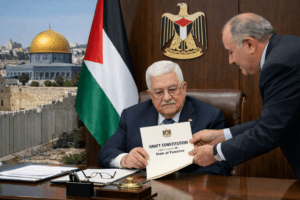
In a move laden with both historical symbolism and immediate political risk, Palestinian Authority President Mahmoud Abbas has formally received a draft constitution intended to transmute the PA from an interim administrative body into a constitutional state. This 70-page document, the product of seven months of committee work, represents more than a legal text; it is a mirror held up to the acute dilemmas of Palestinian politics, reflecting a leadership trying to manufacture legitimacy while navigating the paralyzing pressures of Israeli occupation, internal division, and international expectancy.
At its core, this constitutional push is a paradox. It is an attempt to codify statehood unilaterally in a context where the fundamental prerequisites of statehood—territorial sovereignty, unified security control, and unconstrained governance—are starkly absent. Over 160 countries may recognize the State of Palestine, but as the draft acknowledges indirectly, its writ does not run freely between the Jordan River and the Mediterranean Sea. Israel maintains overarching security authority in the West Bank and a complete blockade on Gaza, while Hamas rules the latter with its own guns and laws. Thus, the constitution is, first and foremost, an exercise in political aspiration rather than an immediate blueprint for governance.
The Mechanics of a “State” That Cannot Enforce Its Laws
The draft constitution’s proposed framework maintains the PA’s existing hybrid parliamentary-presidential system but introduces a critical, albeit familiar, reform: a two-term limit for the presidency. The irony here is profound. President Abbas, now in the 21st year of his four-year term, would be the very first person subject to this new rule. The constitution thus inadvertently highlights the central pathology it seeks to cure—the democratic deficit and entrenched rule that have eroded the PA’s credibility among its own people. The Palestine Legislative Council (PLC) has been moribund since 2007, shattered by the Fatah-Hamas schism. The new charter’s promise of a robust, overseeing legislature rings hollow without a mechanism to heal that rift or force elections Abbas has repeatedly canceled.
This points to the draft’s primary audience. While presented to the Palestinian public, its most attentive readers are in international capitals. For donor states in Europe and elsewhere, long frustrated with the PA’s corruption and authoritarian tendencies, “constitutional reform” is a welcome checkbox on a list of demanded changes. Ramallah can frame this document as a good-faith effort to modernize governance, potentially easing pressure and unlocking aid. It is a performance of state-building for external consumption, a bid to shift the narrative from the PA as a stagnant entity to one proactively laying the groundwork for sovereignty.
The Israeli Counter-Pressure and the Referendum Mirage
The most telling part of the entire process may be its planned culmination: a public referendum. The draft requires majority public approval to take effect. Yet, as analysts note, Abbas is in no rush to schedule this vote, and for a web of interlocking reasons that reveal the true power dynamics at play.
Firstly, Israel has declared it would actively block such a referendum. Viewing any unilateral move toward statehood as a severe violation of the Oslo Accords—which envisioned statehood emerging from bilateral negotiations—Israel could impose crushing punitive measures. It already withholds hundreds of millions in tax revenues it collects on the PA’s behalf, a financial stranglehold that has brought the authority to the brink of fiscal collapse. A referendum could trigger even more severe sanctions, potentially collapsing the PA entirely. Thus, Abbas is caught: the referendum is necessary to legitimize the constitution, but pursuing it could destroy the very institution the constitution aims to elevate.
Secondly, a referendum is a domestic gamble. While it might pass, given public desire for tangible progress toward statehood, it also becomes a de-facto plebiscite on Abbas’s own rule and the PA’s performance. In the void of real elections, it could become a lightning rod for widespread frustration over jobs, services, and security coordination with Israel. Hamas would certainly campaign against it, decrying it as a hollow Fatah-manipulated ploy. The referendum, therefore, is less a democratic tool and more a political weapon—to be brandished in diplomatic forums (“Our people are ready to vote for statehood!”) but sheathed to avoid immediate fallout.
The Ghost at the Feast: Hamas and the Illusion of Unity
The constitution’s text champions “political pluralism,” but its drafting process and envisioned jurisdiction blatantly ignore the elephant in the room: Hamas and the Gaza Strip. The PA has no effective control over Gaza, and Hamas rejects the PA’s political agenda and its underlying accords with Israel. A constitution for a “State of Palestine” that applies, in practice, to only parts of the West Bank and is rejected by the governing power in Gaza is a fiction. It deepens the constitutional crisis of the Palestinian nation rather than resolving it.
This underscores that the draft is a Fatah-centric vision for statehood, not a national one. It aims to consolidate the PA’s (i.e., Fatah’s) institutional framework as the sole legitimate vehicle for the Palestinian cause, internationally and in the West Bank, while continuing to sideline Hamas politically. In this sense, it’s as much about internal Palestinian competition as it is about confronting Israel.
Conclusion: A Shield, Not a Sword
Ultimately, the draft constitution is less a sword to carve out statehood and more a shield for the PA’s embattled leadership. For Abbas, it serves multiple defensive functions:
- A Legitimacy Shield: Against international critics demanding reform.
- A Historical Legacy Shield: An attempt to cement his tenure as the “constitutional founder” of the state.
- A Tactical Delay Shield: The lengthy processes of “public feedback,” PLO committee reviews, and an unscheduled referendum create a long runway of apparent activity, deflecting demands for more risky actions, like confronting Israel directly or holding actual elections.
The tragedy embedded in this 70-page document is that it exemplifies the Palestinian statehood paradox in the post-Oslo era. Real statehood requires liberation from occupation, but the agency of the occupied is perpetually circumscribed. So, the leadership turns to symbolic, legalistic victories—UN observer status, ICC membership, and now, a draft constitution—that assert an identity the world largely acknowledges but cannot materially alter the daily realities of checkpoints, settlements, and separation.
The draft constitution for the State of Palestine is a map to a destination, drawn while the vehicle remains locked in a garage controlled by another. Its true significance won’t be found in its articles on term limits or separation of powers, but in whether it merely papers over the cracks in Palestinian politics or somehow, against the odds, becomes a catalyst for the unified, representative, and accountable leadership that the Palestinian people have long been denied. For now, it remains a document in waiting, reflecting a state in waiting, overseen by a president in waiting—for a referendum he may never dare to call.
You must be logged in to post a comment.